

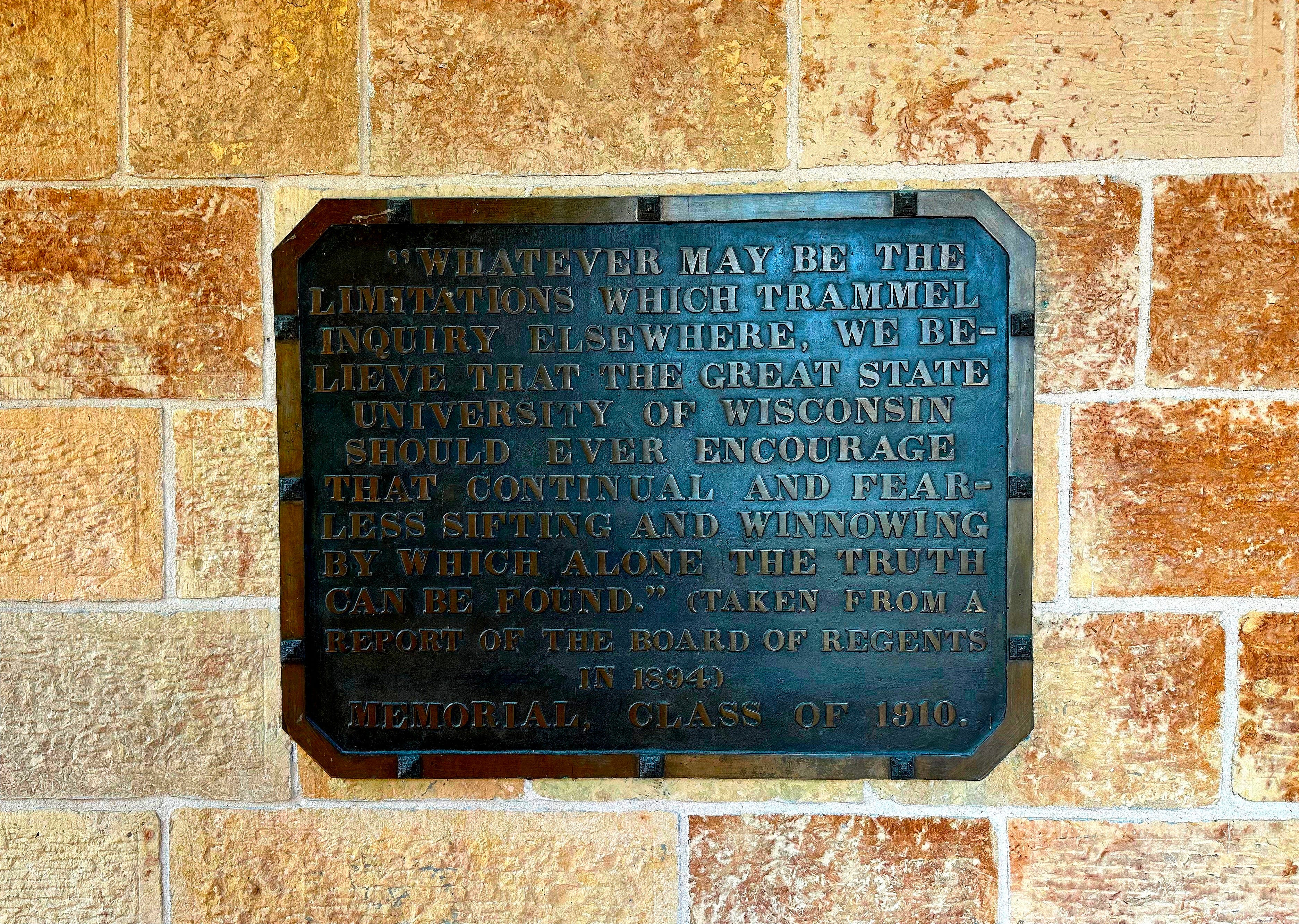
The University of Wisconsin-Madison has been a national leader in academic freedom for over a century, but the institution’s commitment to free speech has faced serious challenges throughout its history.
Wisconsin has often tried to be a bulwark for freedom of thought and speech, from the Board of Regents crafting the “Sifting and Winnowing” doctrine in 1894 to being the first college to willingly revise their restrictive speech code in 1999. But this history is not simple.
UW-Madison was the first college to willingly revise its faculty speech code, but it was also one of the first colleges to implement one in 1981. As higher education faces new institutional crises, reflecting on historical challenges and triumphs is informative for today.
This story begins in 1894. Professor Richard Ely gained fame on campus for his progressive ideas. He was a passionate supporter of organized labor and promoted government intervention to advance social reform. However, his ideas didn’t come without pushback. This eventually led to an investigation by the Board of Regents based in part on accusations that he was teaching students about socialism and other “pernicious doctrines.” However, in a triumph for free speech on college campuses, the regents exonerated Ely of all charges and their report made a much bigger statement.
“In all lines of academic investigation it is of the utmost importance that the investigator should be absolutely free to follow the indications of truth wherever they may lead,” the regents wrote. “Whatever may be the limitations which trammel inquiry elsewhere we believe that the great state University of Wisconsin should ever encourage that continual and fearless sifting and winnowing by which alone the truth can be found.”
Those words, forever etched on a plaque at the entrance of Bascom Hall, serve as a reminder of UW-Madison’s continual vested interest in promoting freedom of thought. However, UW leadership have often failed to uphold the principles of the Sifting and Winnowing doctrine.
In October 1967, student opposition to the Vietnam War grew rapidly on campus. Many students were agitated by the university’s cooperation with the Dow Chemical Company and CIA in their efforts to recruit students.
The tension boiled over on Oct. 18, 1967. That morning, students began protesting at the Commerce Building - now Ingraham Hall - where student job interviews for Dow Chemical Company were held. The protest started out peaceful, but the scene soon turned ugly as students and police both became agitated.
There are variations in what witnesses say happened that day. The campus police stated that the protesters are the ones that first became violent while many students say that the violence started after the police started beating protesters.
The events of the October protest served as a rallying cry for college students across the country. UW-Madison was propelled into the national spotlight, and the events encouraged anti-Vietnam protests at colleges across the country. Many students believed that UW-Madison wasn’t doing enough to protect student speech, a sentiment that would continue into the 1980s and 90s, resulting from the creation of UW’s student and faculty speech code.
UW-Madison formally adopted its first faculty speech code in 1981. In 1989, after incidents of alleged discriminatory harassment at UW-Madison, the Board of Regents formally voted to enact a student speech code.
This speech code regulated all expressive speech that “created an intimidating or hostile environment” and was demeaning “the race, sex, religion, color, creed, disability, sexual orientation, national origin, ancestry or age of the individual or individuals.”
The Board of Regents tried to address serious problems, but they created a student speech code that was so broad that it could regulate all disagreeable speech.
The U.S. District Court for the Eastern District of Wisconsin ended up striking down the speech code in 1991 as being an unconstitutional regulation of student speech. Although colleges do have the right to regulate speech that incites immediate violence, they do not have the right to regulate all speech that is deemed intimidating or hostile.
UW-Madison’s stated goal for the speech code was to increase diversity on campus, but “the UW Rule does as much to hurt diversity on Wisconsin campuses as it does to help it,” according to the District Court. “By establishing content-based restrictions on speech, the rule limits the diversity of ideas among students and thereby prevents the ‘robust exchange of ideas’ which intellectually diverse campuses provide.”
Many on the UW-Madison campus believed that the university had ended all of their restrictive speech policies with the absence of the student speech code. However, the UW-Madison faculty speech code was still in effect. This code regulated expression that “debases the student on the basis of the student’s gender, race, religion, ethnicity, sexual orientation, or disability” and wasn’t “germane to the subject matter of a course.”
It is difficult to define what is “germane to the subject of a course,” so the determination of what was permissible and what wasn’t would be left up to a committee hearing.
This ambiguity led to many investigations of things professors said during class. Lester Hunt, a professor of philosophy at UW-Madison, was investigated for using the term “Injuns” in class. A history professor at UW-Madison was investigated when they failed to use gender-neutral language during class. These professors weren’t ever found guilty of violating the speech code but those investigations had a chilling effect on campus.
Professors constantly worried about saying something that mildly offended someone for fear that they too would be investigated. UW-Madison revised the speech code in 1999 after pressure from the Committee for Academic Freedom and Rights.
The 21st century has seen how past battles over freedom of speech have taken a new shape. Students often feel the need to self-censor because they fear social backlash from their peers, rather than the university.
There have been some notable incidents on campus, including high-profile speaker disruptions and newspaper trashings. UW-Madison is still navigating the effects of the anti-Israeli encampment of 2024.
While the encampment was illegal, the line between legitimate demonstrations and unlawful protests was blurred. Students certainly have the right to speak out on campus, but those protests must follow state laws and university policies. The university made the noble decision to enact a policy of institutional neutrality in its aftermath, but questions still remain about the university’s decision-making process.
Today, too many students are supportive of censoring their peers and disinviting speakers they find controversial. Nuanced political debate is as important as ever during this time of negative partisanship, and it starts with university administrators protecting every student’s right to speak freely and promoting intellectual diversity on campus.
Programs such as the Wisconsin Exchange appear to be steps in the right direction, but as our campus’s history has shown, good decisions are often followed by bad ones.
READ MORE FROM THE MADISON FEDERALIST:
UW-Madison Ranks Near Middle for Faculty Viewpoint Diversity in FIRE Study
