

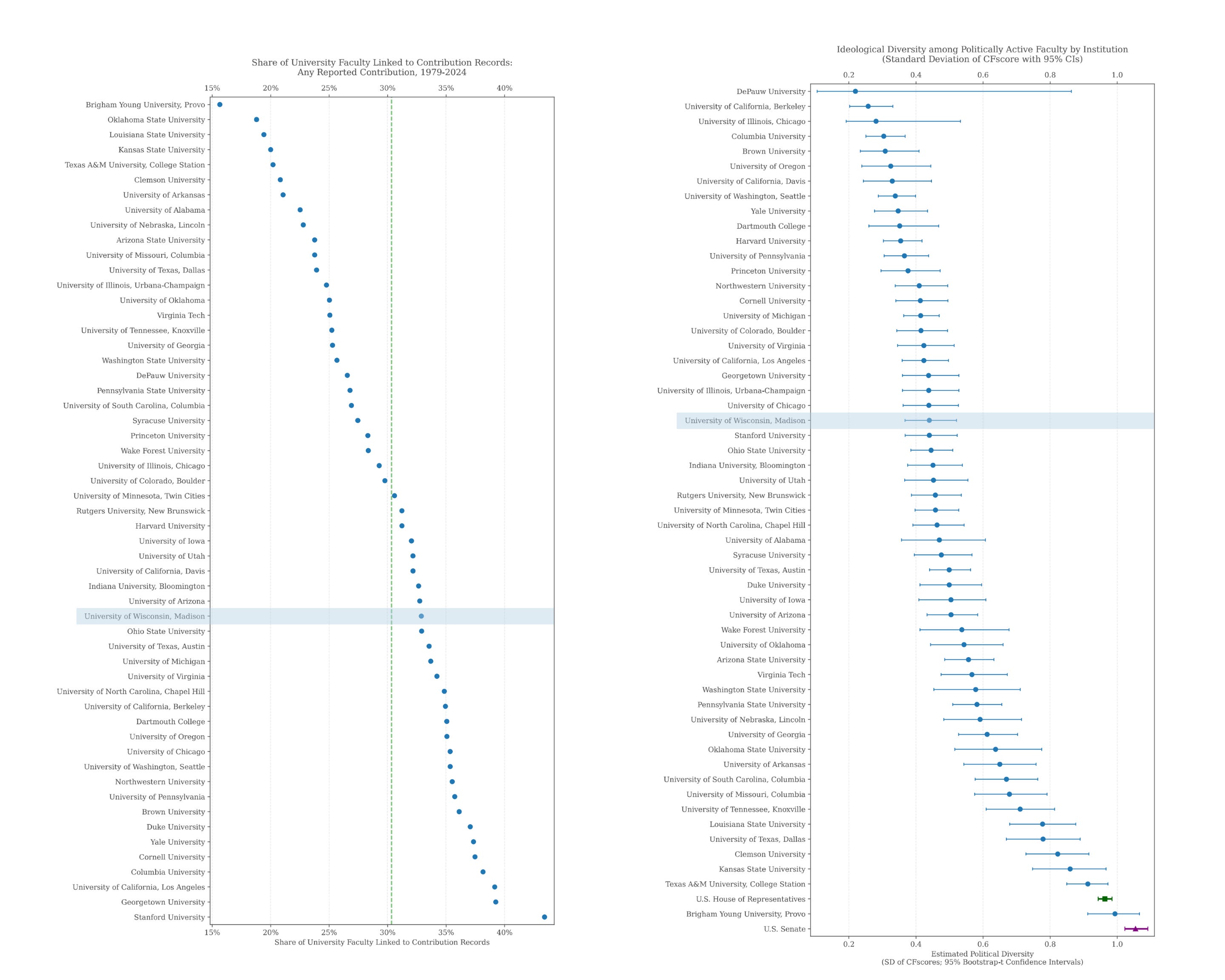
A study released by the Foundation for Individual Rights and Expression (FIRE) in May found that faculty donors at the University of Wisconsin-Madison and other top universities are highly concentrated on the political left.
The report “Faculty Ideology: Measuring faculty viewpoint diversity using campaign contribution data” examined more than 100,000 faculty members at 55 prominent universities, including UW-Madison. The study concluded that faculty donors have become increasingly one-sided in recent years.
It also found that UW-Madison faculty are more politically active and concentrated than a majority of other universities analyzed. “UW-Madison faculty are a bit more likely to donate than other faculty in the analysis, and they are less ideologically diverse than many of the schools in the sample,” said author David Primo in an email to The Madison Federalist. Primo is a professor of political science and business administration at the University of Rochester.
UW-Madison ranked near the middle of the schools analyzed regarding the level of ideological diversity found among university faculty, with the 23rd lowest. Peer institutions such as the Ohio State University and the University of Iowa exhibited greater levels of ideological diversity among politically active faculty compared to UW-Madison, while the University of Illinois and the University of Michigan exhibited less.
“UW faculty who donate to campaigns look similar to schools like Stanford, [the University of] Chicago, and Georgetown in terms of ideological diversity,” Primo said.
The university has taken many steps toward increasing viewpoint diversity on campus in the last two years. “UW–Madison has hired or is exploring hires in units including, but not limited to, public affairs, political science, law, history and economics, whose areas of expertise include conservative political thought, classical economic theory, and classical liberalism,” said university spokesman John Lucas in an email to The Federalist.
Last year, the university launched the Wisconsin Exchange, an initiative to promote pluralism and ideological diversity on campus. The Exchange has since awarded grants to student and faculty-led projects, launched a postdoctoral fellowship program, and hosted events. FIRE president Greg Lukianoff spoke at an Exchange event in March. “Dissent is essential for understanding the world as it is,” he said during a moderated conversation with former chancellor Jennifer Mnookin.
Lucas said Deliberation Dinners, the Discussion Project, and the new office of First-Generation and Limited-Income Services demonstrate the university’s “commitment to the value of diversity in all its forms, including diversity of thought, perspective, identity and background.”
Furthermore, “The university has continued to actively work with its external fundraising partner, the Wisconsin Foundation and Alumni Association, to secure the philanthropic gifts [required] to fund additional endowed faculty chair and professorship positions in disciplinary areas related to conservative thought itself.” The university agreed to create this position in a deal with the Wisconsin legislature in 2023.
The FIRE report matched the faculty members to campaign contribution records contained in the Database on Ideology, Money in Politics, and Elections, which contains hundreds of millions of federal, state and local political contributions. The study focused on faculty members in undergraduate-facing departments and excluded positions such as medical school faculty.
Using these records, researchers assigned a “CFscore,” which is an ideological measure based on patterns of political giving. The methodology allows researchers to compare faculty donors, political contributors and elected officials on the same ideological scale.
According to the study, the median faculty donor scored approximately -1.0 on the report’s ideological scale. This score is comparable to Rep. Alexandria Ocasio-Cortez and Sen. Bernie Sanders.
The report also found significant differences across academic disciplines. According to the study, faculty in the humanities were the most left-leaning. Business faculty were the least left-leaning, but those who made political contributions still generally leaned to the political left. Primo wrote that the least ideologically diverse and most left-leaning fields were among the most politically engaged.
The report acknowledges several limitations to its methodology. Primo noted that some faculty members may be reluctant to donate because campaign contributions are public and could reveal their political views. The report also notes that campaign contributions are only one way of measuring ideology and may not capture the political beliefs of faculty who do not donate.
“I hope the report prompts students, faculty, and administrators to think seriously about what these findings mean for teaching, research, and open inquiry on college campuses,” he told The Federalist.
READ MORE:
Survey Finds Overwhelming Ideological Imbalance Among UW-Madison Faculty
Faculty Hiring Prioritizes Activism Over Scholarship, Argues John Sailer in Campus Lecture

Why would Professors at a public university lean towards a party/political movement that has consistently demonstrated anti-intellectualism and reduced public university funding?