

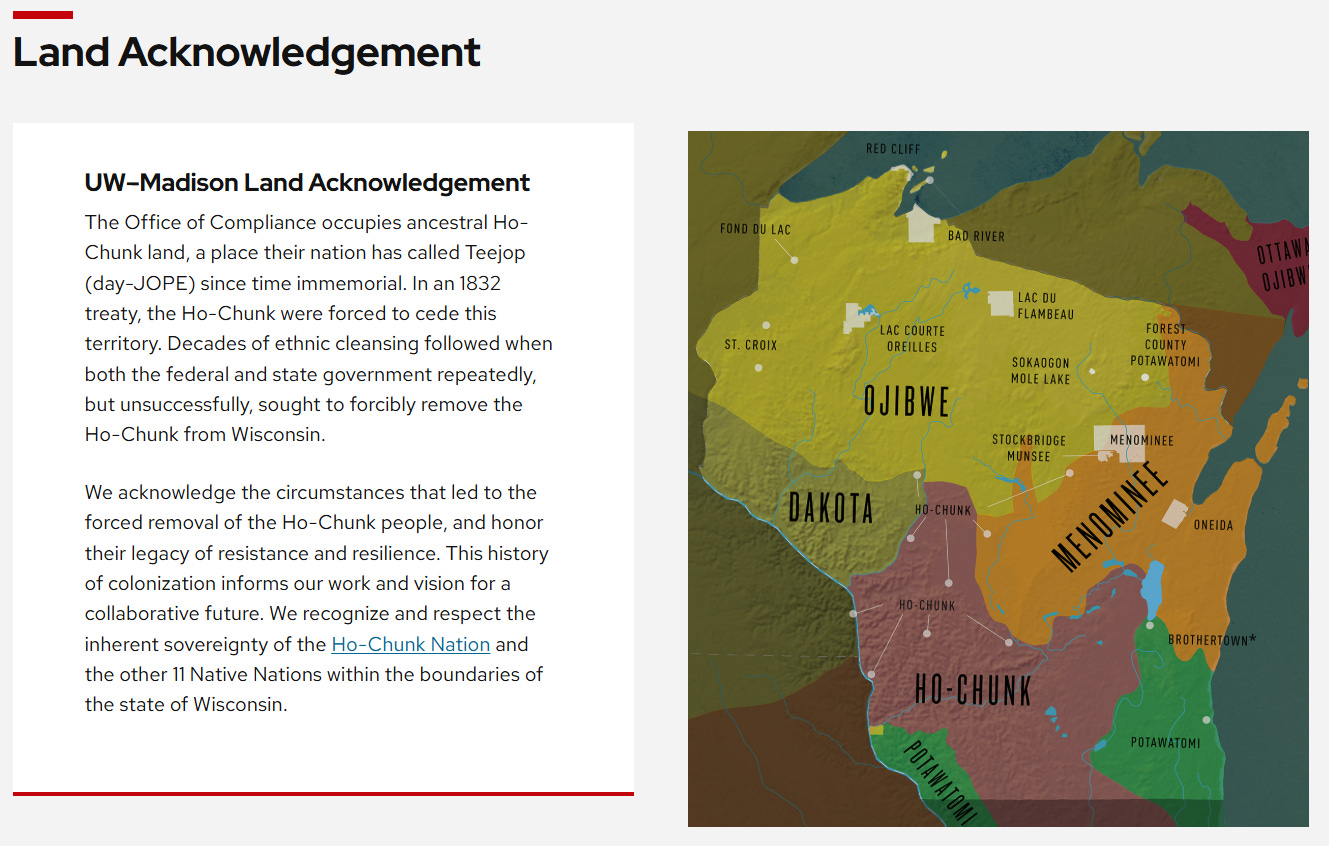
We are all familiar with the now-common land acknowledgements that are heard at SOAR, commencement, graduation, and throughout our time at UW-Madison. However, this tradition is remarkably new. While an understanding of history is essential for every American, land acknowledgments serve little purpose beyond oversimplifying complex events and shaming those of us who may be proud of our nation.
Various divisions and departments list land acknowledgements on their websites, including Anthropology, Pediatrics, and the School of Social Work. University spokeswoman Gillian Drummond told The Madison Federalist, “The Office of Tribal Relations can provide guidance for campus units interested in sharing a land acknowledgement. It does so under the authority of the Chancellor’s Office.” Its website says those writing a land acknowledgement should research “the Indigenous peoples to whom the land belongs” and “use terms like genocide, ethnic cleansing, stolen land, coercive Assimilation, violence-backed treaties, internment, family separation, youth incarceration, sterilization without consent, and forced removal to reflect actions taken by colonizers.”
Drummond said, “UW–Madison does not require or have a policy on land acknowledgements at campus events.” Despite the absence of a formal requirement, they have been delivered as recently as the 2025 December commencement.
Drummond did not answer whether land acknowledgements are an institutional position, and thus, in conflict with a policy adopted in 2024 prohibiting institutional statements on controversial issues. That policy says, “Unless the core mission or ongoing operations of the university are at stake, the articulation of official institutional positions on matters of public concern and controversy is neither necessary to nor helpful for the lively exchange of ideas.”
Until recently, most Americans were presented with an oversimplified version of their history that cushioned the very real suffering of Native Americans. However, the history presented by land acknowledgements is just as oversimplified.
UW-Madison was established in 1848, but land acknowledgments only became common in 2019. Their goal is ostensibly to inform the student body about the Indigenous peoples of the land that now comprises the UW campus and the Teejop (Four Lakes) region. That year, UW launched the “Our Shared Future” initiative to recognize that Madison was once Ho-Chunk land.
After the American Revolution, the British ceded territories in North America from the Atlantic to the Mississippi River, including what is now Wisconsin, to the United States. Quickly, Americans sought to expand their borders, settle the lands, and establish new states. By 1830, the United States had doubled in size and had expanded to twenty-four states and three organized territories; the Michigan Territory included modern-day Michigan, Wisconsin, and northern Minnesota.
This rapid expansion led to the displacement of the Native tribes away from their homelands and further west to reservations that shifted over time. What’s now the UW campus was Ho-Chunk land until the Treaty with the Winnebago after the Black Hawk War of 1832. This treaty ceded Ho-Chunk lands in southern Wisconsin and northern Illinois, including what is now Madison and the UW campus. The Ho-Chunk nation was relocated to a reservation in Iowa after the Treaty with the Winnebago, and it was then relocated several other times at great cost to the nation. This is a sad part of U.S. history, but it is not the fault of anyone alive today.
The Teejop region was important for Native nations, as the numerous mounds, burial grounds, and archaeological discoveries show. It is commemorated today by historical sites and memorials, such as the Our Shared Future heritage marker on campus. Historical markers are a great way to commemorate various aspects of our history. This is why we have markers all around our campus, informing students about the history of North Hall, Camp Randall, and other important sites.
However, land acknowledgments go a step further than this. Land, and who controls it, shifts over time. All land was presumably “stolen” from someone at some point. Until very recently in human history, land almost always changed hands through conquest. Even native nations “stole” land from each other. Should we have a land acknowledgment in Western Poland that it was once German land? Or in Northern Chile, which used to be the now-landlocked Bolivia’s coastline? Memorials recognize history, but land acknowledgements are a performative way to apologize for history.
Why should one aspect of our history be prioritized over all others at our university’s events? To suggest that only this aspect of UW-Madison’s story is important ignores reality and puts one moment above all others. To assume that it is necessary to mindlessly recite apologies for our beautiful and prosperous campus’s existence is preposterous and lazy. It is incumbent upon all of us to understand our history and memorialize the past, not to regurgitate it and diminish its significance.
