

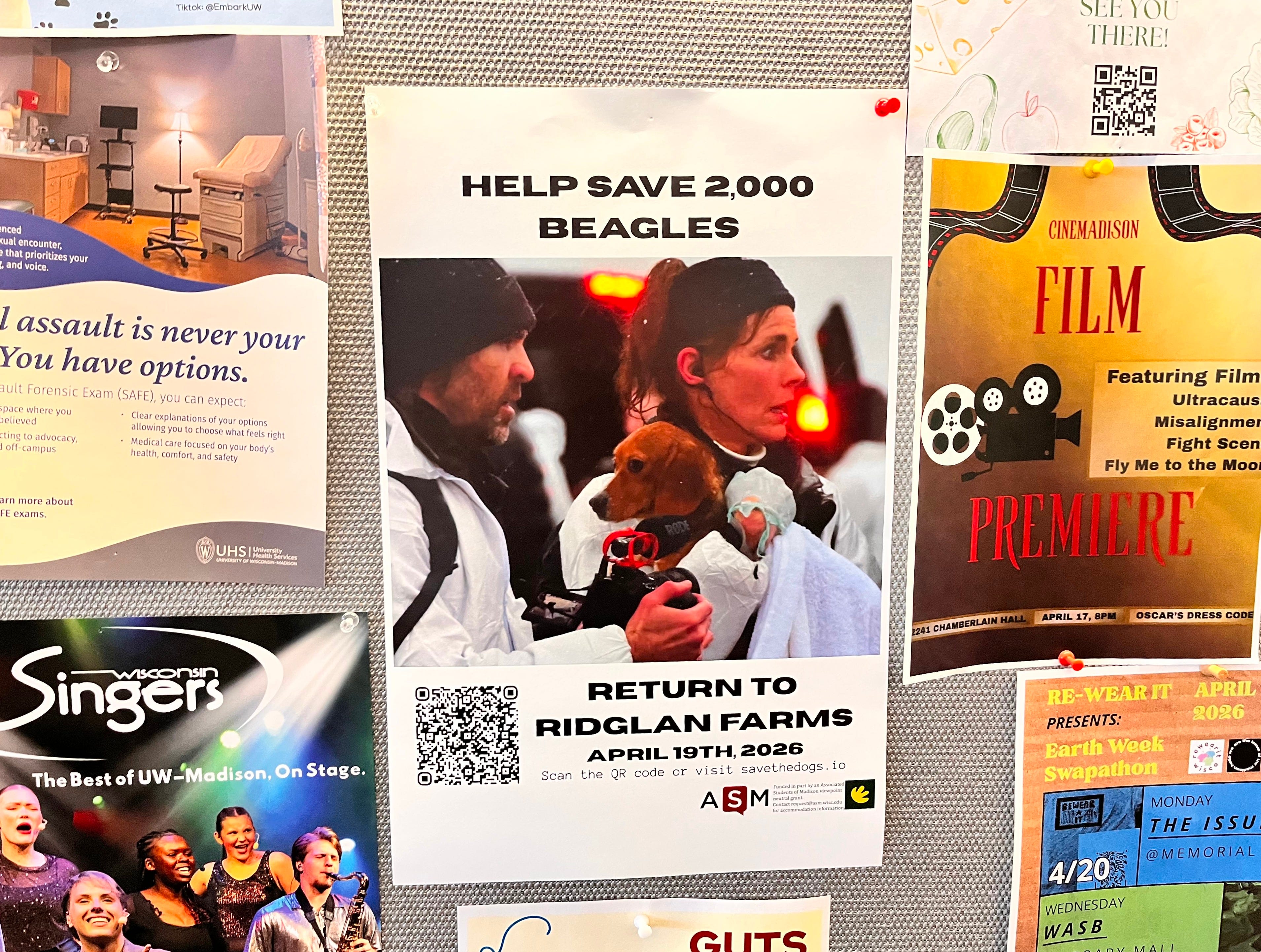
The Foundation for Individual Rights and Expression (FIRE) and the Animal Activist Legal Defense Project (AALDP) are calling on the University of Wisconsin-Madison to end its investigation into the registered student organization Animal Advocacy, arguing the university’s inquiry into flyers promoting a beagle rescue campaign violates the First Amendment.
In a June 25 letter addressed to Interim Chancellor Eric Wilcots, FIRE asserts the university is investigating the student group over constitutionally protected political speech after members distributed flyers advertising an event related to Ridglan Farms, a Wisconsin breeder of dogs for experimentation. According to the letter, university officials alleged the flyers may have encouraged criminal activity because they included a QR code linking to additional information about the campaign.
According to FIRE’s letter, Animal Advocacy members posted flyers reading, “Help Save 2,000 Beagles, Return to Ridglan Farms, April 19th, 2026,” alongside a QR code directing readers to additional information about the campaign. FIRE states the linked materials included information about a previous beagle rescue effort as well as suggestions for legal forms of advocacy, including joining the student organization, signing petitions, donating, sharing information on social media, and contacting lawmakers and regulatory agencies.
The Google document linked by the flyer stated, “On March 15th, 100 activists rescued 22 beagles from animal abuse at Ridglan Farms, a beagle breeding and experimentation center. Now, over 2,000 people have committed to returning to Ridglan Farms to rescue the remaining 2,000 beagles. Now is when we need to ACT.”
The document also included a link to a blog post by animal rights activist Wayne Hsiung. In the post, Hsiung wrote, “Rescuers will descend on Ridglan Farms from all directions and use every nonviolent means to breach the facility walls and rescue the dogs. If the police illegally attempt to stop us, we will shield one another from their attempts to hurt the dogs, and pressure them to enforce the law and protect the dogs.” Hsiung also said, “There are only around 400 deputies in Dane County (including those serving in jails and not on patrol) and 800 spaces for inmates in Dane County jails. If we can mobilize 2,000 rescuers, they can’t arrest and jail us all.”
According to FIRE’s letter, university officials informed Animal Advocacy that the organization was under investigation because the flyers allegedly “solicited others to enter Ridglan Farms and remove animals from the property” and therefore may have violated Wisconsin laws concerning solicitation to commit burglary and the unauthorized release of animals. The letter also states that an administrator warned the organization the flyers appeared to be “soliciting or encouraging individuals to participate in criminal activity.”
In an email to The Madison Federalist, FIRE Strategic Campaigns Counsel Amanda Nordstrom said the university is mischaracterizing the student organization’s advocacy. “Political speech does not lose protection simply because it discusses civil disobedience, links to an activist’s account of past events, or urges people to get involved in a contentious cause,” Nordstrom said. She added that the flyer “pointed people to information about animal welfare concerns and advocacy opportunities. That is classic political speech, not criminal solicitation.”
Nordstrom also told The Madison Federalist that “a student group’s flyer does not become punishable simply because it links to controversial material or to someone else’s description of unlawful conduct.” She added that “students have a First Amendment right to share information, criticize institutions, and direct people to outside sources about matters of public concern,” and said, “Universities cannot discipline students merely because their advocacy points readers toward controversial ideas or activists.”
When asked whether FIRE would pursue litigation if the university ultimately disciplines Animal Advocacy, Nordstrom declined to comment on potential legal action. “FIRE’s immediate goal is for UW-Madison to do the right thing: end this investigation and make clear that Animal Advocacy will not be punished for its protected expression,” she told The Federalist. “I can’t comment on the potential for litigation, but we’re exploring all our options at the moment and will keep the public apprised of any further FIRE advocacy.”
Nordstrom also argued the case reflects a broader issue affecting campus speech. In an email to The Federalist, she said, “This case fits a broader and troubling pattern: universities too often respond to impassioned political advocacy by investigating the speakers first and asking First Amendment questions later.” She added that “students should not have to wonder whether a flyer, a QR code, or a link to controversial commentary will trigger a conduct investigation. That kind of chilling effect is exactly what the First Amendment is designed to prevent.”
Animal Advocacy President Jackson Ray defended the organization’s actions in an email to The Madison Federalist. When asked why the group distributed the flyers, Ray said, “Because there were 2,000 beagles that deserved better lives.” He added that “Free speech is a foundation of activism that allows ordinary people to fight cruel and powerful institutions.”
Ray said he was not surprised but saddened that UW-Madison had chosen to investigate the organization. Responding to allegations that the flyers encouraged illegal activity, Ray said, “The First Amendment is not a gray area, we were within our rights, and we were solely advocating for political action.”
Looking ahead, Ray said he hopes the investigation leads to greater protections for student expression. In closing his response, he said, “I hope that UW-Madison chooses the right thing and we see a new university in which students’ voices are amplified not silenced.”
The AALDP also criticized the university’s investigation. In an email to The Madison Federalist, Litigation Fellow Steffen Seitz said, “The reputation of universities as bastions of dissident speech is not without basis. But it is also true that university administrations often embrace particular dissident speech only after the fact—acting repressively at the time, while embracing dissidents only after their cause has been shown to be on the right side of history.”
When asked whether his organization has seen an increase in universities disciplining student activists involved in animal rights advocacy, Seitz told The Madison Federalist that it has not. However, he said, “While we have not seen an increase in discipline against animal rights advocates on university campuses, we suspect this is because we haven’t seen many campus animal advocates organizing adjacent to direct action campaigns like the Ridglan effort. Were that to increase, it is possible—perhaps even likely—that there would also be an increase in university repression.”
The Madison Federalist contacted UW-Madison spokesperson John Lucas on June 26 seeking comment on the investigation and sent follow-up questions regarding the university’s rationale for opening the investigation, its interpretation of the First Amendment, and the status of the case. As of publication, the university had not responded.
FIRE’s June 25 letter requests that UW-Madison respond by July 9 confirming that it will end its investigation of Animal Advocacy and refrain from imposing disciplinary sanctions on the student organization.
READ MORE FROM THE MADISON FEDERALIST:
Crony Capitalism and the Chicken Industry
FIRE President Greg Lukianoff: UW-Madison ‘Can Do Better’ on Free Speech
