

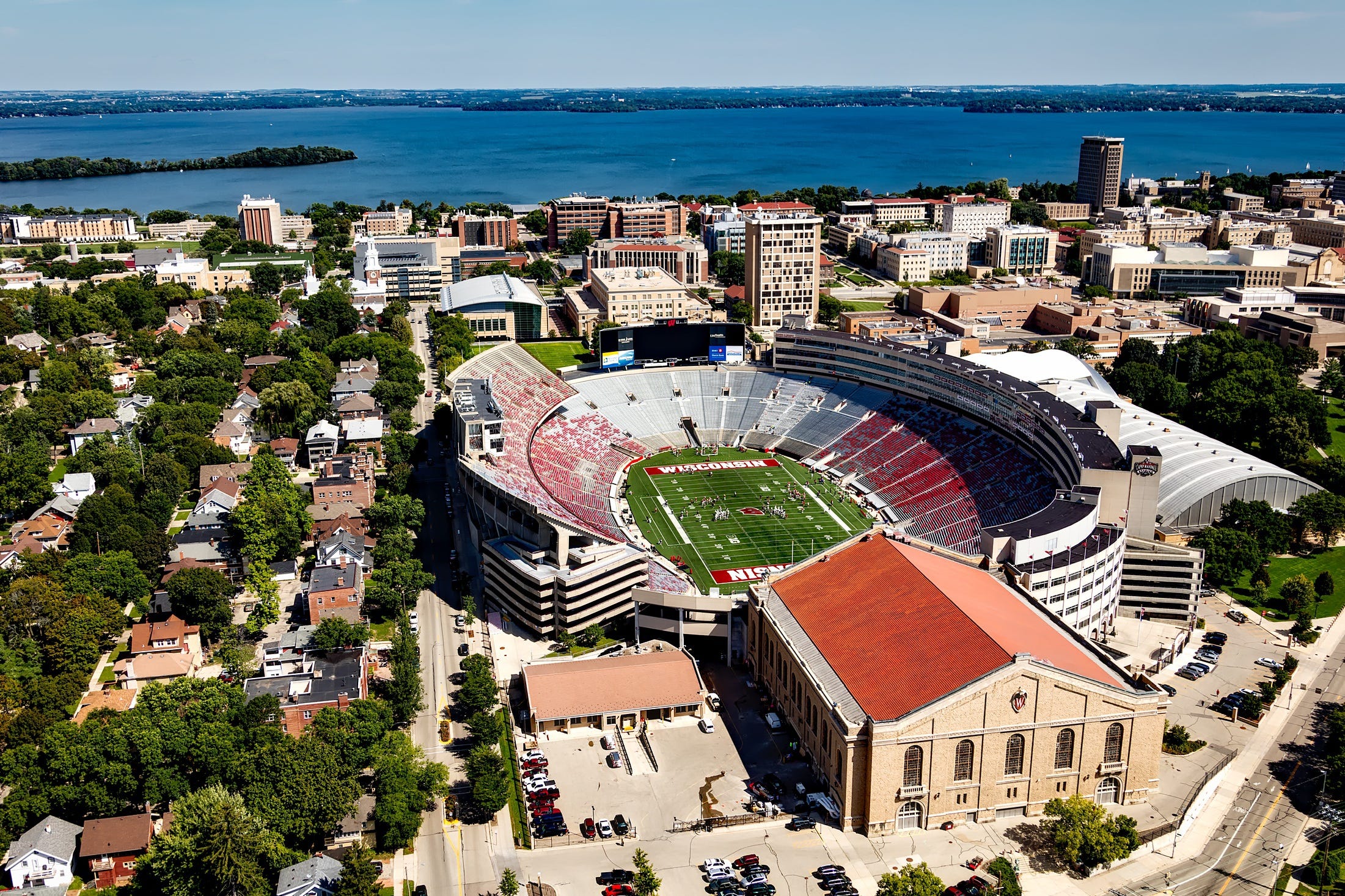
Last month, the University of Wisconsin-Madison and the La Follette School of Public Affairs hosted Greg Lukianoff, president and CEO of the Foundation for Individual Rights and Expression (FIRE), as part of the recently-launched Wisconsin Exchange. In a conversation titled “For Me, but Not for Thee: Free Expression in Higher Education,” Lukianoff joined Chancellor Jennifer Mnookin to examine the changing role of universities amid a challenging campus climate.
FIRE has become a leading watchdog for free speech on college campuses, tracking policies and incidents nationwide to ensure students and faculty can express controversial ideas without fear of censorship.
Partisan politics have increasingly infiltrated higher education. Both students and faculty often struggle to engage meaningfully and constructively with those holding differing political or ideological viewpoints. The Wisconsin Exchange program aims to counteract this trend by fostering dialogue among students of diverse identities and political backgrounds, promoting civil debate as a shared and necessary value.
Lukianoff’s commitment to free speech comes from familial experience. His father grew up under authoritarian rule in Yugoslavia and witnessed censorship firsthand.
Joining FIRE allowed Lukianoff to protect free speech more broadly, producing nonpartisan evaluations of institutional policies and actions.
Lukianoff opened with what he called his “elevator pitch” and declared that free speech is essential on campus. He argued that limiting civil discourse is not only a constitutional violation, but a practice that chills intellectual exchange.
He took an epistemic approach and explained that knowledge grows not only by discovering what is true, but also by being proven wrong. Exposure to differing opinions is essential for intellectual growth. “You have ideas in your head, you have inclinations, you have opinions, you have aversions; this is some of the most important data, some of the most important information in the world,” he said, emphasizing that growth and development can only emerge in the practice of dissent. On college campuses, this means engaging with uncomfortable ideas - not avoiding them - is essential to intellectual and personal growth.
He warned against seeing free speech as a one-way street. “It seems really tempting to want to punish the bad opinions or ignorant opinions of your enemy. But that’s a tool that works like poison gas. You think you’re destroying your enemy with it, but then the wind changes direction and it blows back on you.” He stressed that defending free expression requires defending the speech of all - even those with whom one disagrees.
Lukianoff acknowledged that FIRE has faced pushback from both sides of the political aisle. “It’s harder to find the people who just get it in their bones, who get it as a principle, and that just takes a lot more work,” he said. “It used to be that we would see more threats to free speech coming from the left, although plenty from the right. But it’s really been completely lopsided in the past year. The situation fundamentally changed.”
He also critiqued attempts to re-institutionalize campuses, noting that coercive faculty and excessive political homogeneity stifle intellectual diversity. Coupled with rising social media use and algorithm-driven platforms, society has become increasingly consumer-driven, a phenomenon that trickles down into individual expression. “We should be experimenting with different models of social media that create better environments for dissent,” Lukianoff said. “Social media for truth seeking… it may sound unrealistic, but it can be done.”
Echo chambers and algorithmic platforms create short-term social pressures, increasing self censorship among students fearful of social consequences. This dynamic, combined with institutional pressures and lingering campus restrictions, helps explain why UW-Madison, despite a 126-spot improvement in FIRE’s College Free Speech Ranking, still received an “F” for overall free speech. Surveys, policy analysis and documented interactions revealed that students continue to feel discomfort expressing their views. Mnookin expressed concern over the evaluation, but Lukianoff remained firm: “You still have 40 percent of your students saying that violence can be okay in some circumstances in response to speech. And you can do better. ”
Looking forward, Lukianoff emphasized that fostering free expression on campus requires more than policy changes or rankings - it requires cultivating a culture of intellectual curiosity, courage, and engagement. UW-Madison has begun taking steps to build this kind of community, striving to encourage robust debate rather than suppress it. As Lukianoff reminded listeners, the protection of free speech is not just a legal or institutional responsibility - it is a commitment to the core principles of democracy itself. Only by defending the right to dissent, welcoming differing viewpoints and fostering an environment where ideas can clash without fear can universities truly live up to the Wisconsin Idea of “fearless sifting and winnowing.”
For students and faculty alike, the challenge is clear: embrace debate, defend dissent and ensure the campus remains a place where ideas can collide without fear.
