

The views expressed in this article are solely those of its author. All UW-Madison students can submit op-eds or pitches to madisonfederalist@gmail.com!
At the start of 2026, the Wisconsin Assembly approved legislation requiring cultivated meat to be labeled as “lab-grown.” Supporters described the measure as common-sense transparency, as consumers deserve to know whether their protein comes from a farm or a factory. That instinct resonates with libertarian commitments to informed consent and honest exchange. But transparency should not stop at new technologies. If consumers have a right to clarity in the marketplace, they also deserve to understand how conventional meat production has been shaped by federal policy, and how sustained industry lobbying has helped secure that support.
At the heart of free-market economics is a simple premise: Prices should reflect real costs, and markets should discipline inefficiency without political favoritism. By that standard, the U.S. poultry industry offers a clear case of crony capitalism. It operates within a framework of subsidies, indemnity payments, and regulatory structures that shield large integrators from downside risk. Taxpayers absorb environmental and public health spillovers. Contract growers shoulder debt within vertically integrated supply chains. And sentient animals are reduced to production inputs rather than recognized as individuals.
Start with subsidies. While agricultural support programs are often defended as neutral safety nets for “farmers,” the structure of federal farm policy disproportionately benefits commodity crops like corn and soy. Those crops are the primary feed inputs for animal agriculture. When taxpayers underwrite feed production, they indirectly subsidize the poultry and livestock sectors. Cheap feed enables artificially cheap meat.
The burden does not end there. Taxpayers also absorb the externalities of cheap chicken. Concentrated animal feeding operations generate pollution that strains local water systems, while public health systems bear the costs associated with antibiotic resistance linked to routine livestock use. When crises hit, federal dollars flow to stabilize the industry. Recent avian influenza outbreaks have triggered costly indemnity payments and emergency interventions, effectively socializing losses while allowing corporations to privatize gains. Since January 2022, the H5N1 virus has affected nearly 185 million commercial, backyard, and wild birds in the United States. Since March 2024, it has also been detected in more than a thousand cattle herds across multiple states, including a confirmed case here in a Wisconsin dairy herd.
Meanwhile, the structure of the poultry industry itself reflects a peculiar arrangement that hardly resembles classical market competition. Integrator corporations often own the hatcheries, the feed mills, the processing plants, and the brand. Contract growers, by contrast, own the land, the poultry houses, and the debt. When equipment upgrades are required, or flocks underperform, it is the grower who bears much of the financial risk. In other words, the companies own everything that makes money, and farmers own everything that costs money.
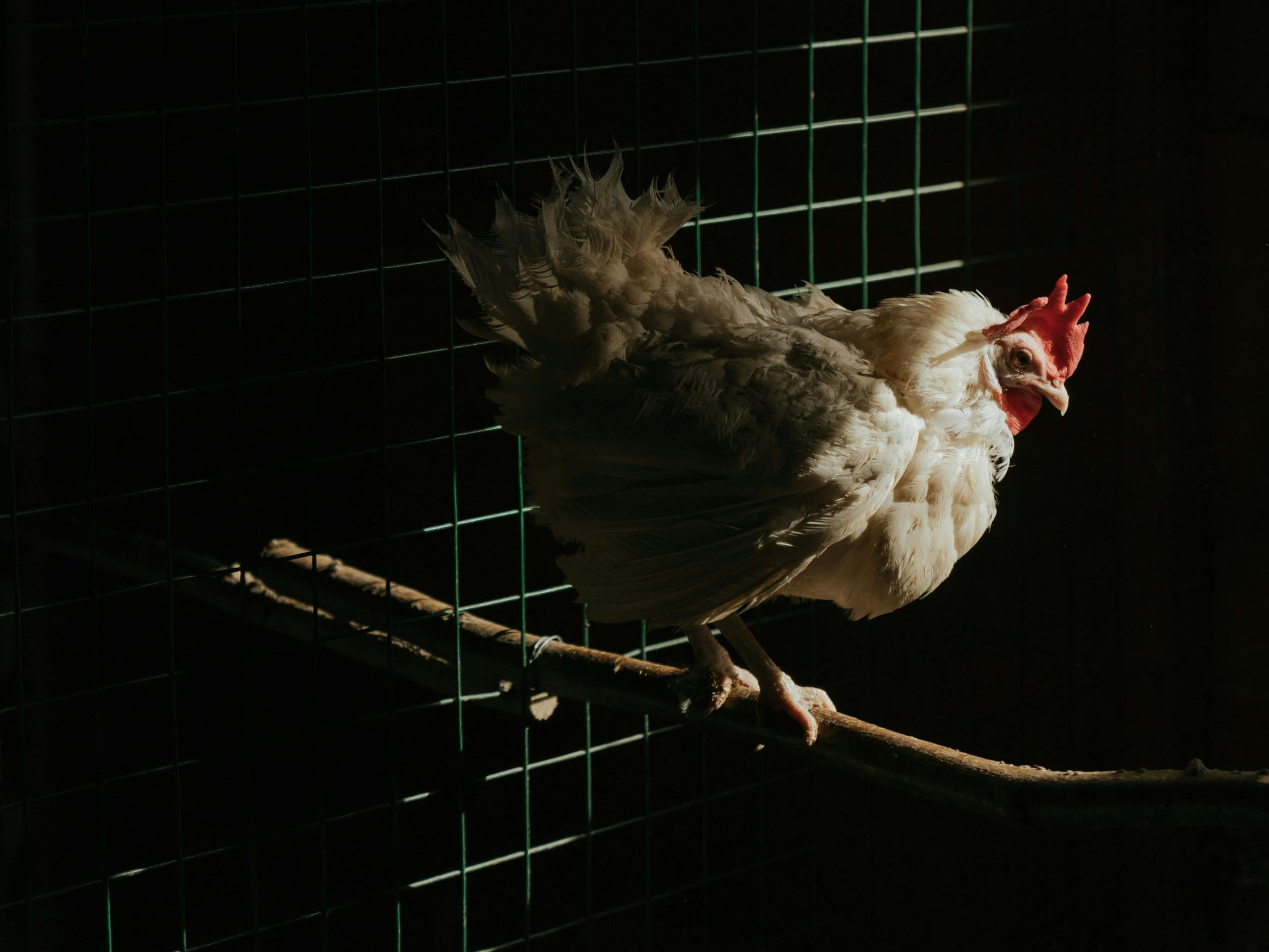
There is another dimension of distortion that receives far less attention: humane washing and the conditions imposed on animals themselves. Humane washing is the practice of using labels and marketing cues to create the impression of high welfare standards. Practices that mainly serve to make consumers feel better about their consumption choices, but do little to help animals. Industrial poultry production typically confines tens of thousands of chickens in enclosed sheds, breeds them for unnaturally rapid growth that strains their skeletal systems, and subjects them to painful practices such as debeaking and crowded transport. Marketing campaigns increasingly emphasize “cage-free” or “humanely raised” labels, yet these terms often mask systems that remain fundamentally industrial in scale and design. Even if welfare standards were improved, the basic framework remains unchanged, which is that animals are treated as resources, and not beings with subjective experiences.
For libertarians who emphasize freedom, consent, and the non-aggression principle, this raises an ethical issue. Chickens are sentient beings capable of experiencing pain and distress, yet they are confined, manipulated, and slaughtered without any meaningful possibility of consent. Because of humane washing, the animals’ preferences are not considered in market analyses. This ethical cost can be understood as an additional negative externality of industrial agriculture, namely the systematic harm imposed on sentient beings whose interests are excluded from the pricing system. Even in the absence of low welfare standards, a system that views living beings purely as resources stands in tension with the libertarian commitment to minimizing coercion and unjustified harm.
The ethical concern is inseparable from a structural one. For conservatives wary of centralized power, the close relationship between large agribusiness firms and the federal government should be equally troubling. If markets are to function properly, the government should not pick winners and losers. The race to produce the cheapest, fastest-growing birds depends on artificially low input costs.
Yet here lies the contradiction. If federal intervention were dramatically reduced and feed subsidies curtailed, chicken prices would likely rise. Consumers accustomed to cheap chicken products might not be pleased. In a time of rising food prices, any additional increase would be politically sensitive.
But perhaps this tension signals something deeper. If the only way to maintain rock bottom chicken prices is through an elaborate system of subsidies, bailouts, risk socialization, and unpriced ethical costs, then the system is not genuinely efficient. It is dependent. A truly free market would allow prices to reflect actual environmental, public health, and moral costs. If higher prices dampen demand, that is not market failure; it is market correction.
Moreover, we are living in a moment of rapid technological change. Artificial intelligence is transforming supply chains and logistics. Innovations such as cultivated meat and advanced plant-based proteins are on the technological horizon. These emerging industries may eventually offer protein production methods that require less land, fewer antibiotics, and lower environmental impact, while also reducing the ethical concerns tied to confinement and slaughter. Rather than doubling down on a subsidy-dependent poultry model, policymakers should ask whether the long-term national interest is better served by moving away from the most distortion-heavy parts of animal agriculture. That question is especially relevant in Wisconsin, where potential cultivated meat bans and restrictive labeling laws risk protecting incumbent industries at the expense of innovation.
None of this requires hostility toward farmers. On the contrary, it may require the opposite. If we cease to view farmers as disposable inputs in a corporate supply chain and the sentient animals they raise as mere units of production, we can begin to rethink rural policy. A system that locks farmers into debt-financed contracts while corporate integrators capture margins is not a model of rural empowerment. It is a model of consolidation.
Instead, perhaps a surprising alliance is possible. Libertarians committed to free markets, conservatives wary of corporate-state fusion, farmers seeking independence, consumers concerned about transparency, and advocates for animals may find common ground. Opening the protein production space to genuine market competition, while ending subsidy distortions and fully accounting for environmental, public health, and ethical externalities, could represent a win for freedom, for rural communities, and for sentient beings whose interests have too long been excluded from the ledger.
