

What if the concentration of progressive ideology at the top of educational institutions was not a natural result of competition in the market of ideas, but rather, a precisely crafted political machine that was used to eliminate differences of viewpoint?
That is exactly what John Sailer uncovered through his work at the Manhattan Institute.
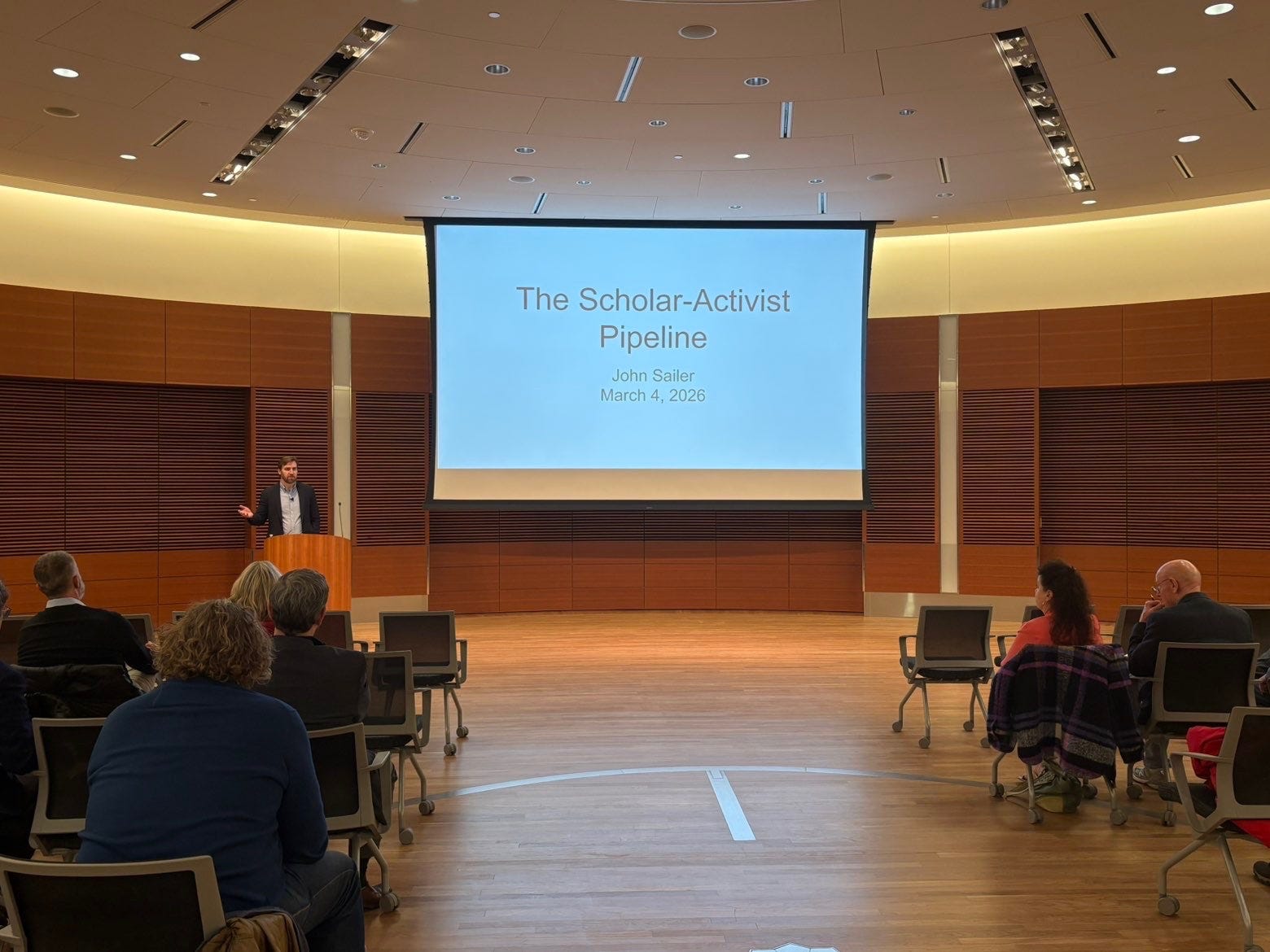
On Wednesday, March 4, the Center for Research on the Wisconsin Economy and Center for the Study of Liberal Democracy hosted Sailer for a lecture on “Scholar-Activist Faculty Hiring in America.” Sailer’s research involves investigations into DEI hiring practices at colleges, uncovering criteria that favor candidates with left-leaning views.
Sailer’s last event in the state was abruptly canceled by the Medical College of Wisconsin, so he viewed this lecture as a triumphant return.
“Despite other controversial figures on the panel, it was me [that was removed] for my fact-based reporting on what universities and medical institutions are doing in order to advance a politically charged idea of equity,” Sailer said about that event.
In his presentation, Sailer claimed that “scholar-activists” were considered to be at the top of the hiring totem pole because of DEI initiatives.
“University systems, private foundations, public agencies, have worked in tandem to create career pathways for scholars who share an activist vision for higher education,” he said. Calling this the “scholar-activist pipeline,” Sailer argues that these practices are theoretically used to increase diversity, but they instead created viewpoint homogeneity.
Through his research, Sailer found three distinct ways in which hiring methods are used to vet candidates who are not left-leaning. These methods include diversity statements, cluster hiring and career investment.
Diversity statements, which are one to two page essays in job applications that required the applicant to “describe their commitment to, and plans for advancing, diversity, equity, and inclusion,” originated in the early 2010s. By 2022, 46 percent of large institutions had adopted DEI criteria for promotion and tenure standards according to the American Association of University Professors. He found that these statements had become heavily weighted by a number of hiring committees.
One example he cited was from Texas Tech, noting hiring records for an application within the Department of Biological Sciences. An applicant stated in his interview that “DEI is not an issue because he respects his students and treats them equally.” This was listed in the report as a “weakness” because the candidate had a “poor understanding of the difference between equality and equity.”
The rubric created for measuring DEI characteristics offered the lowest score to an applicant who “explicitly states the intention to ignore the varying backgrounds of their students and ‘treat everyone equally.’”
Another report from The Ohio State University exemplified how these requirements were used to favor far-left-leaning candidates. One white male was not “outwardly present as a diversity candidate,” but his research on Critical Race Theory was highlighted as a reason he scored high within the DEI criteria.
This shows that the vetting committee used ideological theories as a way to bypass the diversity requirements, effectively allowing the process to be one in which candidates are hired based on political leanings.
“On one hand, this is clearly a way to filter out, either intentionally or not, people who view a whole cluster of social issues differently than the sort of majority opinion on campus,” Sailer said. “This is a perfect way to compound the effects of a viewpoint conformity.”
Another statement Sailer found from another employer stated that “they don’t want to hire white men” when doing a cluster hire. Cluster hiring is essentially hiring multiple faculty members at once across many disciplines, which allows administrators to expand their involvement through conditional funding for faculty alliances.
A final example given by Sailer was career investments, particularly focusing on how one group, the Andrew Mellon Foundation, systematically increased activist hires among universities. According to Sailer, the Andrew W. Mellon Foundation is the “premier funder of the humanities in the United States.”
This foundation is “akin to its own federal agency in giving power” and provides career enhancing grants for candidates that share the foundation’s activist vision for higher education.
One situation Sailer discussed was about Dr. LaVelle Ridley, a professor hired at The Ohio State University after receiving multiple grants from the Mellon Foundation. The professor’s research focused on “cultural politics of black transgender women in the U.S., specifically in advances in anti-capitalism, prison, and abolitionist agendas.”
When professors are funded for a clear political agenda and hired by schools because of DEI requirements, a knowledge vacuum is created where institutions think homogeneously about certain political issues, leading to a decrease of public trust.
In the 21st century view of higher education, the use of scholarship funds must continue the “passionate pursuit of truth, even if it takes you to conclusions that are inconvenient, or even defy the dominant perception of what social justice is or ought to be,” Sailer said.
Sailer concluded by mentioning how this concentration of progressive views at the top of institutions may deter right-leaning thinkers from entering academia, which continues the current institutional culture, even after DEI requirements are removed.
“A lot of people who might have considered an academic career in the first place will look at what they have to do to apply to graduate school, what they have to do to apply to faculty jobs, and what kind of backing for these jobs are available and say, this is clearly not for me,” Sailer said. “I think that’s exactly what has happened because of diversity statements.”
