

Zach Tomlinson is the president of Turning Point USA at UW-Madison.
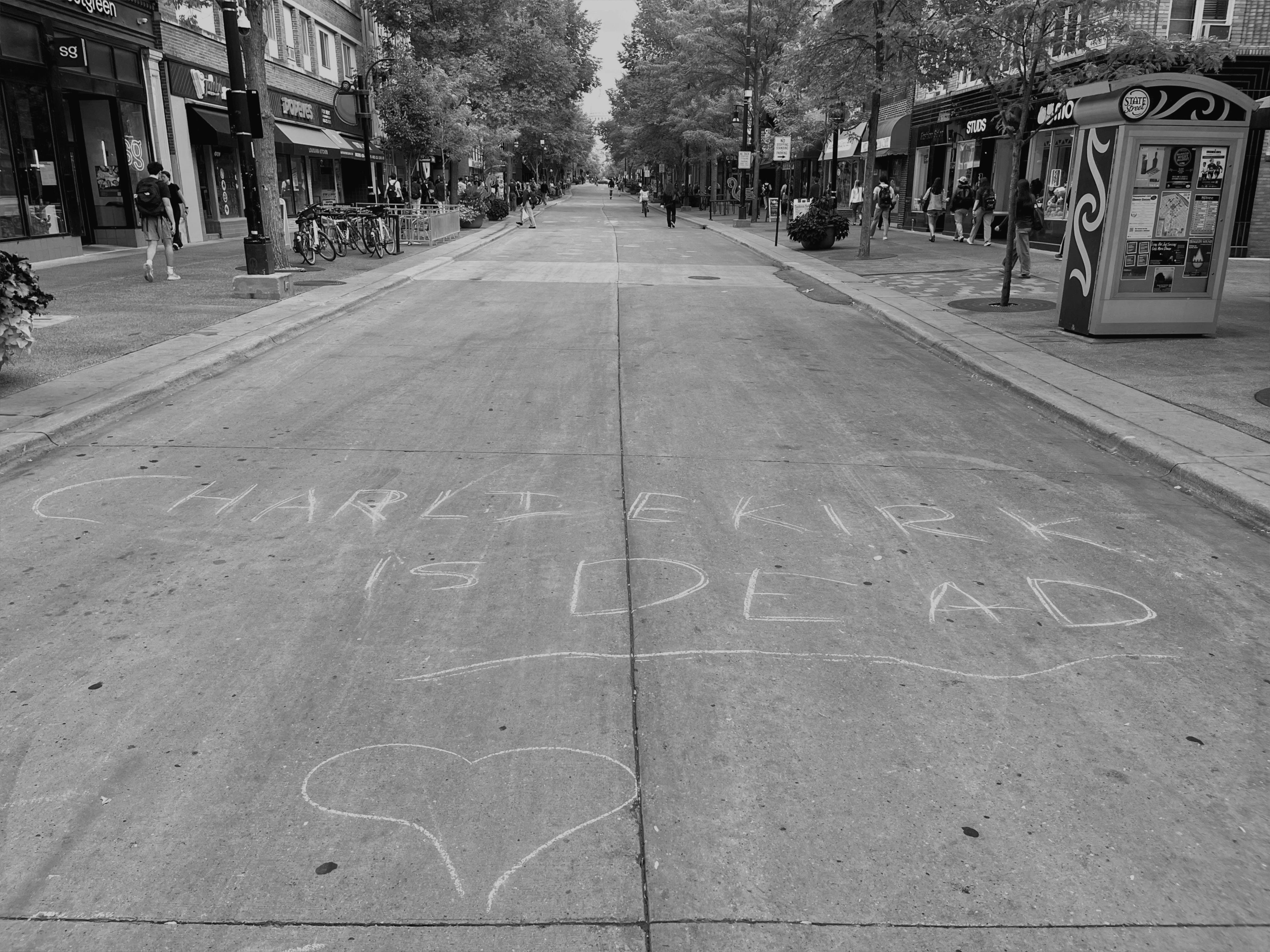
The day following Charlie Kirk’s assassination, I was on my way to class when I looked at the ground on State Street. Written in chalk were messages of hatred rejoicing over his assassination. “Charlie Kirk is Dead,” read one. Another compared him to Hitler. I couldn’t believe what I was reading. His murder was an attack on both the freedom of speech and the freedom of thought. What struck me most was not that people had written that Kirk was dead, but that they were actually celebrating it. The question for me became: Why?
At the age of 18, Kirk picked up a card table, a chair, and a piece of cardboard on which he would write “Prove Me Wrong” about numerous political topics. A kid fresh out of high school, he debated people on the street about any idea he thought was worth discussing. He certainly had plenty of jokes and sarcastic remarks while debating, but no matter what, he would always allow the person speaking to be heard and respected. Kirk stood for the freedom of speech, but also the freedom of ideological exploration. He searched for the truth in everything. Open debate was his platform to do that.
The first college Kirk tabled at was the University of Wisconsin-Madison. It was the first time he invited any person passing by to talk with him. College is supposed to be a place where students encounter new ideas, challenge those ideas, and potentially change their minds. Kirk opened these doors for so many through his willingness to allow others to be heard, regardless of their beliefs.
The United States was founded on these principles: the idea that no matter what you believe, your voice matters and has a right to be respectfully expressed. But how are those foundational principles affected when someone is murdered for simply expressing their opinion? Furthermore, how much more extreme is that effect when students and professors are celebrating the death of a loving husband, son, and father of two children? Is the idea of “Prove Me Wrong” so powerful that it should cost you your life? Thought and debate should result in reflection, not violence, regardless of whether you like the message or not.
As a student at UW-Madison, there are many opportunities to get involved in clubs, organizations, and classes that allow you to pursue what you believe in. The beauty of the United States is that you are free to do that, no matter your beliefs. You can have open discussions with fellow students. You can start clubs for a topic you are passionate about. The opportunities are truly endless.
But the freedom to explore ideas can only exist if we are willing to allow people we disagree with to express their ideas as well, without screaming or violence.
It is easy to extend free speech to people who share your beliefs, but the difficulty comes when you disagree with someone. Liberty isn’t attacked because of more ideas; it is attacked through attempts to silence dissent. When people attempt to shut down others with ridicule, hatred, and bullets, that is when freedom is attacked. That is the danger to free thought. Political disagreement is intense. It should not, however, be dangerous on a college campus.

I am not arguing that Kirk was right about everything. I am not telling you to admire him. I am arguing that all people are entitled to an opinion and to be heard safely, whether you like it or not. College exposes us to many ideas, and you have the privilege to either agree or disagree with those ideas. No matter what side of the aisle you are on, you have a voice, and that shouldn’t ever be infringed upon — especially through violence.
You should be able to sit down with and have a discussion with the people you disagree with, not meet them with anger and hatred. Disagreement should bring conversations, not silence or anger. As the Turning Point USA president at UW-Madison, I strive to bring people from all walks of life together to respectfully share their views.
Kirk’s movement was based on the ability to have respectful conversations and debate. “Prove Me Wrong” wasn’t an attack; it was an invitation. An invitation to dissent respectfully. An invitation to explore ideas and discover the truth.
Regardless of the motivation behind the assassination of Kirk, violence became the ultimate rejection of debate and disagreement. Instead of having a conversation, violence silenced a voice and ended a life.
The messages written after Kirk was assassinated should be concerning to all students at UW-Madison and throughout the country. All life is valuable, and in the United States, you have the freedom to believe what you want. No matter what creed you live by or who you disagree with, have that discussion just as Kirk did.
The chalk on State Street has been washed away, but the question it provoked remains: Can we disagree without hating each other? Can we challenge ideas without attacking the people who hold them? Charlie Kirk spent his life asking people to prove him wrong. Perhaps that is something every college student should be willing to do.
READ MORE:
WISCONSIN ASSOCIATION OF SCHOLARS CALLS ON UW SYSTEM TO CONDEMN CHARLIE KIRK ASSASSINATION
UW-MADISON MEDICAL SCHOOL ADMISSIONS DATA SHOW RACIAL DISPARITIES