

Black and Hispanic applicants faced better odds of being admitted to the University of Wisconsin School of Medicine and Public Health in the 2025 admission cycle than did White or Asian applicants with the same MCAT score and GPA, according to the university’s own data.
Among applicants with the same admission test scores and grade point averages, a Hispanic or Black applicant had nearly 4 times the odds of admission of an Asian applicant.
The data provide evidence that some racial and ethnic groups may be favored in the admissions process, and follow earlier results branded as “brazen” by anti-discrimination activists.
On their own, however, the data do not establish discrimination. Because the school uses a holistic approach in admissions, the disparities could result from other factors, such as life experiences, essays, and letters of recommendation. Furthermore, the dataset does not identify admissions pathways or pipeline programs, such as dual degrees or the Wisconsin Academy for Rural Medicine. These have materially different criteria for admission.
“Our admission process reviews every aspect of an application with the strength of academic preparation key to determining an applicant’s likelihood of success,” university spokesman John Lucas told The Madison Federalist. “Students are admitted on the basis of their likelihood to succeed throughout the rigorous course of study in UWSMPH programs.”
He said that “admission standards fully comply with the law” and “no student is admitted on the basis of their race/ethnicity/identity.” He did not answer whether the admissions process changed in any way between the 2025 and 2026 admissions cycles.
University admissions have come under heightened scrutiny in the wake of a 2023 Supreme Court decision barring universities from using race as an admissions factor.
The medical school’s admissions data were received in August in response to a December 2025 open records request. The data categorizes applicants as “admitted,” “matriculate,” “denied,” and “waitlisted.” This analysis counts “matriculate” and “admitted” toward acceptance.
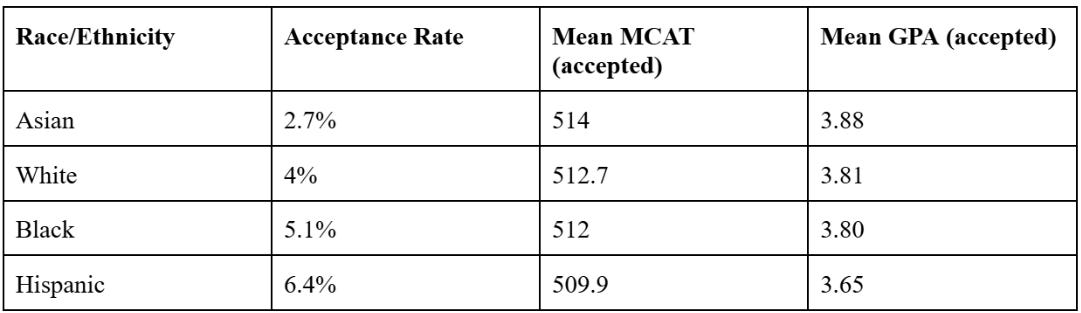
The table below shows the overall acceptance rates for Asian, White, Black, and Hispanic applicants. It also contains the mean Medical College Admission Test (MCAT) scores and GPAs of the admitted applicants for each group. The acceptance rate for Hispanic applicants is more than double that of Asian applicants.
The differences widen among out-of-state admissions, which are more competitive. While the total acceptance rate for in-state applicants is 22 percent, the total acceptance rate for out-of-state applicants is 1.8 percent — making Wisconsin residency a far greater indicator of admission odds than ethnicity.
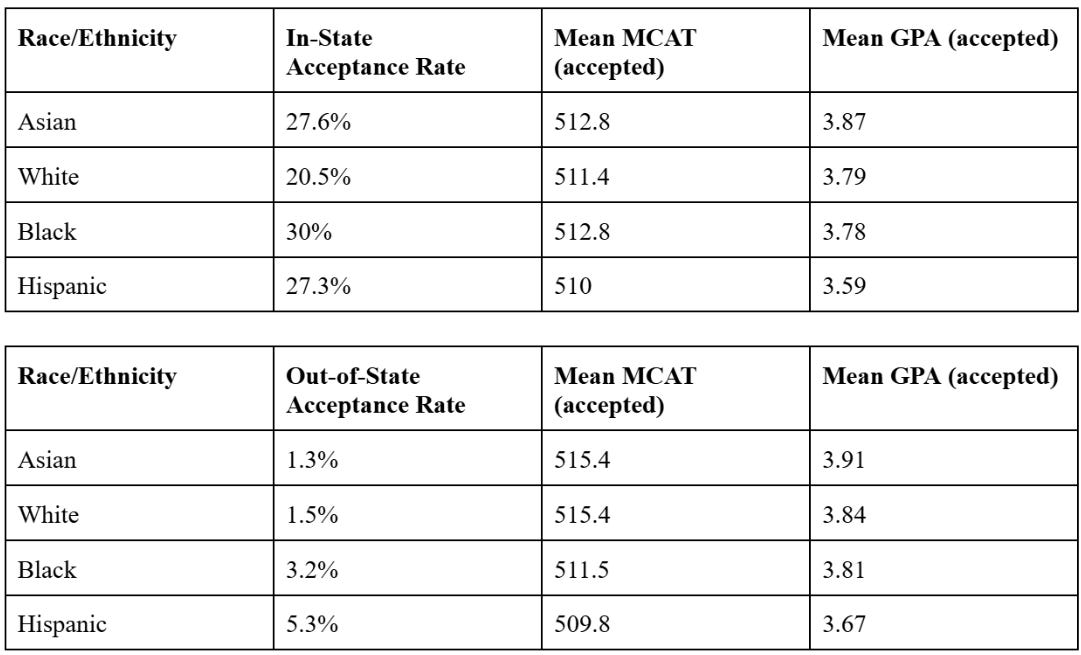
There were fewer than a dozen applications from those of Native American ancestry and no admissions.
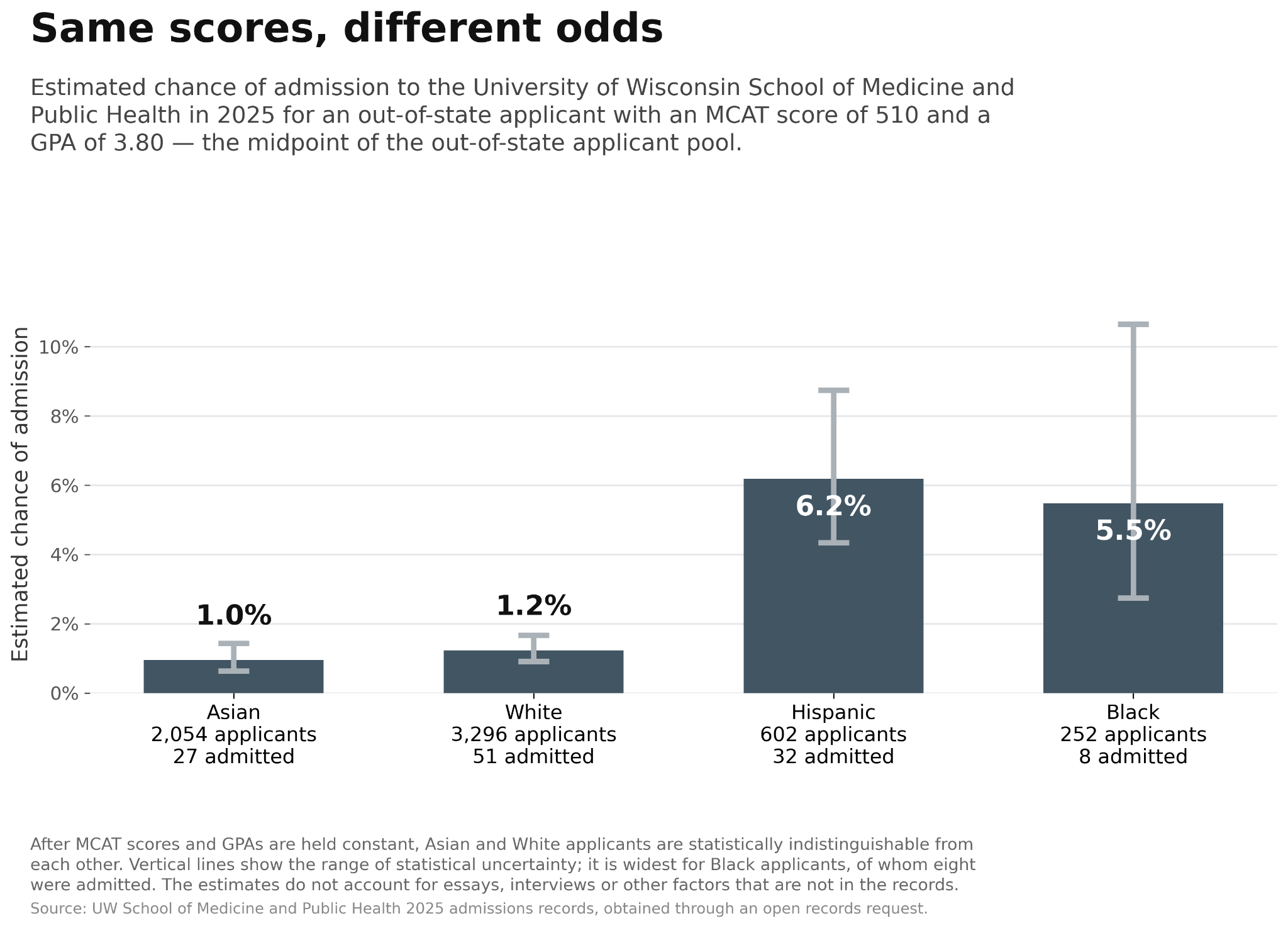
While the raw acceptance rates show a sizable difference, the average MCAT scores and GPAs do not tell us how the odds of admission differ for applicants with the same scores. Regression analysis, however, allows such a comparison, revealing that, among applicants with the same MCAT scores and GPAs, a Hispanic applicant had 3.5 times the odds of admission of an Asian applicant. A Black applicant had 3.7 times the odds.
When residency is also factored in, the disparity actually grows higher. Both Black and Hispanic applicants had about 4 times the odds of admission of Asian applicants.
Among out-of-state applicants, a Hispanic applicant had 6.8 times the odds of admission of an Asian applicant with the same GPA and MCAT. A Black applicant had 6 times the odds.
White and Asian applicants were statistically indistinguishable in the same model.
When looking only at in-state applicants, a Hispanic applicant has about 1.4 times the odds of admission of an Asian applicant with the same GPA and MCAT. A Black applicant has more than 2 times the odds. Notably, the in-state findings were not statistically significant. The in-state sample was much smaller, so the estimates are imprecise.
Disparities in admissions also showed up in the 2024 application cycle. According to a study by Do No Harm, a group opposed to identity politics in medicine, UW-Madison was identified as “particularly brazen in efforts to reward black candidates and punish Asian candidates” when compared to other medical schools. In that year, the average MCAT scores of rejected Asian and White applicants were higher than the scores of accepted Black applicants.
Former chancellor Jennifer Mnookin discussed the report with The Madison Federalist in November, saying that since the 2023 Supreme Court ruling in Students for Fair Admissions vs. Harvard, “the university has reviewed and revised admissions policies in accordance with the guidelines, and we certainly expect all of our schools, including SMPH, to abide by the legal standards not to consider race directly in the course of their admissions.” She said, “I know this is something that the new dean of the medical school is paying close attention to and assessing.”
After the Students for Fair Admissions ruling, UW-Madison announced it would review its admissions practices. Universities cannot directly consider race or use a proxy for race when making admissions decisions.
In its biennial report to the state legislature in 2024, the medical school said it “maintains compliance with all state and federal legislation,” including Students for Fair Admissions. It said it “has reviewed questions in the application process to ensure compliance while continuing to align with the mission and vision of the school and University.”
Since the beginning of the second Trump administration, many schools have been subject to civil rights investigations by the Education and Justice departments due to race-based practices in their admissions. The Department of Justice found that multiple University of California medical schools violated civil rights laws by intentionally using race in their admissions decisions. In July, the Education Department announced it was investigating five medical schools for race-based admissions practices.
In June, the DOJ announced an investigation into 15 unnamed medical schools. UW-Madison did not answer whether the school was under investigation, and the DOJ declined to comment.