

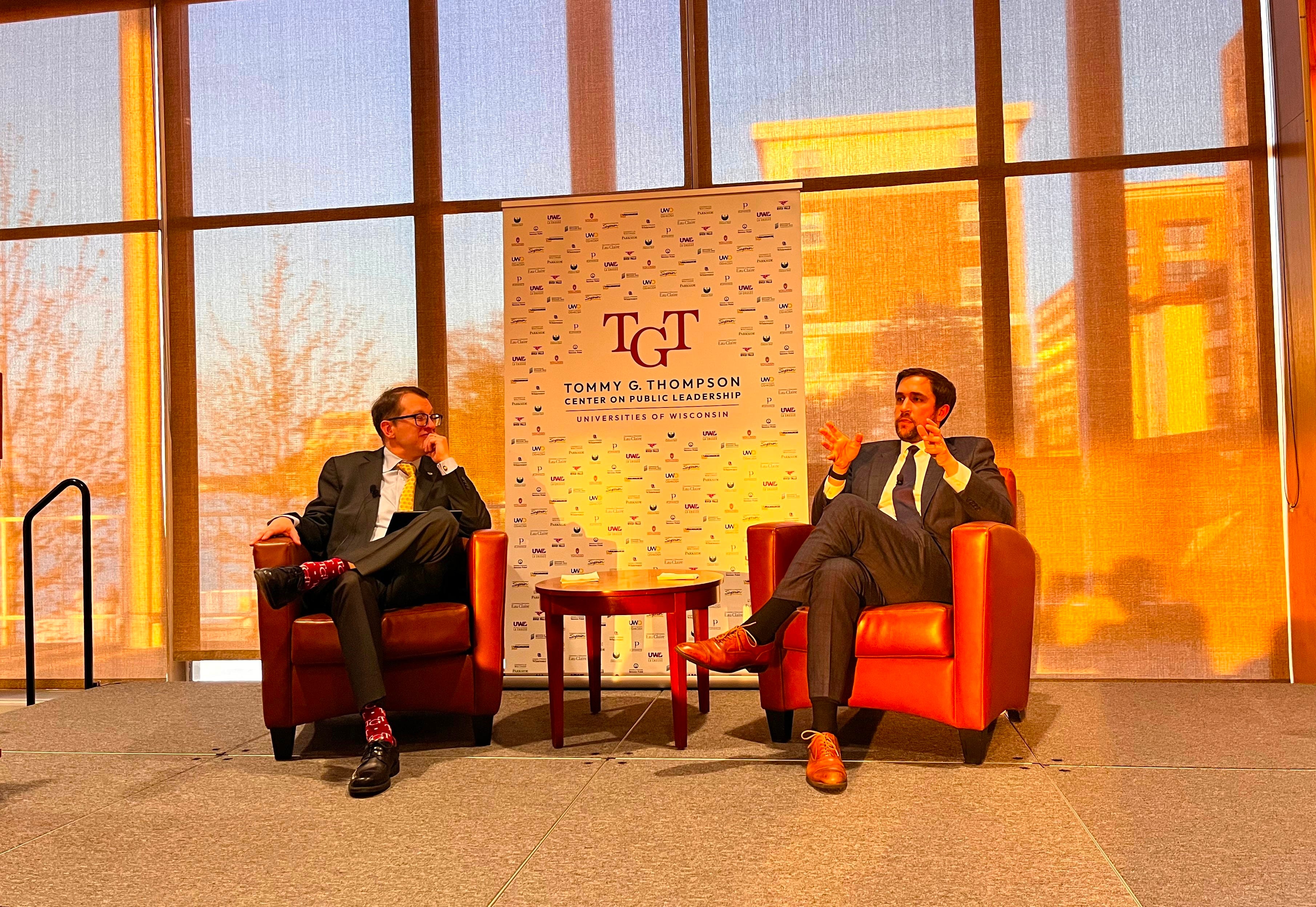
Conservative journalist and activist Christopher Rufo believes higher education may be changing for the better. “I know for a fact that we are in a better place than we were five years ago,” he told The Madison Federalist. “But the question is really: Are they sufficient structural changes long-term? The answer to that is obviously no, so we will have to do much more moving forward.”
Rufo gained national prominence for his reporting on critical race theory and DEI in governmental institutions, especially universities and public schools. Rufo has been instrumental in reshaping how the right approaches higher education reform, including advising Florida Governor Ron DeSantis. He is currently a senior fellow at the Manhattan Institute.
Rufo sat down with The Federalist for an exclusive interview before speaking at the University of Wisconsin-Madison on April 22. He was hosted by the Tommy G. Thompson Center on Public Leadership and the Center for Research on the Wisconsin Economy in an event titled “Making Universities Great Again.”
According to Rufo, higher education is facing a crisis of its own making, and conservatives in government should not shy away from using their power to fix it. “A lot of these institutions that have been fattening themselves in ideology and in politics are going to be put on a crash diet. They won’t be able to do what they’ve been doing moving forward,” he said. “And I think ultimately that’s what it’s going to take for these institutions to actually have a moment of seriousness.”
“Universities have essentially been printing taxpayer dollars for a half century, with no limitations. That can’t go on forever,” Rufo said. He believes federal and state governments are in a unique position to make change because “student demographics [will] start tipping and declining” in the coming years. As the percentage of the U.S. population aged 18-22 decreases, colleges will need to compete for students like never before. “I think you’re going to see a lot of people get much smarter in a much faster fashion than we’ve seen so far.”
DIVERSITY, EQUITY, AND INCLUSION
While the University of Wisconsin-Madison’s Division of Diversity, Equity, and Educational Achievement was closed in 2025, most of its employees were retained, and many departments continued to list DEI as a priority on their websites. An art exhibit sponsored by the Office of Multicultural Arts Initiatives – which still claims to be part of the defunct central DEI office on its website – took down a flier advertising Rufo’s event and claimed it marked “the active presence of reactionary discourse on campus.”
According to Rufo, the continued presence of DEI on college campuses is widespread. He pointed to the New College of Florida, where he was a trustee, as the model for change. “We just fired everyone and said the DEI office is gone and all the employees are gone. That’s what you ultimately have to do.” Rufo said reform takes “decisive leadership.”
He believes conservatives “decisively won the debate in the realm of public opinion,” and even many within the university system recognize that DEI went too far. “When people are running away from their own ideas, when they’re trying to hide their own actions, and when they are denying their own previously stated beliefs, that shows you that public opinion has shifted dramatically against them.”
“The question is for legislators and administrators to translate public opinion into an administrative reality.” However, he wondered whether “toughness even exists in academia.” He believes that the university “chancellors, presidents, provosts” have largely been unable to drive meaningful change, so “political leaders” must fill the leadership void.
STATE-LEVEL SOLUTIONS
The Thompson Center conducted a recent survey about faculty political ideology, which found that the overwhelming majority of UW-Madison professors identify as progressive. According to the survey, nearly one-third of faculty said they would be less likely to support hiring a candidate with conservative views on abortion or immigration.
In states such as Texas, North Carolina and Ohio, state legislatures have addressed the viewpoint discrimination problem by creating civics education schools. At the Arizona State University and Florida State University, their respective civics school directors are former members of the UW-Madison political science faculty. Rufo believes the civic school model is “great,” but “there’s limitations of it.”
“One thing I’ve learned is that some of these centers are run better than others, without naming names,” he said. “Leadership is hard because you’re entering a larger institution that is generally hostile, and then you are also trying to manage and protect yourself and protect your scholars and create something under challenging conditions.”
“The key benefit for the civic schools is that you have a clear administrative unit that can do hiring, that can do course offering, and that can, in some cases, [offer] majors, and in fewer, but increasing number, of cases, train graduate students.”
To Rufo, their most important aspect is the creation of “a faculty pipeline” for right-leaning academics. “For many years, even Ivy League, conservative faculty members were telling their graduate students or their potential graduate students, ‘Don’t do this, because on the other side of your PhD, no matter how good your scholarship is, it’s a very brutal hiring environment.’”
Now, the faculty at civics institutes say they have a new problem: “We have a huge supply of positions open, and we’re struggling to hire.” Rufo believes the “pipeline problem” can be partially addressed by civics schools themselves as they begin to produce more graduates.
THE TRUMP ADMINISTRATION
Rufo believes the Trump administration’s efforts to reform higher education “have stalled” since Elon Musk “left the administration.” Since that point, “I wouldn’t say that they’ve taken a heavy hand ... I would say the opposite.”
“I realized, having worked with the various agencies, on education, on civil rights law, on federal grant making, on DEI, those were issues that were kind of de facto delegated to Elon,” he told The Federalist. “The problem is that after Elon left the administration, a lot of the progress on the basket of issues that might be associated with anti-woke politics just kind of stopped.”
“That doesn’t mean there aren’t good people. There are many good people at the Department of Education, at the Department of Justice, at the White House Domestic Policy Council, at HHS, all these various agencies, they’re good people,” Rufo said. However, “Having Elon on the team, driving managerial disruption is much better than not having Elon on the team and having salaried functionaries trying to kick the machine into gear. They just can’t do it.”
STUDENT JOURNALISM
Rufo believes that student journalists can play a major role in exposing discriminatory practices in higher education. “The immediate cause is shedding light on what is happening around you for the people that live, work, and play around you,” he said. Because of this, journalists provide an important “service to the public, at least within your domain.”
He also views college newspapers as an important talent pipeline, as “the talent and instinct and craft” developed on campus “might be put to service on a larger playing field in the future.”
“All of these conservative-leaning student papers around the country seem to be magnets for not only talent, but a particular kind of talent,” Rufo said. “That demands a higher level of courage than your peers and competitors. And that’s something that holds true on the big stage.”