

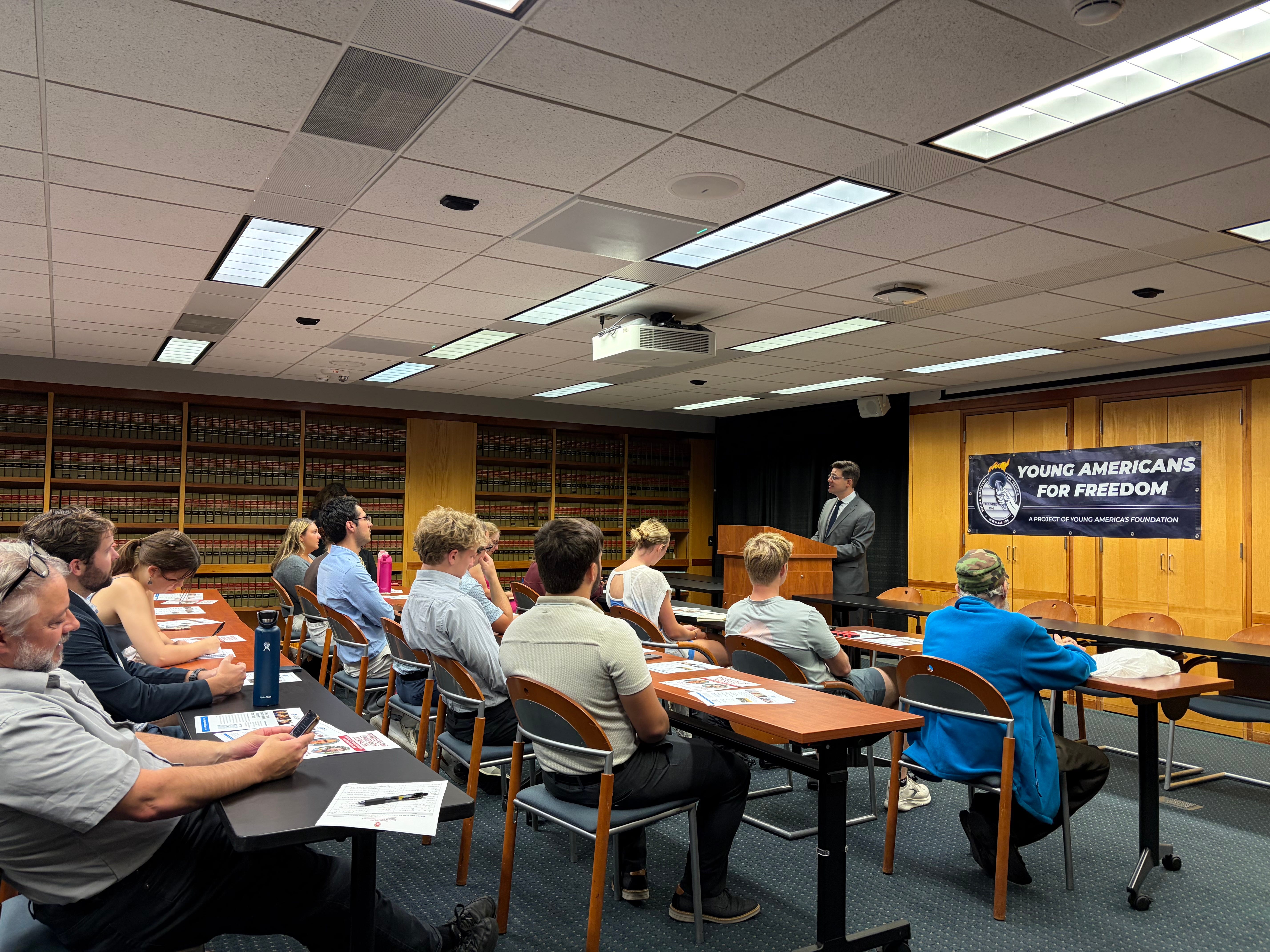
Matthew Continetti, director of domestic policy studies at the American Enterprise Institute, recently gave a lecture at the University of Wisconsin-Madison detailing developments in conservative economic thought.
Continetti is a columnist at the Wall Street Journal and the founding editor of the Washington Free Beacon. He is the author of The Right: The Hundred Year War for American Conservatism, which focused on the history of the American conservative movement.
Continetti’s October 15 lecture, which was hosted by the Center for the Study of Liberal Democracy, Center for Research on the Wisconsin Economy, and Young Americans for Freedom, served as a timeline for conservative movements, tracing conservative political thought from 20th century schools of thought to modern day right-wing groups.
Continetti began by discussing the upcoming midterm elections, where he identified the major buzzword of the election as “affordability.” He commented on voters’ frustration about issues such as the price of gas and property taxes. Contenitti argued that voters often look to the government to address rising costs, even when government policies contributed to these costs.
Continetti specifically mentioned the “Chart of the Century,” which has tracked the costs of goods and services, as well as wages, from January 2000 to December 2024. He noted how many areas with high government involvement rose the highest — yet voters still view the government as the solution.
The popularity of this viewpoint brings Continetti to his central questions: How do we recover freedom when people desire to be reliant on the government? And how has our society changed to warrant this desire?
Continetti’s answer lies in conservatism, which he differentiates from views of the modern Republican Party. Instead, his view of conservatism lies in the history of conservative movements and schools of thought, which give an answer to these questions.
Continetti began his chronology of conservatism internationally. He noted how European socialism and its emphasis on government brought about competing schools of thought. The Austrian school of economics instead championed free markets and less government interference in society, viewing economic and political freedom as one and the same.
Continetti compared this to government programs in the early United States. During this time there was government interference, but it was limited to supporting development through research, land protections, land grants, etc. with little federal power.
However, Continetti noted, this hands-off approach was seen as not enough by the progressives, and he criticized the GOP’s response to the Great Depression as a failure that led to more government interference into Americans’ daily life.
By the mid-20th century, conservative economists such as Milton Friedman were revisiting the Great Depression and challenging conventional explanations of its causes. Continetti specifically noted how 1970s “stagflation” backed up this view, as the government pumping money into the economy did not fix the combination of high inflation and unemployment.
Continetti said conservatism got a boost in the 1980s, with the popularity of supply-side economics and Ronald Reagan’s tax cuts, but he determined this was ultimately undermined by Bill Clinton’s policy of “globalization,” which Continetti argued had drawbacks for the U.S. as he felt it started the free trade of drugs and trading with communist China.
Bringing his discussion back to the present, Continetti noted how in 2015, soon-to-be President Donald Trump fully rejected globalization, arguing that Americans were being cheated by it and campaigning for policies such as tariffs and to “build a wall” along the U.S.-Mexico border. However, Continetti did not describe Trump as a conservative, instead saying he has no real political philosophy.
Similar to Trump, Continetti concludes his speech with a discussion of potential right-wing groups that could be the face of conservatism in the future. He specifically singles out National Conservatives or “Natcons”, who he notes as rejecting typical conservative thinkers and leaders, and instead supporting very traditional virtues—family, religion, social cohesion, etc.. Continetti determines that many of these Natcons support only some of Trump’s policies, yet he argues that Trump opened the doors for Natcons to lead the next wave of conservatism.
Looking to the future, Continetti expressed hope for more free-market principles in the next election, and called for more economic education. He said conservatives still rely on older thinkers, such as Friedman or Mises, and he argues that more economic education could lead the way for a new generation of conservatives.
An audience member asked what the future of conservatism looked like, and if there was a way back to it in the U.S.. Continetti saw it going one of two ways, depending on the outcome of the 2028 Presidential Election. He felt that if J.D. Vance — who he saw as the probable Republican nominee — lost, there could be a major pendulum swing back to progressivism in the U.S.
