

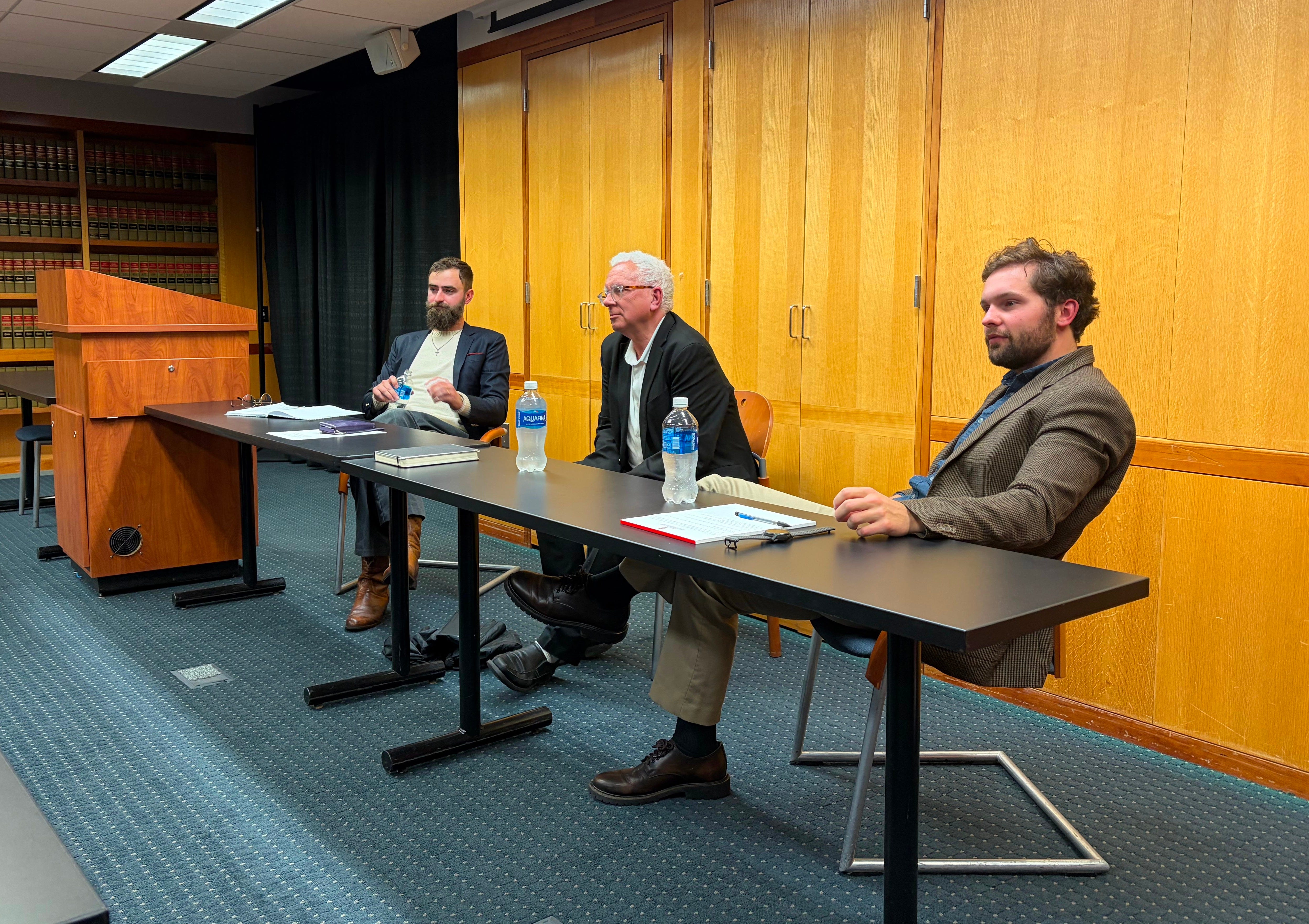
Leading progressive and conservative journalists came together for a moderated conversation at the University of Wisconsin-Madison on October 15.
John Nichols, executive editor of The Nation, and Luther Abel, associate editor at National Review, spoke about the impact of artificial intelligence, social media, and political polarization on journalism.
The event was the first in the “Beyond the Headlines” speaker series, hosted by the Wisconsin Exchange, the Center for the Study of Liberal Democracy, the School of Journalism and Mass Communication, and the Department of Political Science.
The conversation started off with a discussion on the rise of opinion writing within journalism and how that has affected the profession. “You have opinion writers [now], who are really paid to tell the reader what he or she wants to hear,” Abel said. “However, for the health of the republic, I’m not a huge fan, and it’s never been easier for a lot of hacks to get in front of a lot of people and say things that simply aren’t true.”
There were many justifications given as to why this rise in opinion journalism has occurred, but the conversation seemed to always come back to the death of daily newspapers. “The root of traditional journalism was the daily newspaper. Large newsrooms, a ton of people, … going deep into their beat, and they get to know all the players on the beat,” Nichols said. “As we have seen the collapse of the newsroom, … I think a lot of people have decided, well, the easy way is to be the opinion writer.”
The discussion then shifted toward the rise of “new media” and the immediacy that readers want news. “We feel a sort of obligation and incentive … [to] be the first with the hottest opinion,” Abel said. “If it’s way too good to be true, give it 24 hours. And you’re not going to be cashing in on the hundreds of thousands of people visiting your piece. But in the long run, you’re not going to get burned nearly as often.”
Nichols took the view that the new media has been beneficial for society in the way that people now get information much faster. “I think that new media, at times, is better than old media. It gets us information immediately,” he said. “You know about things that are happening very, very fast. It allows citizens to communicate information about what they are seeing as they are seeing it. Sometimes, it does get us to realities that we would not otherwise have.”
The panelists also spent time talking about the necessity for journalists to be curious and want to investigate the truth, no matter where it leads them. Both used Wisconsin’s recent Democratic primary for governor as an example of how journalists should want to be surprised.
Referring to the evening of David Crowley’s upset win against Francesca Hong in the primary, Nichols said, “It was so fun. You know, no matter your ideology, … that was amazing stuff. And what I would say about that is, whatever area you’re in, have the actual desire to be surprised. To, you know, be shocked by something and be delighted by telling people about it.”
Abel talked about his experience at the Hong watch party and interacting with different political perspectives. “That was a blast of a watch party,” he said. “And so again, what’s going on? Appreciate that the people around you feel very strongly one way or another. And to find out why that is.”
Near the end, the conversation shifted towards a discussion on how much media politicians should consume. “I don’t trust a president who doesn’t consume a lot of information from a lot of different sources,” Nichols said. “I think for a president, a leading official, you have to have some things that you read, that you disagree with.”
That principle doesn’t just apply to politicians. Everybody can benefit from reading a variety of sources with different viewpoints. Both panelists ended the discussion by acknowledging how much they enjoyed reading the other’s work and being exposed to different opinions.
The next event in the “Beyond the Headlines” series will be on November 17 at 6:00 pm in Law Building room 7200. It will feature JR Ross, editor of WisPolitics, and Kelsey Dallas, managing editor of SCOTUSblog in conversation about journalism and the judiciary.
