

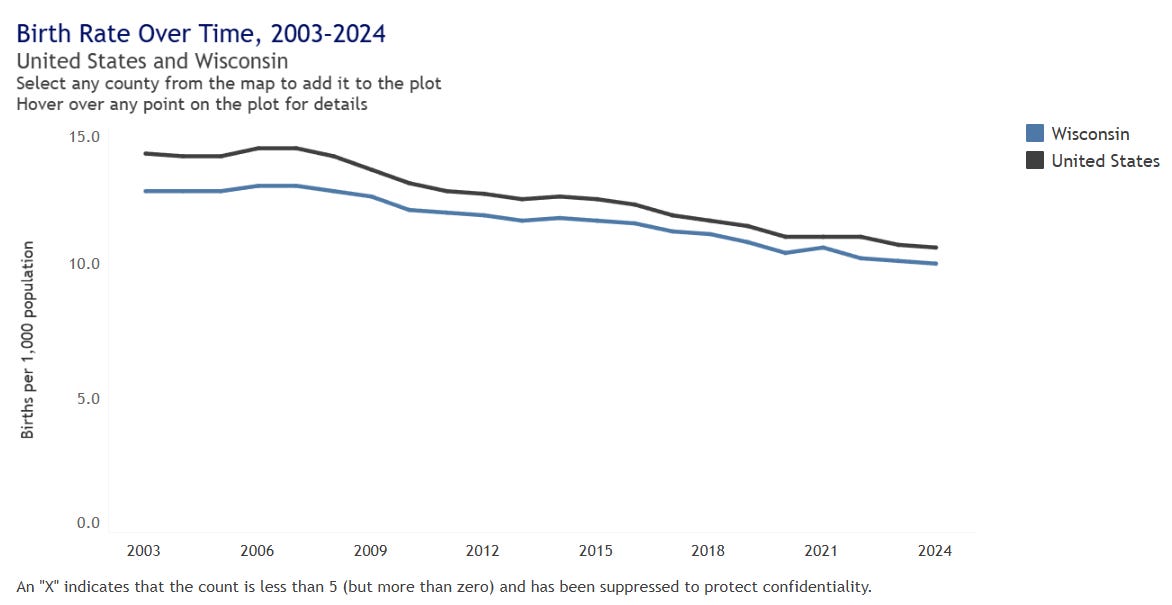
Wisconsin is facing a demographic crisis that lawmakers and voters can no longer afford to downplay: the state’s birth rate is collapsing, and the consequences are already being felt across its communities.
According to recently released data from the Wisconsin Department of Health Services, just 59,675 babies were born in the state in 2024. The figure represents an 18% decline from the 2007 birth peak, marking the lowest number of births since before World War II. Wisconsin has remained below replacement-level fertility (2.1 children for each family) since 1974, and projections suggest that the state could lose nearly 200,000 residents by 2050 if the current trend continues.
Policymakers must instead prioritize making Wisconsin a state where families can afford to live and raise children.
This decline is not limited to rural Wisconsin, though rural communities are experiencing the effects first. In 29 of the state’s 46 rural counties, deaths now outnumber births, contributing to shrinking school enrollments and workforce shortages. Even Wisconsin’s largest and most economically productive cities are no longer immune. Milwaukee recorded just 7,386 births last year—a 22% drop since 2019— while Dane County now has the lowest fertility rate in at least a generation.
For decades, Wisconsin’s population growth depended on strong families and stable communities. In 1920, when the number of births was the same as it was in 2024, Wisconsin’s population was less than 2.6 million, compared to the now over 6 million residents. Today, however, population growth is increasingly reliant on migration, not births. In 2023, more than 93% of Wisconsin’s population growth had come from net migration. A year later, 2024 data displayed that only 6.8% of the state’s growth came from natural population change (births minus deaths). Without families with children moving into the state, Wisconsin’s youth population would already be in steep decline.
The reasons behind this collapse can be traced to both statewide economic and cultural shifts. Rising housing and healthcare costs have made family formation increasingly unaffordable, particularly in urban areas such as Madison, where the cost of living now exceeds the national average by about 4%. At the same time, cultural priorities have shifted away from marriage and family toward prolonged education and career advancement. Many young adults delay having children until they have reached select career accomplishment, when fertility declines and family size becomes limited.
Wisconsin is also experiencing poor retention of the young adults they need most to rescue a declining population. States like Florida, Texas, and Arizona, which provide warmer climates, lower taxes, and stronger private-sector job growth, attract working families. Between 2010 and 2020, Wisconsin experienced its slowest population growth in recorded history, and the out-migration of young adults continues to weaken the state’s long-term economic outlook.
Wisconsin’s fertility crisis is not quickly approaching, it is already here.
With a birth rate below the national average, lawmakers are finally turning to acknowledge the problem. Governor Tony Evers’ 2025 “Year of the Kid” initiative includes investments in family tax relief, healthcare access, and child focused programs as an attempted retention of families with their eyes on settling elsewhere. While these efforts are a step in the right direction, reversing Wisconsin’s demographic decline will require a broader, more intentional strategy.
Policymakers must instead prioritize making Wisconsin a state where families can afford to live and raise children. Expanding housing supply, reducing childcare and healthcare costs, incentivizing family migration from neighboring states, and retaining stable income workers can secure a dwindling population. Cultural renewal matters as much as economic policy, and Wisconsin must reaffirm that strong families are not obstacles to growth, but the foundation of it.
Wisconsin’s fertility crisis is not quickly approaching, it is already here. It is reshaping the state’s economy, workforce, and communities. If action is not taken soon, the cost of inaction will only grow.

Impressive analysis of how the 93% migration dependency masks the underlying fertility issue. When population growth hinges almost entirely on people moving in rather than natural increase, it creates a fragile foundation that can shift with economic winds. The comparison to 1920 population levels really underscores how much the demographic balance has tilted over the past centruy.