

Since the beginning of Trump’s second term, Wisconsin’s AG has signed on to more than 40 lawsuits. Why? And what does it cost the state?
This article was originally published by the MacIver Institute.
INTRODUCTION
In January of 2025, U.S. President Donald Trump signed an executive order to restrict federal funding from being used to support gender transitions for individuals under 19. It mandated that federal funding not be used for puberty blockers, hormone therapy, or surgeries, and instructed federal programs such as Medicare and Medicaid to deny coverage for these interventions.
The order also directed federal agencies to make sure that hospitals receiving federal funds were not using those resources to do gender-transitioning procedures on minors.
In response to this executive order, Wisconsin Attorney General Josh Kaul, along with 14 other state attorneys general, signed onto a multi-state lawsuit challenging the policy.
But this is just one of over 40 lawsuits that Kaul has signed onto on behalf of Wisconsin since the beginning of Trump’s second term.
As these lawsuits continue to grow in number, so do questions about the scope of the attorney general’s power and whether this level of involvement in national political battles is what the state office was intended for.
THE ROLE OF THE ATTORNEY GENERAL & JOSH KAUL
The Wisconsin Attorney General’s role is to be the chief legal officer of the state. While the position was created in the Wisconsin State Constitution of 1848, the duties of the role are outlined in Wisconsin Statute § 165.25.
They appear before the Wisconsin Supreme Court, handle litigation for state agencies, and take part in other legal actions at the direction of the governor or legislature. The office also functions as legal counsel to state officials and provides guidance to district attorneys.
The attorney general serves for four years and is not subject to term limits. Wisconsin Attorney General Josh Kaul was originally elected in 2018, again in 2022, and will seek re-election against Republican candidate Eric Toney this fall.
Aside from the political lawsuits, Kaul’s tenure has not been without controversy.
In 2025, Milwaukee Journal Sentinel Reporter Daniel Bice broke that Kaul had hired a new special assistant attorney role for environmental litigation whose salary is paid by the State Energy Environment and Impact Center at New York university law school. Controversially, the center was funded by Michael Bloomberg.
As MacIver’s Senior Fellow William Osmulski put it, “The State of Wisconsin got the lawyer for free. In exchange, SEIC got to use the authority of Wisconsin’s Attorney General to fight climate change. A quid pro quo.”
Taken together, these developments and the volume of lawsuits targeting a Republican federal administration have prompted concerns that the office is being used for political purposes.
In previous attempts to reign in the power of the attorney general, Wisconsin Act 369 was passed in 2017. Among other things, this legislation dictates that when the DOJ wants to discontinue or compromise a civil action, they must get approval from a state intervenor or the Joint Committee on Finance. It also requires that DOJ settlement funds are deposited into the general fund. This limited the attorney general’s ability to withdraw Wisconsin from lawsuits and increased legislative oversight.
While Kaul may not have been able to unilaterally withdraw Wisconsin from lawsuits filed by the previous conservative attorney general, it has not prevented him from signing onto a plethora of multi-state lawsuits against the current federal administration.
MULTI-STATE LAWSUITS
A multi-state lawsuit is any coordinated litigation between two or more attorneys general against the same defendant––typically the federal government and its agencies––over policies, regulations, or executive orders in federal district court.
It is not unprecedented for attorneys general of one party to co-litigate or sign onto lawsuits against the federal administration of the opposing party, but this tool has been used with increasing frequency since Trump’s first term.
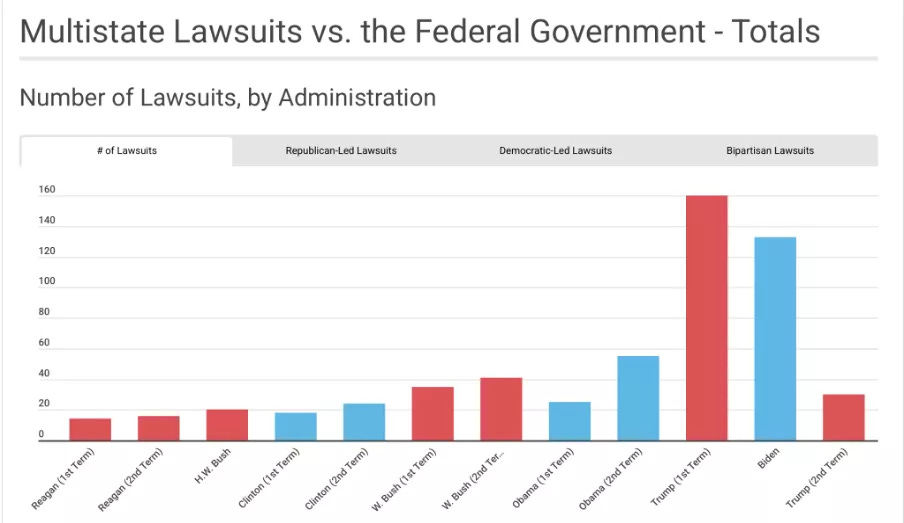
In most of the coalitions that form these multi-state lawsuits, a few anchor states do the heavy lifting. These states usually draft the litigation, represent the coalition of states, and file the initial complaint. Often, the litigation is co-drafted by two or more states.
Democratic attorneys general in states like California and New York have been some of the most active in filing lawsuits against the Trump administration, with other major contributors including the AGs of Illinois, Massachusetts, New Jersey, and Washington.
The Badger State, on the other hand, appears to take a more passive role. While Wisconsin filed a petition against the Environmental Protection Agency in 2025, in most other cases, the state joins as a sign-on plaintiff rather than serving as a lead plaintiff.
States do this because when multiple states join together, it strengthens and legitimizes their claim. It also increases the likelihood that a federal judge will issue a nationwide injunction, whether preliminary or permanent, preventing the federal government from enforcing a regulation or policy across the country.
To establish standing, plaintiff states must provide specific claims showing how the federal action harms their state. This is supposed to be evidence that the action harms residents, conflicts with state law, increases costs for the state, or exceeds federal authority, to name just a few examples.
It is difficult to know exactly how much Wisconsin taxpayers are spending on these lawsuits against the federal government. Wisconsin’s state budget and Department of Justice appropriations do not specify how much funding is allocated to individual cases. As a result, the public, which elects the attorney general, is left unaware of how much staff time and taxpayer money is being spent on research, filings, and coordination with other states in these lawsuits.
This raises an important question: if Wisconsin is repeatedly joining national litigation, what exactly is the state fighting for? Take a look at some of the major lawsuits Josh Kaul has signed-on to:
Birthright citizenship executive order— Kaul joined a lawsuit challenging President Trump’s executive order denying citizenship to certain children born in the United States.
Blocking Medicaid funding for Planned Parenthood— Kaul joined litigation opposing a federal provision cutting off Medicaid funding for Planned Parenthood.
Restriction of Medicare and Medicaid for Transgender Interventions on Kids— Kaul participated in a lawsuit challenging an HHS declaration and related proposed rules aimed at limiting federal money on transgender interventions.
$100,000 H-1B visa fee— In another case, Kaul joined a coalition contesting a new $100,000 fee on H-1B visa petitions.
Freeze of federal education grant funding— Kaul also joined a lawsuit challenging the administration’s decision to freeze various education grants.
Firings of federal probationary employees— Kaul joined a challenge to the administration’s termination of many federal probationary employees.
Dismantling of the Department of Education— Kaul participated in litigation opposing the administration’s effort to cut the Department of Education’s workforce to shut down the agency.
Dismantling of AmeriCorps— Kaul joined a lawsuit challenging the administration’s effort to scale back AmeriCorps.
SO… CAN HE DO THIS?
Short answer, yes. The authority to sue the federal government on behalf of Wisconsin comes from state law and legal precedent. The better question is whether he should be doing it.
In some cases, conservatives also sue the federal government to protect state sovereignty and individual liberty when they believe federal actions infringe on them. Lawsuits themselves are not unusual in recent years. What matters is whether they are being used to defend legitimate state interests or are primarily driven by ideology and the goal of obstructing federal policy. These cases cost taxpayers money and can divert time and resources away from state matters.
Kaul’s claim of protecting Wisconsin interests is doubtful given he participated in all of two lawsuits against the Environmental Protection Agency during the Biden administration, despite federal policies, such as vaccine mandates, that many conservatives argued challenged state authority and individual liberty. Today, when Kaul signs onto new lawsuits against the Trump administration, he often announces them jointly with Governor Tony Evers, reflecting his political and policy alignment.
Time spent suing the Trump administration is time not spent on crime-related legal support, protecting Wisconsin consumers, enforcing laws against public corruption, and other state-level legal priorities that directly and immediately affect Wisconsin residents.
The question is not whether the attorney general can sue––he can. The question is when should he? And at what cost? That is what voters deserve to know, because DOJ leadership is elected and funded by Wisconsin taxpayers. Those taxpayers will decide their next attorney general this November.