

In 1991, a U.S. District Court struck down a University of Wisconsin System rule governing discriminatory harassment, finding it unconstitutionally broad and vague in UWM Post v. Board of Regents.
Now, more than three decades after the court’s ruling, UW–Madison’s harassment reporting guidance raises renewed concerns about clarity and protected speech.
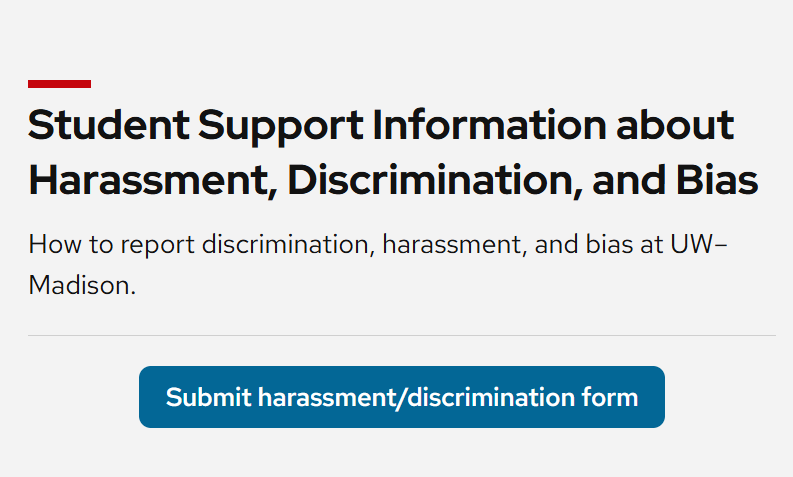
Earlier this year, the Foundation for Individual Rights and Expression (FIRE), a free expression advocacy group, reviewed the Office of Student Assistance and Support’s (OSAS) “Student Support Information about Harassment, Discrimination, and Bias” webpage. FIRE gives the page a “yellow light” rating, a designation for policies that restrict a limited amount of protected expression or whose vague wording could too easily be used to restrict it.
A major problem with the OSAS webpage is that it does not clearly distinguish between harassment, discrimination, and bias.
One part of the page describes reportable conduct as “unwelcome conduct that targeted someone based on their belonging to a specific group or ‘protected class.’” Further down the page, “Harassment and Discrimination” is defined as “Offensive or insensitive acts towards an individual, group, or their property that are based on their belonging to a specific group or ‘protected class.’”
The linked reporting webpage describes “Discrimination, Harassment & Bias” as conduct that adversely affects an individual’s employment, education, or participation in institutional activities or programs, or denies equal privileges or treatment based on protected status.
However, the Board of Regents policy cited there, Regent Policy Document 14-6, distinguishes discrimination from discriminatory harassment. The reporting webpage’s description closely tracks the policy’s definition of discrimination. The policy separately defines “Discriminatory Harassment” as “unwelcome…conduct that: is directed at an individual or group of individuals on the basis of…protected status…[and] is sufficiently severe or pervasive so as to interfere with an individual’s employment, education or academic environment or participation in institution programs or activities and creates a working, learning, or living environment that a reasonable person would find intimidating, offensive or hostile.”
These descriptions serve different purposes, but the OSAS webpage does not clearly explain how they relate to one another or distinguish reportable conduct from prohibited conduct.
In a comment to The Madison Federalist, Laura Beltz, director of policy reform at FIRE, explained, “By providing a definition of ‘Harassment and Discrimination’ that is different from the definition provided in other Wisconsin policy, students have no way of determining what is and is not prohibited and how to conform their behavior to avoid punishment.” Beltz added that because OSAS offers no clear definition of bias while encouraging students to report it, “students may reasonably be confused about what sorts of speech could be called biased and subject to investigation and punishment.”
In a comment to The Federalist, UW–Madison spokesman John Lucas stated, “UW-Madison is committed to providing a learning and working environment free from discrimination in compliance with all applicable federal and state laws and regulations.” He also stated that “For formal definitions, policies and procedures, students are encouraged to visit the Office of Compliance Civil Rights Investigations webpage: https://compliance.wisc.edu/eo-complaint/.”
Although the OSAS page links to that webpage, it does not explicitly identify it as the source of formal definitions, policies, and procedures or explain how its own descriptions relate to those standards.
Lucas also explained that the university’s reporting system serves purposes beyond identifying formal policy violations. Students may report incidents because they want support, wish to raise concerns about an instructor’s teaching, or simply want the university to maintain a record of an interaction. He added that “only a limited number of reports are assessed as a potential policy violation that could lead to a formal investigation.”
Providing support to students who have been hurt by discriminatory conduct is certainly commendable. The OSAS page describes support services and optional next steps, and the linked reporting webpage explicitly identifies support and resources as the form’s primary goal. Nevertheless, the distinction between seeking support and initiating a disciplinary process could be clearer. The OSAS page discusses possible formal investigation immediately after defining harassment and discrimination, before readers reach the “Student Support” section.
Lucas’s assurance that only a limited number of reports are assessed as potential policy violations does not fully resolve the uncertainty created by the webpage. The page states that even single or isolated incidents may be formally investigated if they meet its stated threshold, while encouraging students to report conduct ranging from microaggressions to degrading language. It should explain more clearly that reporting such conduct does not, by itself, establish a policy violation.
Although using different definitions for different purposes is not, on its face, unconstitutional, unclear distinctions can discourage what Beltz describes as the “sorts of conversations college students should be having, in order to learn more about other viewpoints and refine their own positions. Instead the lack of clarity risks chilling protected speech.”
Beyond their inconsistency, some of the university’s definitions also raise concerns about their breadth.
In Davis v. Monroe County Board of Education, the Supreme Court established a standard for holding a school liable for damages under Title IX for deliberate indifference to known student-on-student sexual harassment. The Court held that such conduct must be “so severe, pervasive, and objectively offensive, and that so undermines and detracts from the victims’ educational experience, that the victim-students are effectively denied equal access to an institution’s resources and opportunities.” The decision addressed institutional liability for damages; it did not establish a universal constitutional test for every university harassment policy or disciplinary action.
FIRE nevertheless argues that Davis supplies the appropriate standard for university policies governing peer harassment. According to FIRE’s website, “As the Court’s only decision to date regarding the substantive standard for peer harassment in education, Davis is controlling on this issue.”
FIRE notes that universities “very often” define harassment as conduct that is “severe or pervasive” and objectively offensive, rather than conduct that is “severe, pervasive, and objectively offensive.” Under the Davis damages standard, severity and pervasiveness are both required, alongside objective offensiveness. FIRE argues that using the broader formulation in campus speech policies risks encompassing protected expression.
As Beltz explained, “A lot of speech involving protected statuses…could be considered objectively offensive, and sometimes severe. Repeated discussions about these topics could also be objectively offensive and pervasive. The Supreme Court’s standard from Davis allows breathing room for these sorts of discussions by requiring that speech also has to be objectively offensive and both severe and pervasive to be punishable as harassment.”
The OSAS webpage, for example, states that conduct may be investigated when it is “so subjectively and objectively offensive and is so severe or pervasive that it limits or denies a person’s ability to participate in or benefit from the university’s education program or activity.”
RPD 14-6, titled “Discrimination, Harassment, and Retaliation,” similarly uses “sufficiently severe or pervasive,” alongside requirements concerning interference with employment or education and an environment that a reasonable person would find intimidating, offensive, or hostile. It applies to students and employees and expressly requires protection of First Amendment rights. Its departure from the Davis formulation does not, by itself, establish that it is unconstitutional.
Nevertheless, FIRE’s concern deserves a specific response: How does the university ensure that its broader reporting descriptions and harassment standards do not encompass protected speech or discourage difficult discussions between students?
The objective requirement is particularly important because it prevents the subjective experience of the person reporting conduct from being the sole determinant of whether that conduct constitutes harassment. Both the OSAS webpage and RPD 14-6 include an objective component. The question is whether the university’s guidance adequately explains that safeguard and the other requirements for a policy violation.
When asked how its policies relate to FIRE’s concerns and the Davis standard, the university stated, “UW-Madison policies and procedures are consistent with federal law. As a public university, UW–Madison is, as a matter of both law and institutional values, dedicated to the First Amendment of the United States Constitution and values freedom of expression as an essential part of its educational mission.”
That commitment is welcome, but the university’s guidance should explain how it works in practice. Students should be able to distinguish between conduct they may report for support and conduct that could warrant investigation or punishment. Clear definitions and a clear explanation of that distinction would help the university support students while protecting the expression essential to its educational mission.
