

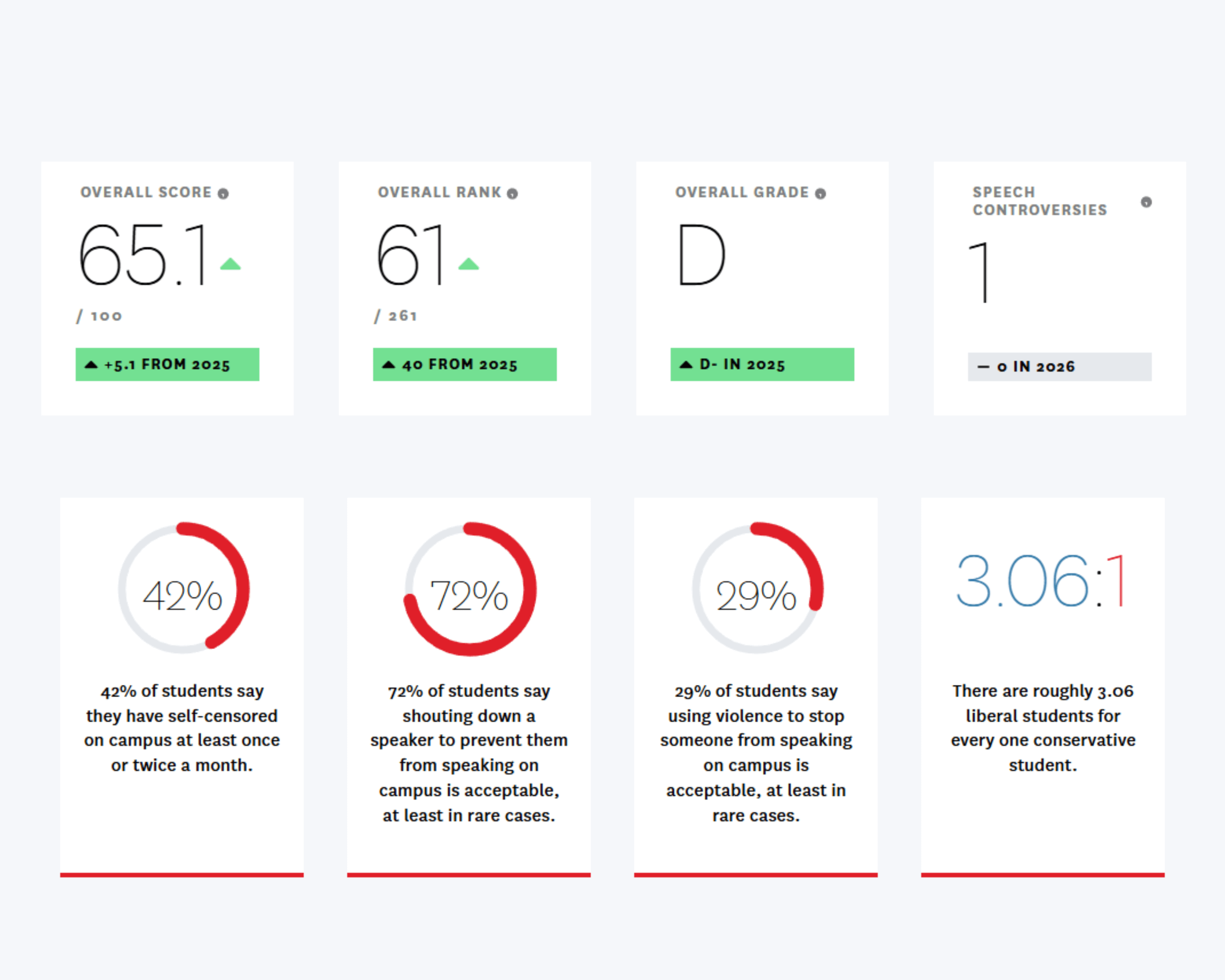
The Foundation for Individual Rights and Expression recently released its 2027 college free speech rankings, placing the University of Wisconsin-Madison 61st out of 261 colleges and universities.
The placement represents a 40-place increase from UW-Madison’s 2026 ranking. FIRE’s rankings draw on student survey responses, university speech policies and documented campus speech controversies to evaluate each institution’s free-speech climate.
UW-Madison received an overall score of 65.05 and a D speech-climate grade, an improvement from the D- it received in the prior ranking. FIRE reported gains in comfort expressing ideas, disruptive conduct, administrative support and openness.
The university earned a C+ in disruptive conduct, its highest category grade. It received a C in openness, D grades in comfort expressing ideas and self-censorship, a D- in administrative support and an F in political tolerance. FIRE reported that political tolerance was unchanged from the prior year, while the self-censorship score declined.
In FIRE’s survey, 42 percent of UW-Madison respondents said they self-censor on campus at least once or twice a month. One anonymous student from the Class of 2025 said they felt “as a conservative student” they had to suppress their own opinions “nearly every day in classes and on campus.”
The survey also found a 3.06-to-1 ratio of liberal to conservative respondents. Those figures describe the survey sample and should not be treated as a census of the student body.
The ranking arrives after several prominent campus disputes over speech and protest. In April 2025, Students for Justice in Palestine protested an event featuring former United States Ambassador to the United Nations Linda Thomas-Greenfield at the La Follette School of Public Affairs. The protest included disruptions inside Shannon Hall and demonstrations outside the venue. UW-Madison later suspended the organization for alleged violations of university policies.
UW-Madison could improve their ranking by reforming several “yellow light” policies containing “ambiguous language that could be used to suppress student speech,” according to FIRE in a comment to The Madison Federalist.
FIRE also cited a broader problem: Students have a reluctance to share views they believe may be unpopular. FIRE recommended “programs to teach students how to engage in respectful, rational debate and dialogue, even with those they ardently disagree with,” to promote political tolerance.
UW-Madison is covered by the Universities of Wisconsin’s 2015 free-expression statement, which closely aligns with the principles of the University of Chicago’s Statement. The university also points to its long-standing “sifting and winnowing” metaphor coined by UW President Charles Kendall Adams that has come to represent the pursuit of knowledge through differing ideas and perspectives.
When asked for comment, the university affirmed its support for “the freedom to exchange, consider, and challenge different ideas.” University officials also pointed to revised student protest guidelines, the implementation of free expression training for new students, and The Wisconsin Exchange, which aims to promote civil discussion in a “polarized world.”
“As a public university UW–Madison is, as a matter of both law and institutional values, dedicated to the First Amendment of the United States Constitution and values freedom of expression as an essential part of its educational mission.”
Another recent dispute involved registered student organization Animal Advocacy. The university opened an administrative investigation because of flyers with a QR code that linked to material describing plans to enter Ridglan Farms and remove dogs. University officials said the review was administrative rather than criminal, while Animal Advocacy denied that its materials encouraged illegal conduct.
FIRE and the Animal Activist Legal Defense Project criticized the investigation and urged the university to end it. UW–Madison concluded that Animal Advocacy was not responsible for soliciting burglary on July 7. The university did find the group responsible for an improper-posting violation related to posters for a separate speaking event and issued a written reprimand and educational sanction.
FIRE’s results show that UW-Madison’s overall ranking has improved, while concerns about self-censorship and political tolerance among surveyed students remain. Whether the university’s policy changes and newer dialogue initiatives affect those measures will become clearer in future rankings.
