

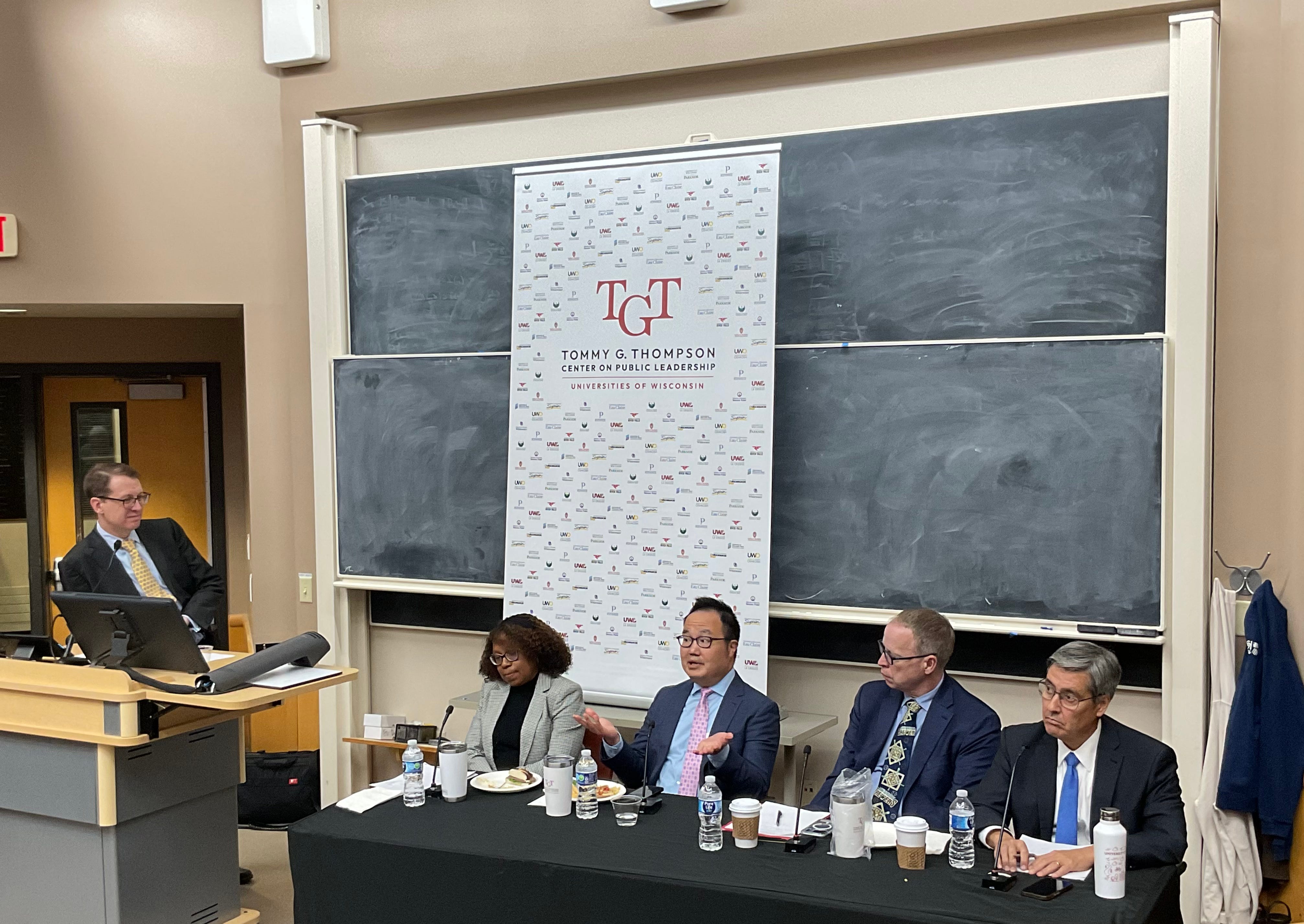
Four faculty members at the University of Wisconsin-Madison participated in a wide-ranging conversation about faculty’s academic freedom, free expression and campus climate on Oct. 23.
The Open Inquiry event was sponsored by the Thommy Thompson Center and the Wisconsin Exchange and was hosted at Grainger’s Mordridge Hall. The panel included Provost and Executive Vice Chancellor for Academic Affairs John Zumbrunnen, Law School dean Dan Tokaji, Professor of Poetry Timothy Yu, and Associate Professor of Constitutional Law Franciska Coleman.
The conversation was centered on the Thompson Center’s faculty survey, which examines the ideological composition of tenure-track and tenured faculty, attitudes toward hiring, perceptions of campus climate, academic freedom, and experiences with expressing controversial opinions.
Alex Tahk’s survey included many findings applicable to the discussion of faculty viewpoint diversity. First, it found that faculty who identify as liberal outnumber those who identify as conservative. The survey found nearly two-thirds of assistant professors identify as “liberal” or “extremely liberal” compared to less than half of tenured faculty. This pattern could reflect either generational change, career-related shifts, or both. Following this, faculty who are conservative are more likely to feel uncomfortable expressing themselves academically.
In addition, a large majority of conservative faculty believe someone with conservative views would feel “not at all” or only “slightly” welcome at UW–Madison, while none said conservatives would feel “very” or “extremely” welcome. These results could have stemmed from the hiring process, where faculty reported they would be significantly less likely to support hiring a candidate who expressed a conservative view compared to one who expressed a liberal view.
Meanwhile, the survey also found that more conservative and libertarian professors taught economics related academic fields. It found that 24 percent of faculty in econ related fields identified as some degree of conservative, compared to under 4 percent in other social science fields.
When looking at the views of non-white faculty, a surprising finding was that Asian faculty were more likely to be conservative than non-Asian faculty by 7 percentage points. This result demonstrates that faculty of color may contribute to greater ideological diversity.
Following faculty expressing political viewpoints, immigration is the most striking concern. Thus, when hiring faculty members, 45 percent said they would be less likely to hire a candidate who expressed that “the U.S. should strictly limit immigration and deport those who are here illegally.”
In contrast, if a candidate expressed the view that “the U.S. should allow immigrants without legal status to remain in the U.S. and offer a path to citizenship,” only 7 percent said this would make them less likely to hire, showing a substantial difference of 38 percentage points.
In terms of academic expression, faculty were more supportive of freedom when the public was the source of objection than when colleagues in the field objected, particularly for teaching.
Faculty also gave weight to professional peer judgment in defining the boundaries of acceptable academic work. The differences between “public objection” and “colleague objection” versions are statistically significant for both research and teaching. Most faculty still support substantial freedom even in the face of professional peer judgment, with majorities favoring “quite a bit” or “a great deal” of freedom except when colleagues object to teaching.
During the event, all four faculty members on the panel provided significant insights regarding the findings of the survey. When addressing the first amendment being exercised within the university, having an inclusive and welcoming environment, and fostering intellectual pluralism, Yu responds by stating that it plays a crucial role in incentivizing speech, yet this depends on the groups that back up the expression and support you in it.
He expanded on his comments when discussing the conservative views of Asian faculty, which clashes with the assumptions that certain political beliefs automatically come with racial identity. When talking about how welcoming the campus climate is, academic freedom, and ideological pluralism, Yu highlighted the importance of encouraging the pursuit of truth and people feeling welcome to express their viewpoints on campus without fear of retribution from the university, as that can produce conflict and tension.
Tokaji further commented on how the university should incentivize diverse expression by leveraging respectful disagreement as part of efforts to change the culture on campus.
The panel debated what principles should guide the university in thinking about when it’s appropriate for faculty to express their political views. Zumbrunnen responded on the institutional consequences where people should first be aware of why one should express them in the classroom. He also expands on faculty choice in expressing them if it benefits students.
If this were the case, it may strengthen the academic pluralism and freedom for faculty to comfortably teach and mentor their students with more feeling of welcoming and inclusiveness.
The panel then discussed the relationship between demographic characteristics and intellectual perspectives with faculty of color. Coleman emphasized from her research that there’s different suppression of speech that impacts faculty of color through censorship, particularly targeting those who are conservative. Although censorship provides protective measures if these speeches involve racism, it inhibits the range of opinions individually that faculty of color may have that would dilute the university’s pluralism.
