

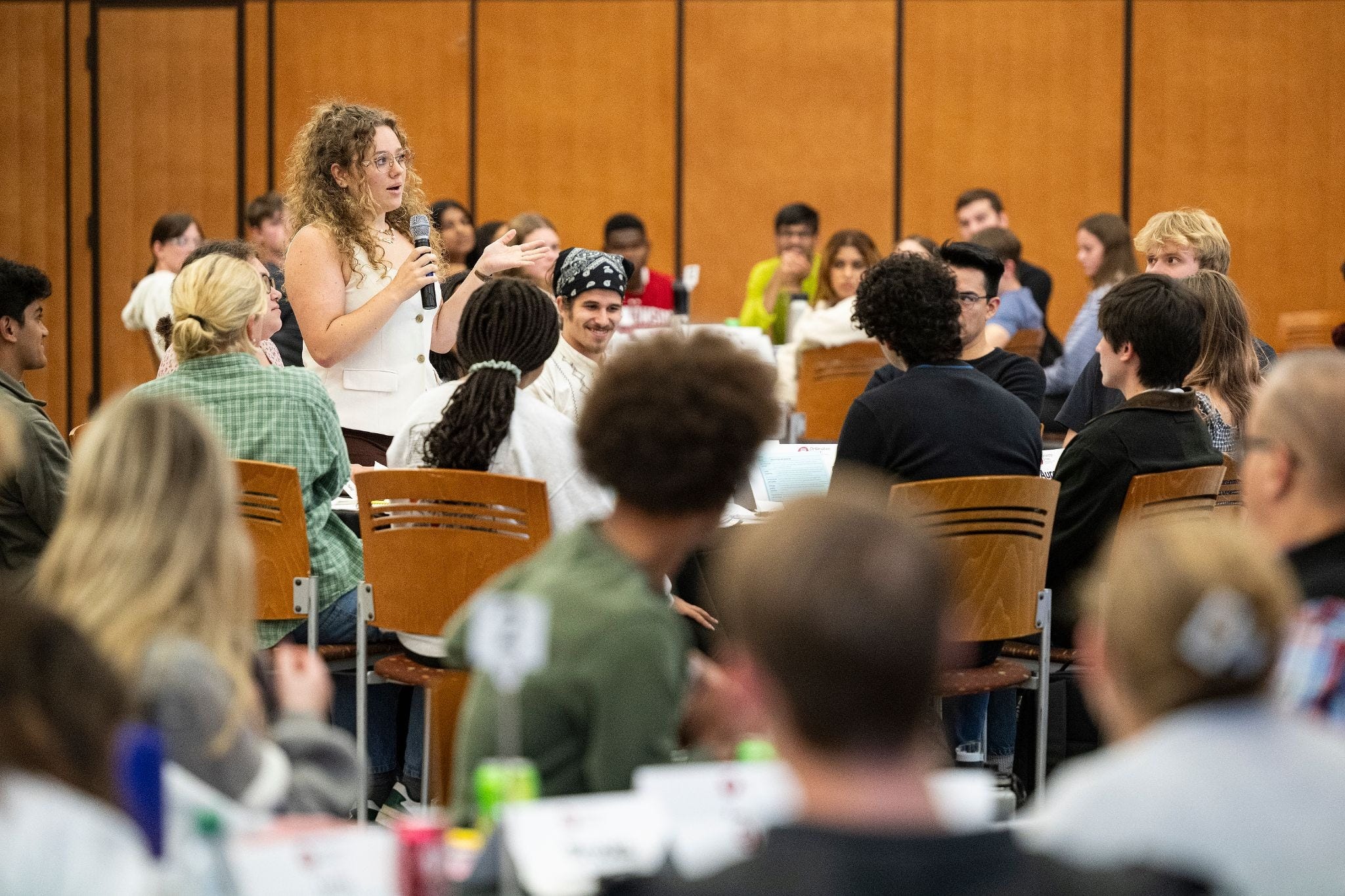
Politics can be a divisive subject for college students, but some believe that sharing a meal around the dinner table can provide an environment for productive conversation.
The Deliberation Dinners program engages undergraduate students at UW-Madison in discussion about controversial political issues throughout the school year.
Over the course of six dinners, one each month from October to March, students have a chance to expand their knowledge of politics and discussion skills, especially with people with whom they may disagree.
The Deliberation Dinners were developed by The Discussion Project, a UW-Madison program dedicated to training university instructors to initiate meaningful discussion in the classroom. The Deliberation Dinners program was first founded in 2023 by Diana Hess, dean emerita of the School of Education and the principal investigator of The Discussion Project.
Last year, 365 undergraduate students participated in the dinners, according to the annual summary. This year the program plans to host a similar number of students, and in the future, they hope for up to 500 students.
Sarah Bendorf, a sophomore studying accounting at the Wisconsin School of Business, has been involved with the Deliberation Dinners for one year.
“I really did enjoy each of the dinners and left them feeling empowered because I knew my voice was heard,” Bendorf told The Madison Federalist via phone call. “Everyone was just really welcoming and understanding.”
She first applied to the Deliberation Dinners after receiving an email about the program because she wanted to meet more people during her freshman year.
Applications for the 2026-2027 dinners opened August 24, according to Akshay Manna, a student assistant with the Deliberation Dinners program. Students who apply will provide demographic information and take the Political Typology Quiz from the Pew Research Center to categorize them into one of the nine political types, which include “conservatives,” “moderates,” and “liberals.”
This anonymous information is used to ensure each table of 10 to 12 students has diverse beliefs for a stronger discussion. “It’s really important to us that at each table there is political diversity and diversity of ideas and opinions represented,” Manna said.
Bendorf said she leans more conservative in her political beliefs. “Coming into the situation, I knew that there wasn’t going to be a lot of people that agreed with me on everything I said, but what I learned through these dinners is that even people that aligned, at the same level of the spectrum, when they took that survey, even they didn’t agree,” she said.
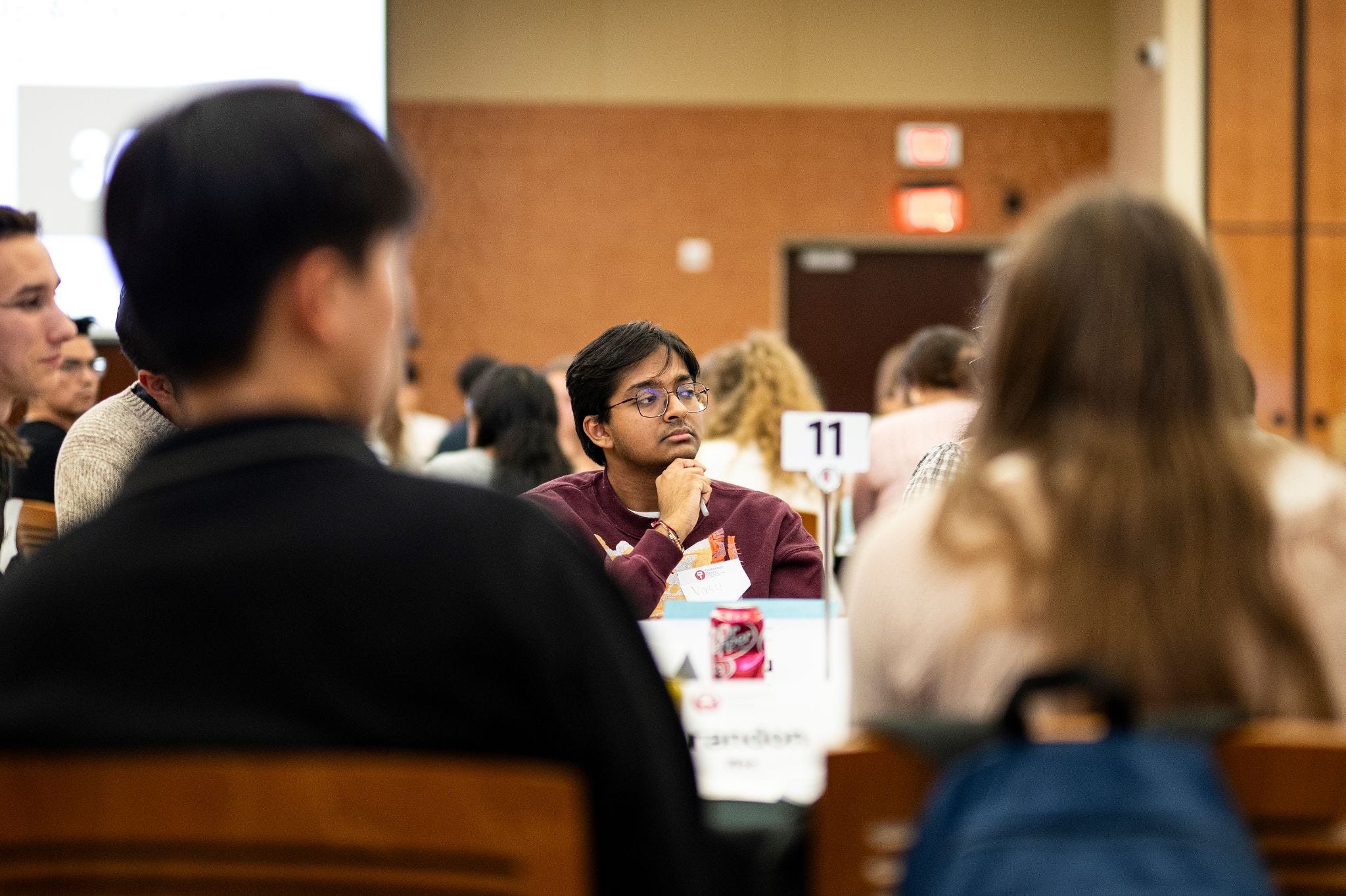
After accepted students are placed into a group, they are matched with a trained UW-Madison instructor who acts as the facilitator for each table. This approach is what sets the Deliberation Dinners apart from other national small groups that discuss political issues: They are intentional about incorporating political diversity at each table and ensuring a trained facilitator is present.
Students remain with the same group and facilitator for all six dinners to help foster relationships. “As the time went on, we all got really close,” Bendorf said about her group. “We were able to talk more freely. We would see each other outside of these dinners and be friends and have fun, so that was a cool experience for me.”
Along with the students in the program, there are 36 facilitators who go through training from The Discussion Project to be able to moderate and engage discussion on controversial issues. The facilitators represent seven different schools and colleges within UW-Madison.
Ajay Sethi, a professor of Population Health Sciences, has been involved as a facilitator of the Deliberation Dinners for the past two years. This fall will be his third year.
In a statement to The Federalist, Sethi described how the dinners impact both him and the students at his table. “After each dinner and before I go to bed, I reflect on the conversation and deliberation skills that I tried to help students develop and think about the improvements I’ve seen and how I might guide them at the next dinner,” Sethi said.
“Other than being a guest lecturer in various classes, I don’t teach or advise undergraduates, so I’ve enjoyed serving as a facilitator and getting to know the students who have been at my table both years,” he said.
Katherine Cramer, the Virginia Sapiro Professor of Political Science at UW-Madison, was a facilitator during the program’s inaugural year and currently serves on the advisory board for the Deliberation Dinners.
“I have been enormously impressed with the wide range of opinions I have heard voiced during these discussions, the skill students have developed in asking questions of and learning from each other, and the satisfaction they have shown in discussing controversial issues in an intense and yet respectful way,” Cramer said in a statement to The Federalist.
“I am more convinced than ever that talking about public issues in a respectful and productive way is a skill that can be cultivated, that it can be enjoyable, and that students on our campus have the appetite to learn about each others’ views and have others learn about their own,” she said.
The goal of the dinners is not for all participants to come to a consensus, but rather to deliberate. “Deliberation, more specifically, is a discussion that answers the question, ‘What shall we do?’ — without requiring or seeking consensus,” according to the program’s website. “The work is in listening to understand and ensuring everyone has a voice.”
Sethi believes the dinners are “a nice opportunity to bring students together to share their own and listen to others’ perspectives on a variety of subjects.”
“One time, I asked students to visualize deliberation, as opposed to debate, as a conversation occurring between people who have different perspectives but are on the same team,” he said. “I asked them to think about how talking to their own teammates might sound and feel different from talking to members of a different team.”
Similarly, Cramer said the Deliberation Dinners “provide an opportunity for students on our campus to develop skills to encounter and reflect on a wide variety of perspectives on important public issues, learn more deeply about those issues, and clarify their own beliefs and stances on those topics.”
To help students prepare for each dinner, they are provided with 15 to 20 pages of background reading on the topic. The program has a writer who drafts and revises the reading before sending it to experts on campus and then to interest groups.
The background reading for the abortion topic was sent to Planned Parenthood and the Wisconsin Right to Life to get comments from both sides so there is “equal footing with information,” according to Lynn Glueck, the program director of the Deliberation Dinners. Then the background reading is revised and sent to the students to prepare for the dinner.
“I’ve appreciated the neutrality and educational value of the reading materials that are created for each deliberation,” Sethi said. “They’ve always included some content or perspectives that are not top of mind. Listening to students and how they think (and how they think about thinking) has been wonderful.”
Sethi said facilitators meet before and after the dinners to brainstorm how to help students improve their “deliberation skills.” Facilitators are given the years and majors of the students at their tables to help them “learn about any perspectives and opinions they may have on various topics we discuss.”
Sethi and Cramer both noticed growth with the participating students throughout the course of the program.
“Some start out as better listeners than others. Some more naturally lead with curiosity while others improve that skill over time,” Sethi said. “Some have a harder time distinguishing deliberation from debate at the beginning. In both years I’ve participated, I’ve noticed growth and improvement among the students assigned to my tables who make it to the majority or all of the dinners.”
Cramer also noted the evolution she saw in her students. “I observed the students at my table evolve from strangers with each other, to students who were slightly wary of each others’ views, to inquisitive discussion participants, to friends who were deeply respectful of each other and proud of the fact that they had developed that mutual respect,” she said.
Bendorf also recounted her experience as a student during the dinners. “The first few meals were difficult just because we were a new group of people talking about a lot of personal experiences,” she said.
“It’s just kind of cool to see that and see how I don’t have to be one-sided all the time, and I could ebb and flow and have varying ideas and positions on certain topics,” she said.
Professor Aja Watkins, assistant professor of philosophy at UW-Madison, was the facilitator at Bendorf’s table. “She was really great at leading our discussions and sort of helping us all make sure our voices were heard,” she said.
Monet Walvoort is another student who participated in the Deliberation Dinners program this past year. Walvoort is a sophomore studying Elementary Education at UW-Madison.
In a statement to The Federalist, she said that “the atmosphere was comfortable and inviting, which made it easy to converse with other students and share my opinion.”
Although Walvoort said attending the Deliberation Dinners was out of character for her, she “felt enriched with knowledge and community” and wants “to continue attending over the next few years.”
Each of the issues for the six dinners will be released monthly, and over the course of the program, the issues become even more “contentious,” according to the Deliberation Dinners program. The political issues must be salient, have political authenticity, and must be open-ended with several perspectives.
The first dinner will begin this October with a topic related to voter identification requirements. Some of last year’s issues included marijuana legalization, gun regulations, abortion policies, and U.S. immigration criteria.
During the discussions, Bendorf said “there’s a lot of compromise that is willing to be made.”
After disagreements on these issues, Bendorf said she received the most “thank yous” after the dinner. “People making comments, like, ‘Hey, you had a really good point there and it made me see things in a way I’ve never seen it before,’” she said.
Walvoort similarly believes the dinners encouraged her to put herself in other’s shoes and have a better understanding of “where someone might be coming from” when discussing opposing views. “It is a skill often overlooked, as a lot of times people see empathy and understanding as a weakness rather than a tool for collaboration and peace,” Walvoort said.
Bendorf was also able to use information she learned from the dinners in other situations. “I would go around campus, I would see sort of the same similar discussions show up in other spaces, even less formally. I would be able to use facts that another table mate would share during one of the dinners and bring it to this discussion, which was kind of cool because you’re just expanding your source of knowledge and being able to look from different points of view,” she said.
“I have a lot of respect for the people around me, a lot of respect for the people that put this on and were in charge, and I’m really grateful that I was able to have this experience,” Bendorf said.
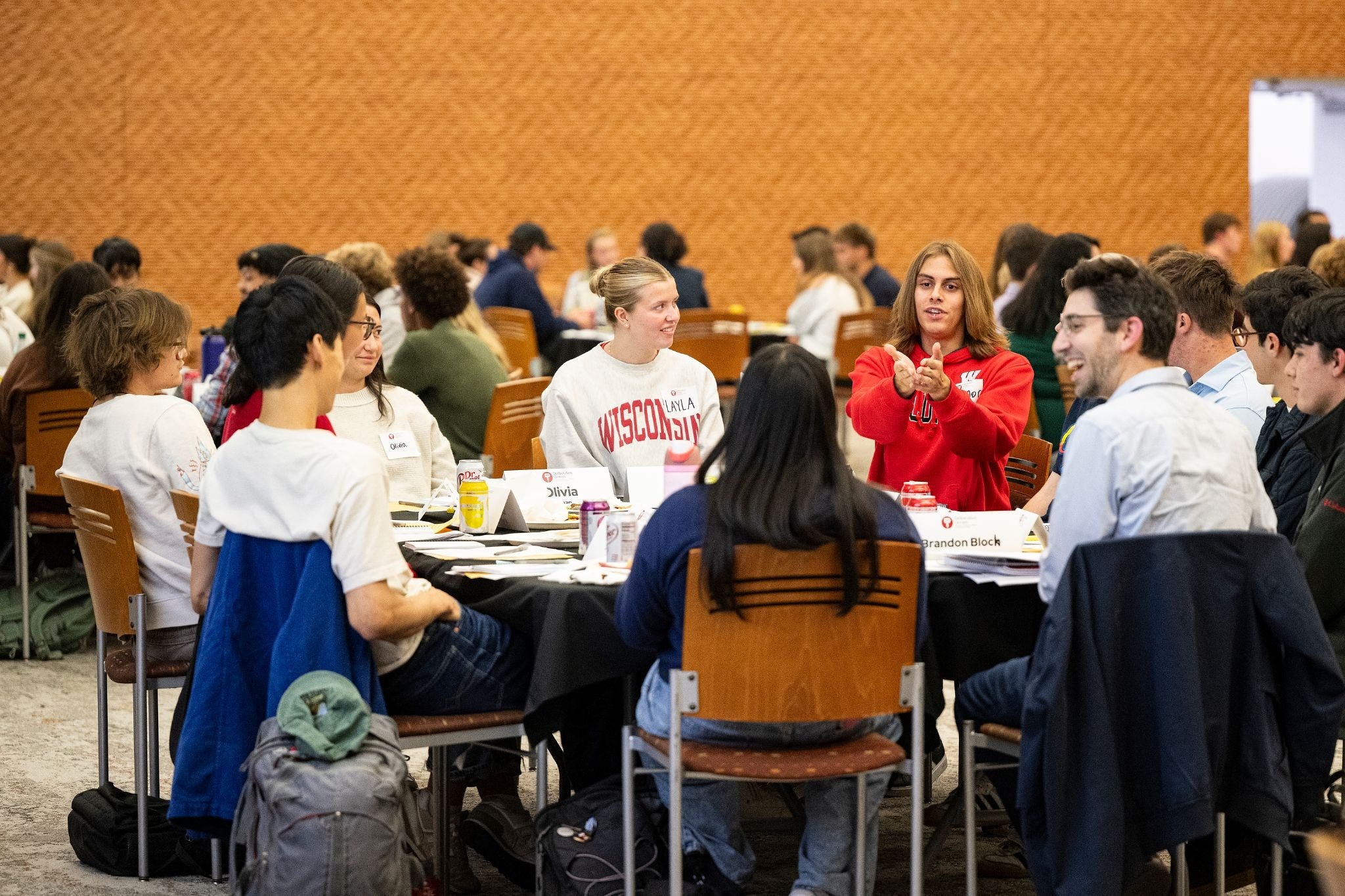
Since the beginning of the Deliberation Dinners in 2023, the Wisconsin Evaluation Collaborative has conducted independent evaluations of the program. The program’s effectiveness is measured through student pre- and post-program surveys and post surveys for the facilitators, according to the Deliberation Dinners program. After each dinner, students must also complete an exit ticket survey which collects feedback to improve the experience and assess what the students learned.
Walvoort said the program has a positive effect on campus discourse, and she “would highly recommend the program to other students who want to grow their critical thinking skills as well as their ability to openly talk to new people while considering their differing perspectives and opinions.”
“It is encouraging to know that even when your views differ from your peers, collaboration and meaningful discussion are still possible.”