

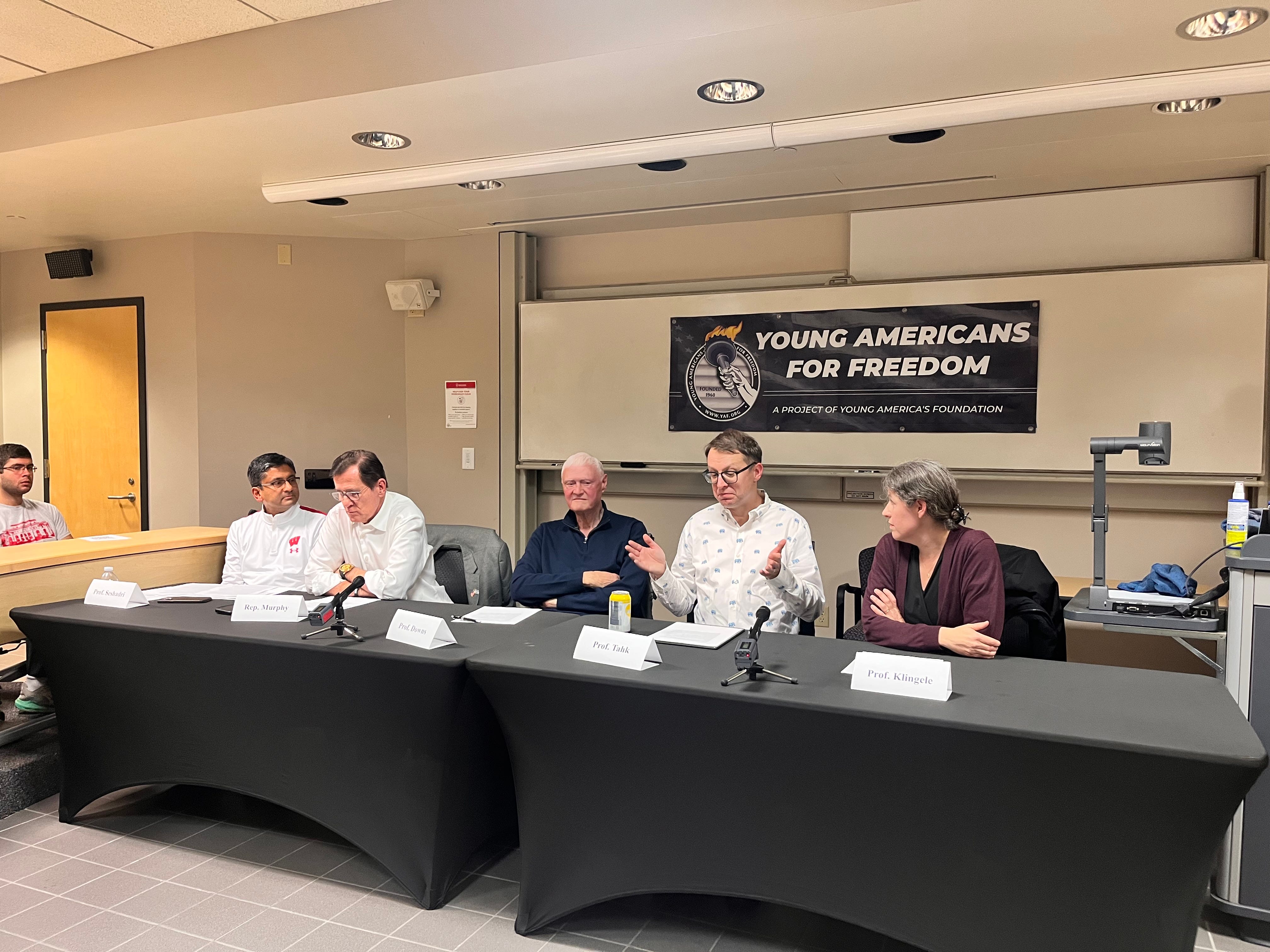
On October 15th, UW-Madison’s Young Americans for Freedom (YAF) chapter hosted a panel examining ideological diversity in higher education and concerns about the campus’s overwhelmingly liberal political culture.
The discussion, moderated by YAF Chairwoman Courtney Graves, brought together five panelists with extensive experience in university governance and campus political life. The panel featured Cecelia Klingele, UW Law professor and director of the Center for the Study of Liberal Democracy; Alex Tahk, associate professor of political science and director of the Tommy G. Thompson Center; Donald Downs, political science professor emeritus; State Rep. Dave Murphy, chair of the Assembly Committee on Colleges and Universities; and Ananth Seshadri, professor of economics and director of the Center for Research on the Wisconsin Economy.
Panelists began by outlining what they believe the purpose of higher education should be. Klingele opened by saying universities exist to pursue truth, which requires broad participation. “The goal of higher education is to try to find what is true and to promote the common good,” she said. “We need people to bring lots of different ideas and experiences to the table…so that we can sift and winnow appropriately.” She added that diversity on campus must include not only demographic representation but also “real people with a diversity of life experiences.”
Much of the discussion focused on ideological diversity, which panelists argued is increasingly limited at UW-Madison. Tahk defined it simply as the presence of “a diverse range of ideological perspectives on campus.”
Downs expanded on this, saying ideological differences include political beliefs as well as deeper philosophical commitments. Someone can hold strong views, he argued, while still being open to engaging with alternative perspectives. Downs said universities should function as “agents of social progress” by exposing students to a wide range of ideas. “We influence the world by helping to train people’s minds and teach them how to critically think,” he said. “That can only happen when they’re exposed to everything.”

Murphy argued that professors undermine their own educational role when their political leanings become too obvious to students. “If it’s painfully obvious to you what the point of view of your professor is, he’s doing a bad job,” he said. He suggested that faculty should be evaluated not by their activism but by their ability to present material neutrally.
Seshadri warned that campus environments dominated by a single ideology function as “echo chambers.” He defined ideological diversity as including “political, philosophical, and worldview perspectives” across faculty, students, and staff. Without a balance of views, he said, students risk entering the world with “untested beliefs, unchallenged assumptions,” and less preparedness to navigate real-world disagreement. “It’s not about endorsing every view,” he added. “It’s about humanizing the other.”
Seshadri pointed to long-term research on organizational performance, arguing that viewpoint diversity is more academically valuable than demographic diversity alone. “A 40-year review…finds viewpoint diversity reliably boosts performance,” he said, claiming the effects of demographic diversity are often “negligible or negative.”
Panelists also addressed the pressures conservative faculty and staff may experience on campus. Klingele said research suggests non-tenure track academic staff skew further left than faculty, which can create the perception among conservatives that they must conceal their views. “Among those who are not, I think there’s tremendous pressure or often a perception that there’s a need to hide themselves in that environment,” she said.
Tahk said such self-censorship undermines academic integrity. “If you shade your truth, then you’re basically committing a form of intellectual fraud,” he said. When people soften or hide their views “to not get in as much trouble,” he argued, the quality of academic work declines, and merit “becomes the fatality.”
Downs drew on political philosopher Allan Bloom to describe what he views as the deeper threat. “The greatest tyranny isn’t that which outright says you can’t say this,” Downs said, “but one in which it makes certain thoughts unthinkable because they don’t even occur to you.” He argued that expanding the “Overton window”- the range of ideas considered acceptable in public discourse- is necessary for genuine intellectual diversity. The only way to change that, he said, is for those who value intellectual freedom “to make present our perspective about intellectual freedom and diversity.”
Throughout the evening, the panelists maintained that intellectual diversity is central to the mission of a university and essential to students’ development. They warned that when institutions allow one perspective to dominate, students lose opportunities to test their beliefs, understand opposing views, and cultivate the critical thinking skills that higher education claims to promote.
Seshadri, Klingele, and Tahk are all members of the Wisconsin Exchange’s steering committee. The full conversation can be viewed here.
