

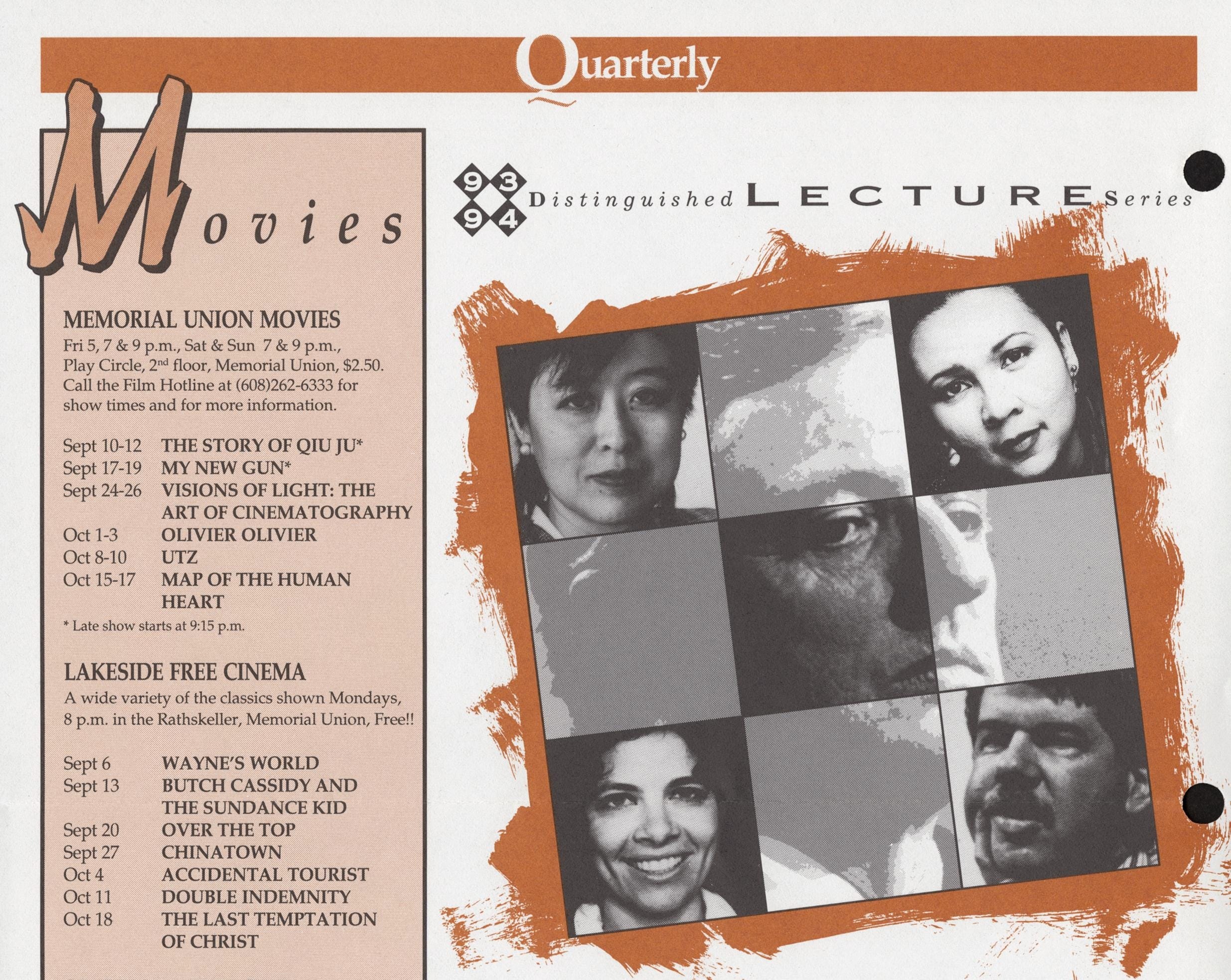
Political science professor emeritus Donald Downs believes William F. Buckley Jr. was “not only a key creator of modern conservatism, but its savior.” He discussed Buckley’s 1993 visit to the University of Wisconsin-Madison, his enduring legacy, and what conservatives today should learn from Buckley with The Madison Federalist.
Downs is the co-founder of the Center for the Study of Liberal Democracy and was a professor at UW-Madison for three decades. He is the author of multiple books, including Free Speech and Liberal Education and Cornell ‘69: Liberalism and the Crisis of the American University. Downs participated in a Young Americans for Freedom panel on intellectual diversity earlier this year, and served as the organization’s faculty advisor before he retired.
2025 was the centennial of Buckley’s birth, and 2026 is the 75th anniversary of his foundational book God and Man at Yale. Buckley visited Madison on multiple occasions, including a 1993 Distinguished Lecture Series appearance that Downs attended.
Downs said Buckley coming to UW-Madison at that time was akin to “Nixon going to China” or “Mamdani going to Trump.” While there was “a lot of buzz and concerns about protests,” the event went smoothly. When fellow conservative activist Phyllis Schlafly spoke on campus earlier that year, the event was accompanied by demonstrations.
“The Union theatre was jammed packed. My wife and I sat behind four young adults who hated Buckley and kept loudly saying hostile things while he spoke,” Downs told The Federalist. “My wife got in an argument with them when they shouted at her for asking them be less loud. It was a lot of fun.”
“I was close to the students who brought him in under the aegis of the Distinguished Lecture Series and joined the dozen people who had dinner with him at a now-defunct restaurant on State Street.” He said a student gave him the paper on which Buckley had written the speech and “was surprised to see that it was handwritten in small writing all crammed together with red ink revisions scribbled on it.” Downs was impressed that Buckley “was able to deliver a speech with such mellifluousness with this scribble as the blueprint. It was barely legible.”
“Another thing that made the event memorable was witnessing and interacting with the students who brought him in. I was so proud. It wasn’t only conservative students, though they were an important part of it, but also liberal and moderate students who wanted to juice up the intellectual vitality of the campus public realm. It was a sheer joy see their spirit and to teach some of them. Like-minded faculty built on that in years to come.”
“In those days, the student papers often challenged campus orthodoxies, especially the Badger Herald. It was UW-Madison at its best.” The Badger Herald was initially founded as a conservative publication and earlier hosted Buckley for a fundraiser in 1971. The Madison Federalist has since replaced the Herald as the conservative student publication in Madison.
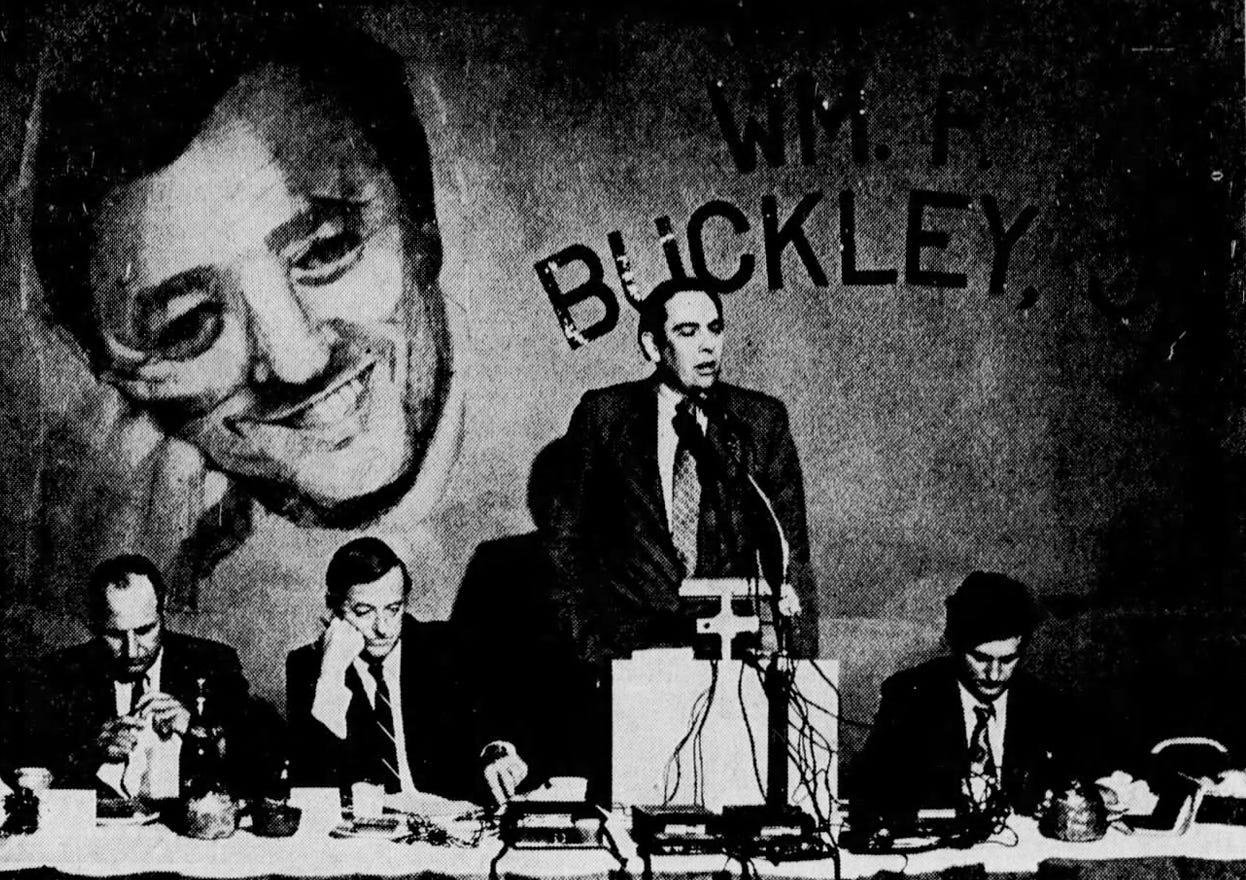
Downs said Buckley’s campus legacy is more apparent among student groups such as YAF than among faculty, “though I know several faculty who took his ideas seriously even when they disagreed. UW-Madison would be a more interesting and challenging place if we had more who did.”
Downs also reflected on Buckley’s broader legacy. “Before Buckley, conservatism was a floundering ideology and force that was marginal compared to the liberalism of the New Deal and the post-New Deal and World War II era. Along with other major figures like Frank Meyer, Buckley gave it a home and a voice that appreciated its different dimensions.”
Buckley made people take conservatism “seriously” and “its ultimate triumph was the election of Ronald Reagan in 1980, which embodied many of Buckley’s ideas and was loaded up with people who were influenced by him”.
Buckley was a pioneer in building conservative networks and institutions, such as National Review, which “hired many smart and dedicated thinkers and doers while creating networks of influence.” Meanwhile, the show Firing Line “featured not only him, but top-notch modern liberals who were willing to take him on. He was a public intellectual par excellence.”
Downs said Buckley’s conservatism was defined by a commitment to “freedom supported by a strong civil society that balanced progress with tradition. The latter includes family, freedom of religion, respect for excellence and achievement, and values of personal responsibility and patriotism. It also respects the need for government and national defense bounded by rule of law. Too much government suffocates this freedom, leading to the decay of free institutions.”
Downs also noted that a key part of Buckley’s legacy was the expulsion of the “radical” John Birch Society from the conservative movement, which was “McCarthyistic and oppressive.” Downs said, “Buckley realized its inclusion in the movement violated core principles and that its inclusion would pull the conservative movement down with it.”
“Today, conservatism faces a similar challenge from the right with the likes of Tucker Carlson and Nick Fuentes challenging it from within by an aggressive form of racial nationalism,” Downs said. “Leading conservative figures like Robby George of Princeton have resigned from the Heritage Foundation over the foundation’s president tolerating them as part of the movement.”
“We seem to be living through a replay of the old dispute over the John Birch Society. Today’s challenge, sadly, is just beginning. It mirrors what is transpiring on the left in certain respects, as our policy frays.”

