

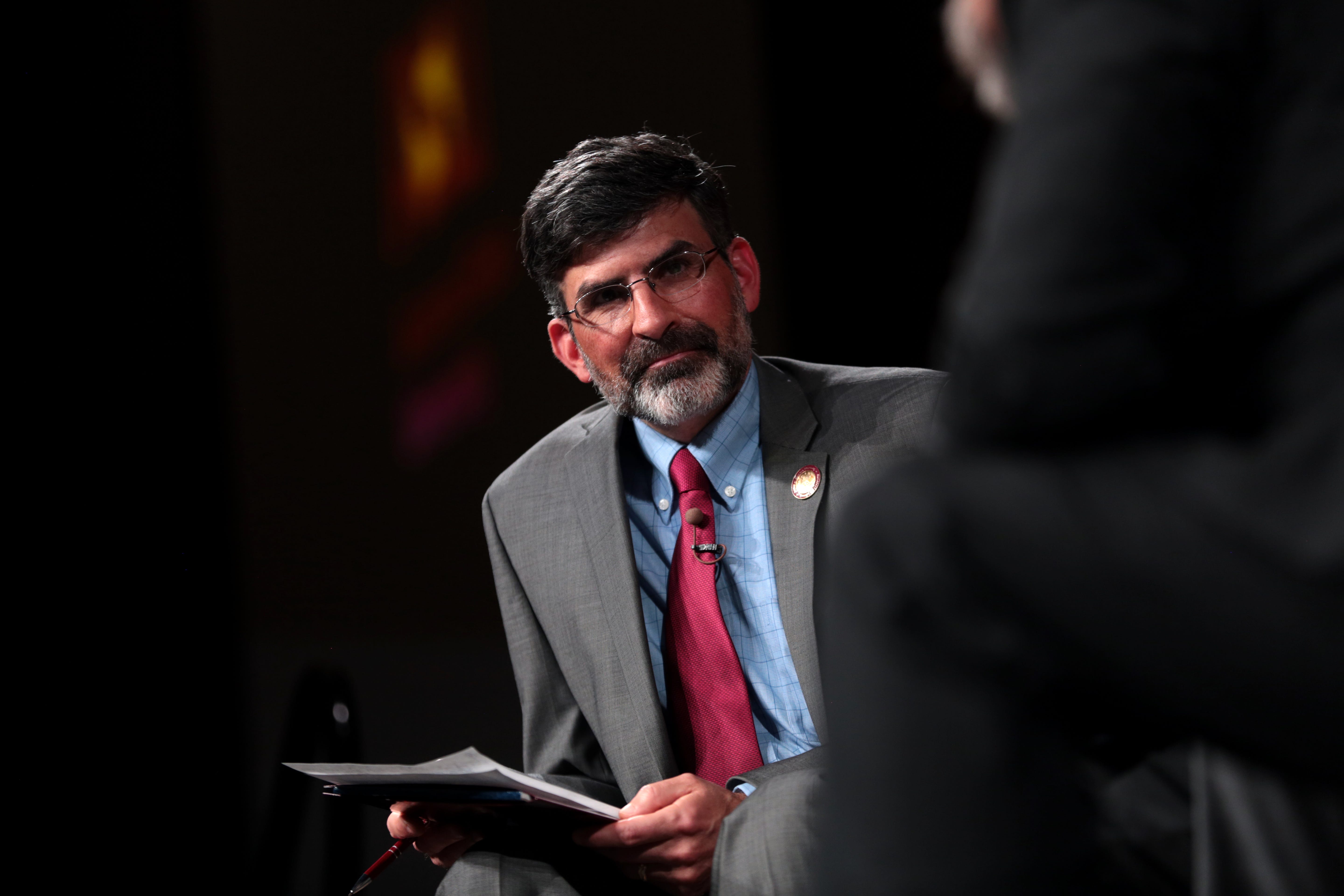
Professor Paul Carrese delivered a lecture on September 14 titled “The Constitution, Civic Education and Reflective Patriotism.” Carrese is the founding director of the School of Civic and Economic Thought and Leadership at Arizona State University. He recently published the book “Teaching America,” elaborating on the themes in his lecture.
Carrese’s Constitution Day lecture was the first in the Center for the Study of Liberal Democracy’s Civic Virtue Lecture Series. Law professor Cecelia Klingele introduced Carrese, noting that “days after commemorating the 25th anniversary of the event of 9/11, it seems … fitting that we begin this series with a discussion of a virtue that was on play in the weeks and months following the tragic events” of that day.
Carrese began his lecture by observing that the political culture of the country is not healthy, torn between extremes of “regularly violent political speech and political anger” and “civic apathy or civic disaffection”. He suggested that universities “should consider at this moment whether we are failing at civic education and citizenship education” which may be a cause of the rise of these harmful attitudes.
He observed that Constitution Day was instituted in 2004, after an awareness developed that the civic unity engendered by 9/11 was “cracking and deteriorating”. That trend, he noted, has only continued in the years since, “especially among Americans 35 and under”, citing a 2022 Quinnipiac poll indicating that 55 percent of people aged 18-34 would rather not “stay and fight” for the American homeland if it were invaded. He referenced a 2025 Gallup poll as evidence that among all age groups there has been a decline in patriotism.
Carrese suggested that academics in higher education should not disclaim responsibility for contributing to the increase in both violence and apathy and should work to remedy their causes. Carrese explained that the prevalent view in “research university culture” is that mere education about, “let alone encouragement” of civic attitudes is considered to be “indoctrination”.
Carrese indicated that this is potentially a serious problem because if the attitudes have “shifted in higher education, all of the teachers, no matter what subject … all the teachers and any school, as well as the principal as well as the board members” will adopt such attitudes. A shift in the educational institutions, he argued, is evidenced by “our declining, deteriorating specific culture” in the United States.
The remedy for these problems, Carrese proposed, was a proper educational program to address the “deficit of knowledge among younger Americans”. For him, it is a cornerstone of restoring the “civic virtue of reflective patriotism, American patriotism” which has, perhaps, been adversely affected by the “academic neglect of or even undermining” of it.
Carrese argued that because the Constitution sets up a complex structure and a republican form of government it “implicitly calls for a citizenship education in this kind of knowledge of virtues”. Alongside “reflective patriotism,” it includes the virtues of “civic friendship across … party policy”. Indeed, the separation of powers, as it “prompts argument within and across separate institutions” itself “implicitly calls for civic friendship” so that disagreements might be amicably processed and resolved.
The civic virtues of reflective patriotism and civic friendship, according to Carrese, must be paired with “civic education”. Carrese emphasized that the founding fathers “wrote regularly about the importance of educating the citizenry” in the principles underpinning the then new Republic. Carrese noted that George Washington, in both his first and his final annual messages, himself articulated the importance of civic education for the future of the nation.
“Our poor state in civic knowledge”, Carrese said, “calls for [the] University of Wisconsin-Madison and other leading universities and colleges to recover this kind of wisdom again”. Carrese suggested that it is necessary to “learn to disagree constructively and yet maintain civil bonds across deep differences”.
Carrese acknowledged that the picture he painted of America might seem bleak, but “to avoid despair” or even a “naïve optimism” the virtue of “civic hope in America” was required. Nevertheless, he said that it is difficult to rebuild.
He suggested that among the “glitters of hope” is the fact that several universities are undertaking projects to promote civic education, noting that the project he led at Arizona State University will celebrate its 10th anniversary this academic year. That type of project, he observed, “has spread to 13 states, 18 public university campuses”.
Carrese concluded by calling on the audience to exercise civic hope in America and to participate in the project to rebuild the virtues of reflective patriotism and civic friendship.
