

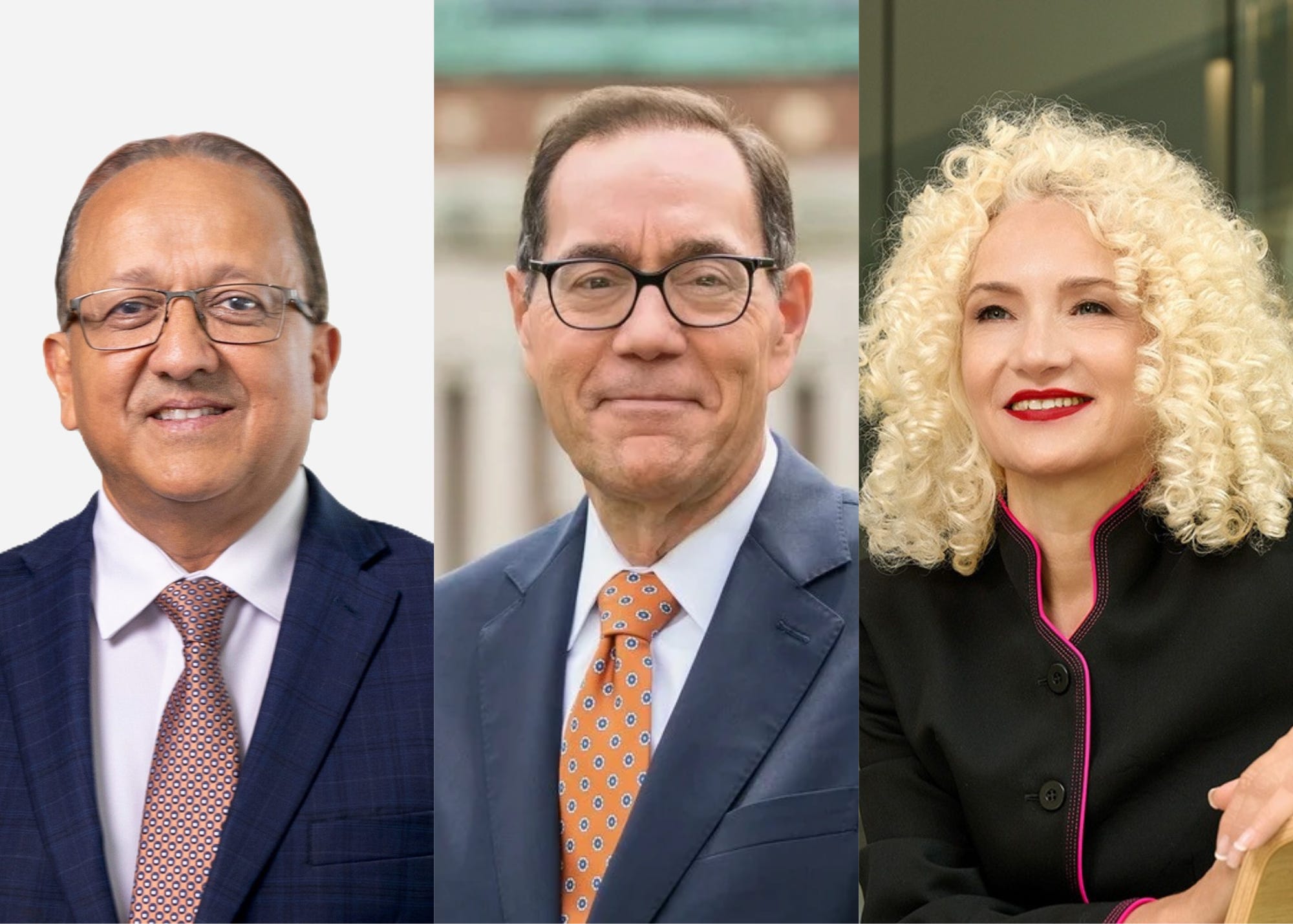
On Thursday November 5th, the University of Wisconsin-Madison chancellor special regent committee announced three finalists in the search for the university’s next chancellor.
The finalists were University of Illinois Urbana-Champaign College of Engineering dean Rashid Bashir, University of Illinois Urbana-Champaign provost John Coleman, and University of Connecticut president Radenka Maric. They each visited campus for public forums over the last week.
The Madison Federalist reviewed the backgrounds of each candidate’s record on free speech and intellectual freedom.
JOHN COLEMAN
Coleman is a former UW-Madison professor and chaired the political science department from 2007 to 2014. His work has mainly been focused on elections, campaign finance, and the relationship between congress and the president.
He has also been a strong supporter of free speech throughout his career, has written extensively about the effects that spending has on political campaigns, and has defended the free speech rights of both people and corporations to spend money in elections.
He has also made many statements in support of freedom of speech on college campuses. At the beginning of his tenure at UIUC, he announced that he wanted the school “to be a campus that models how there can be dialogue, even amidst passionate disagreement, across difference. Why wait for other institutions to figure this out? Let Illinois set the model for robust and productive dialogue and discussion.”
However, UIUC didn’t always live up to those expectations Coleman originally set. Earlier this year, the school came under fire in response to an investigation of an Instagram post by Illini Republicans, a conservative advocacy group at the school. The post “depicts a federal agent pointing a gun at a man kneeling on the ground with the caption ‘ONLY TRAITORS HELP INVADERS.’ The post also included a statement in support of U.S. Immigration and Customs Enforcement.”
UIUC took the position that the school was required by federal law to investigate the matter due to the Title VI complaints filed by students. “We have also received a high volume of Title VI reports related to the Illini Republicans posting and are required by federal law to review and process those reports,” Patrick Wade, the university’s director of executive communications and issues management said at the time.
However, the Foundation for Individual Rights and Expression sent multiple letters to the university arguing that the university wasn’t required by federal law to investigate the post. “Contrary to your assertion that UIUC’s actions were required by federal law, federal law does not require UIUC to establish or maintain any particular process for reviewing Title VI discrimination complaints. Nor does federal law require UIUC to publicly announce it is reviewing a social media post in response to complaints or publicly ‘condemn’ the content of the post.”
Coleman stood by the Title VI investigation into the instagram post. Meeting notes from UIUC’s February 9th senate meeting say “Provost Coleman stated that the University has publicly condemned the imagery and that reports have been referred to the Title VI Office and other appropriate offices for review in accordance with established procedures.”
At the same time, Coleman also recognized that the post was protected under the first amendment. The notes state, “Provost Coleman and Dean of Students Steven Bryan emphasized that the Office of Student Conflict Resolution and Title VI processes are addressing the matter, noting that the post is considered offensive but constitutes protected speech under the First Amendment.”
In his public forum last Thursday, Coleman took a strong view in support of freedom of expression on campus. “I am a very prominent defender of academic freedom and people being able to say what they want on a university campus,” he said. “It was a commitment to free expression and free speech that drove the teaching and the research that made this university amazing.”
He also talked about his personal experiences dealing with free speech controversies throughout his career. Likely referencing the Title VI investigation at UIUC, Coleman said, “Sometimes we are asked to do things that we couldn’t do. I’ve been asked to decommission registered student organizations because of things they said in public on Instagram. It didn’t violate any university policy. It was within their right to say it.”
In dealing with that situation, Coleman said, “We talk to them and say, the fact that you can say it doesn’t mean you have to. I mean, you can think about other ways to make your point, so let’s do that.”
RADENKA MARIC
Radenka Maric, the current president of University of Connecticut and finalist for the chancellor position, has also come under scrutiny because of how she has handled free speech rights on the UConn campus. Following the October 7th attacks on Israel and the subsequent conflict, many students protested Israel’s military actions in Gaza.
UConn has a tradition of allowing several “spirit rocks” around campus to be painted by the public. Naturally, these rocks frequently became the location of Pro-Israeli and Pro-Palestinian messaging and art. Such expressions concerned UConn’s leadership, including Maric.
According to UConn’s student newspaper, the Daily Campus, in October of 2023, Maric attempted to have UConn’s paintable rocks removed after students started painting pro-Palestinian and pro-Israeli messages. In a statement from a spokesperson, the university announced “With everything going on between Israel and Hamas, President Maric…believe[s] it would be in the University’s best interest to remove the rock entirely as we do not want to initiate any further tension amongst the UConn community.””
In the Fall of 2023, posters depicting what appeared to be Hamas fighters were posted around UConn’s campus, with captions like “resistance isn’t terrorism” and “liberation by any means necessary.”
In emails obtained by the Daily Campus, Maric voiced disagreement over the view that the posters were protected speech. “I’m afraid I have to disagree with the speaker from yesterday that the flyers with Hamas soldiers with automatic weapons on our campus are freedom of speech and with the message ‘By all means and resistance isn’t Terrorism’. We arrest students for yelling N world, and when students tell us how these posters affect and disturb them, we cannot say that is OK.”
According to her emails, she later ordered these posters taken down, however they never were. It is unclear why.
She also drew criticism for ordering university officials to “handle the Daily Campus position to deny the publication of any Op-Eds that do not align with the Palestinian (Hamas) narrative and the basic rule of journalistic integrity.”
This came after her vice president for communications, Michael Kirk, had written to her saying “The Daily Campus is student-funded and student-led and has historically operated as an independent journalistic publication that the university does not attempt to exercise control over.”
However, Maric has also adopted pro-free speech stances. Notably, in March of 2025, she testified before the Connecticut legislature’s Higher Education Committee in opposition to SB 980 “An Act Improving Safety on the Campuses of Institutions of Higher Education”, a bill that would restrict freedom of speech on campus by broadening the definitions of “hate speech” and “hate incidents” among other terms.
“UConn is required to comply with the First Amendment. UConn cannot prohibit, limit, or punish individuals based on their constitutionally protected free speech or expression rights. Even deeply offensive and vile speech, which we characterize as ‘hate speech’ is nonetheless protected speech under the First Amendment,” she said. “The proposed definition of ‘hate incident’ appears to include ‘hate speech’ as conduct which institutions should investigate and/or punish; this is something public institutions of education are constitutionally prohibited from doing. Speech which is not protected, such as that which rises to the level of a ‘true threat,’ or conduct that accompanies hate speech, is actionable under the law and our policies.”
Ultimately, the bill never made it out of its committee and was never put to a vote in the Connecticut legislature.
Similarly, at her public forum Friday, she expressed that “Giving [a] voice to everybody will not happen without free expression and inviting people to express themselves…free expression should never be stopped…The university should encourage curiosity and constant inquiry in pursuit of the truth….in order to pursue the truth…we have to have academic freedom and freedom of speech.”
Maric also raised concerns about the federal government’s increased pressure on universities and the public statements made by their administrators.
Appearing to reference the Trump Administration’s Compact for Academic Excellence in Higher Education, Maric said, “There is a lot of pressure now from the federal government…I will share with you that we [will] never embrace neutrality policy. Because we still believe that there are events that are happening outside of the campus, that our community has a strong say or strong feelings about events that happen.”
RASHID BASHIR
Bashir, the third finalist for the UW-Madison chancellor, is the dean of the college of engineering at UIUC. A native of Pakistan, Bashir moved to the U.S. with his brother when he was 15 years old.
Bashir spoke at UW-Madison on Monday in a wide-ranging discussion that covered topics such as Artificial Intelligence use, freedom of speech, and the culture on campus. On AI, Bashir seemed receptive to the concerns that many students have over AI use on campus. He described it as a “really good assistant” while also acknowledging that “when it comes to learning, and sort of core understanding of basic concepts, it can be very risky. It can make someone look like they know a lot more.”
Bashir also expressed strong support for freedom of expression on campus. “It is a responsibility of everybody that every student feels safe, no matter what their background is, no matter what their situation is, where they’re coming from.”
He also discussed the environment on campus. In reference to the recent reports of sexual assault and hazing on campus, Bashir said “We need to create a culture of safety and a culture of making sure ... this never happens.”

