

This essay was also published with The College Beat on Bishop Robert Barron’s Evangelization & Culture Online found at www.wordonfire.org.
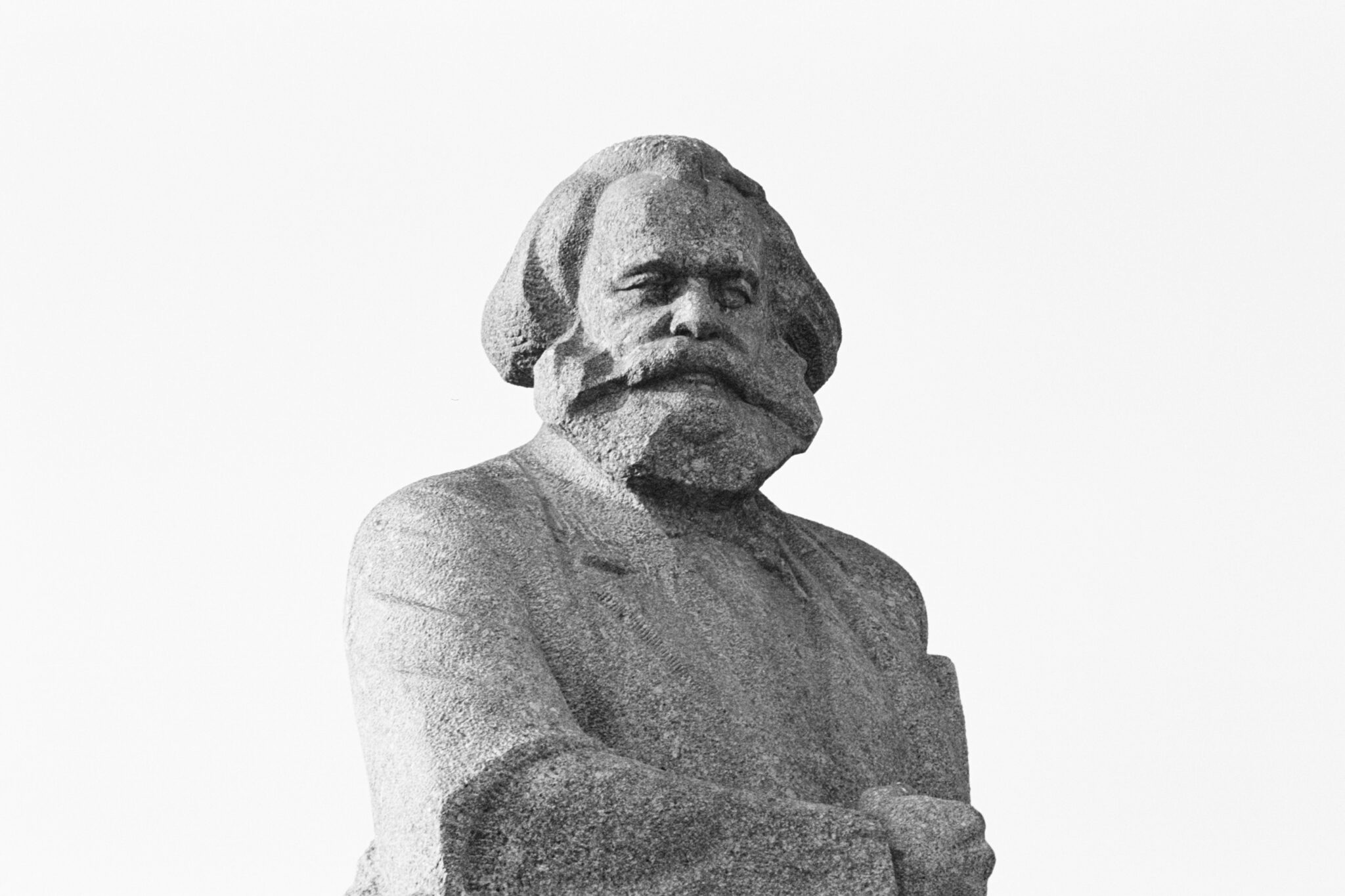
In my early high school years, I became interested in Marxist thought through TikTok videos. The ideas presented to me seemed obvious at the time—things any reasonable person would believe. Marxism was about uplifting the working class: a goal that felt selfless to believe in. It seemed completely normal to believe in things like the common ownership of the means of production and the abolition of private property.
I was far from the only young adult attracted to the ideas of Marxism. New statistics come out all the time, but a 2020 poll from the Victims of Communism Memorial Foundation found that 30 percent of people ages 16–23 viewed Marxism favorably. Catholics should take this seriously. In his 1937 encyclical Divini Redemptoris, Pope Pius XI said, “Communism . . . strips man of his liberty, robs human personality of all its dignity, and removes all the moral restraints that check the eruptions of blind impulse.” When young people grow up uncritically exposed to these ideas, they will naturally become more tolerant of injustices they believe are done for the pursuit of some higher end. Pope Francis noted this phenomenon in his 2020 encyclical Fratelli Tutti: “Today, in many countries, hyperbole, extremism and polarization have become political tools. Employing a strategy of ridicule, suspicion and relentless criticism, in a variety of ways one denies the right of others to exist or to have an opinion.”
Although Marxism is a viral and accessible ideology, it is far from being good or true.
One of the biggest reasons why Marxism is so attractive is because it is actually ridiculously simple. At the same time, its terms are crafted in a way to make it sound complex and deep to anyone not familiar with the ideas. For instance “dialectical materialism” sounds complex and academic, but it really just means that economic conditions can affect history.
The basic Marxist pitch today goes something like this: People profiting from owning the things that other people use to make money is bad. This is because the person who owns that thing didn’t work in the same way the actual worker did. Because the person who owns the thing (e.g., a factory) profited from someone else’s work, the owner must be taking advantage of the worker! After all, the worker would probably keep all the money for himself if he were able, and the only reason he isn’t able is because the first guy “owns” the thing that the worker uses to make money. Therefore, if the workers just get rid of ownership altogether, the workers will have more money!
The Marxist pitch uses a form of the “foot in the door” technique. Instead of jumping immediately to grand ideas about the eternal struggle between capital and labor or the necessity to abolish private property, the pitch starts with more palatable ideas, such as business owners taking advantage of vulnerable workers. However, it ends with the necessity of a revolution of the working class and the abolition of private property. This technique pairs well with modern social media algorithms, which often present ideas in a similar format. In this way, Marxism almost seems like it was created for social media. In today’s internet, someone with a moderate interest in strategy games might find their social media algorithms quickly filled with content on the virtues of chess and the mind-numbing simplicity of tic-tac-toe; in a similar way, someone with a God-given conviction to love the poor might soon find themselves inundated with content on the virtues of the late Second Spanish Republic or Mao’s Great Leap Forward.
Although Marxism is a viral and accessible ideology, it is far from being good or true. Pope Leo XIII’s encyclical Rerum Novarum points out the essential flaw in Marxism’s most basic idea: The private ownership of the means of production exists as the owner’s “wages under another form.” To deny the owner of that property is to deny the owner of their ability to use their wages to better their position in life. Rather than naming a purely institutional culprit for the evil in the world, the Church points to the failure of people to live up to their duties to love their neighbor and to treat them with dignity. As Leo XIII observes,
The first thing of all to secure is to save unfortunate working people from the cruelty of men of greed, who use human beings as mere instruments for money-making. It is neither just nor human so to grind men down with excessive labor as to stupefy their minds and wear out their bodies.
Though it is good and just to point out where Marxism is wrong, my reversion to the Church came a few years ago after many people in my life prayed for me for a long time. One thing that viral movements like Marxism do not have on their side is a genuine love and respect for the human person, which is far more obvious and meaningful than any number of TikToks from even the most savvy ideologues.
Catholic social teaching explicitly recognizes the love of God and the infinite dignity he has bestowed upon every human, whom he has made in his image and likeness. These two facts build on each other to reveal to us our call to charity. Pope Benedict XVI wrote in Caritas in Veritate, “Charity is at the heart of the Church’s social doctrine. Every responsibility and every commitment spelt out by that doctrine is derived from charity which, according to the teaching of Jesus, is the synthesis of the entire Law.” This commitment to charity makes Catholic social doctrine far more grounded than Marxism could ever hope to be. Although Marxism does claim that workers should be afforded some level of dignity, this is quickly forgotten when people are used as means to the end of the communist utopia.
Most of the problems of political life today stem from our inability to engage in genuine dialogue with people we disagree with.
Today’s political and technological environment allows nearly everyone in our society to be exposed to the scandal and hatred often common in the world of politics. Just as in every other area of life, the Church offers hope for politics. In Fratelli Tutti, Pope Francis called for a new culture of political and social love:
Only a gaze transformed by charity can enable the dignity of others to be recognized and, as a consequence, the poor to be acknowledged and valued in their dignity, respected in their identity and culture, and thus truly integrated into society. That gaze is at the heart of the authentic spirit of politics. It sees paths open up that are different from those of a soulless pragmatism. It makes us realize that the ‘scandal of poverty cannot be addressed by promoting strategies of containment that only tranquilize the poor and render them tame and inoffensive. How sad it is when we find, behind allegedly altruistic works, the other being reduced to passivity.’
The establishment of a culture of political and social love can be achieved through dialogue that includes, as Fratelli Tutti describes, “readiness to give and receive, while remaining open to the truth.” Most of the problems of political life today stem from our inability to engage in genuine dialogue with people we disagree with. The way we engage in technology today only leaves us more isolated while providing an illusion of connection with others. As Pope Francis wrote, “We are growing ever more distant from one another, while the slow and demanding march towards an increasingly united and just world is suffering a new and dramatic setback.” Such a large calling must start small. If we wish to establish a culture of political love, we must find the strength to engage and dialogue face-to-face with those we disagree with; we must find room for charity in our hearts and communicate it to them in a way that is authentic and invites them to a deeper relationship.
The social doctrine of the Church is in some ways more difficult to accept than Marxism because people will always find it easier to convert society to their ideal vision than to convert their own hearts to God. However, as the Church looks to evangelize in this new age of social media, we will attract the most people through standing by our convictions. The Church offers a message of divine love and hope that is attractive in any age, and it is clear that most of the ideas that we compete with today are merely shallow ideologies with no real foundation. In my experience, Marxism falls apart in the face of authentic charity. The Gospel message is as effective an antidote to human evils as it ever was.
if you want to claim to understand marxism then actually quote marx. this article may lead the reader to believe the only thing you've read is top 5 pope quotes on a-z quotes and that you 'learned' marx solely on tiktok