

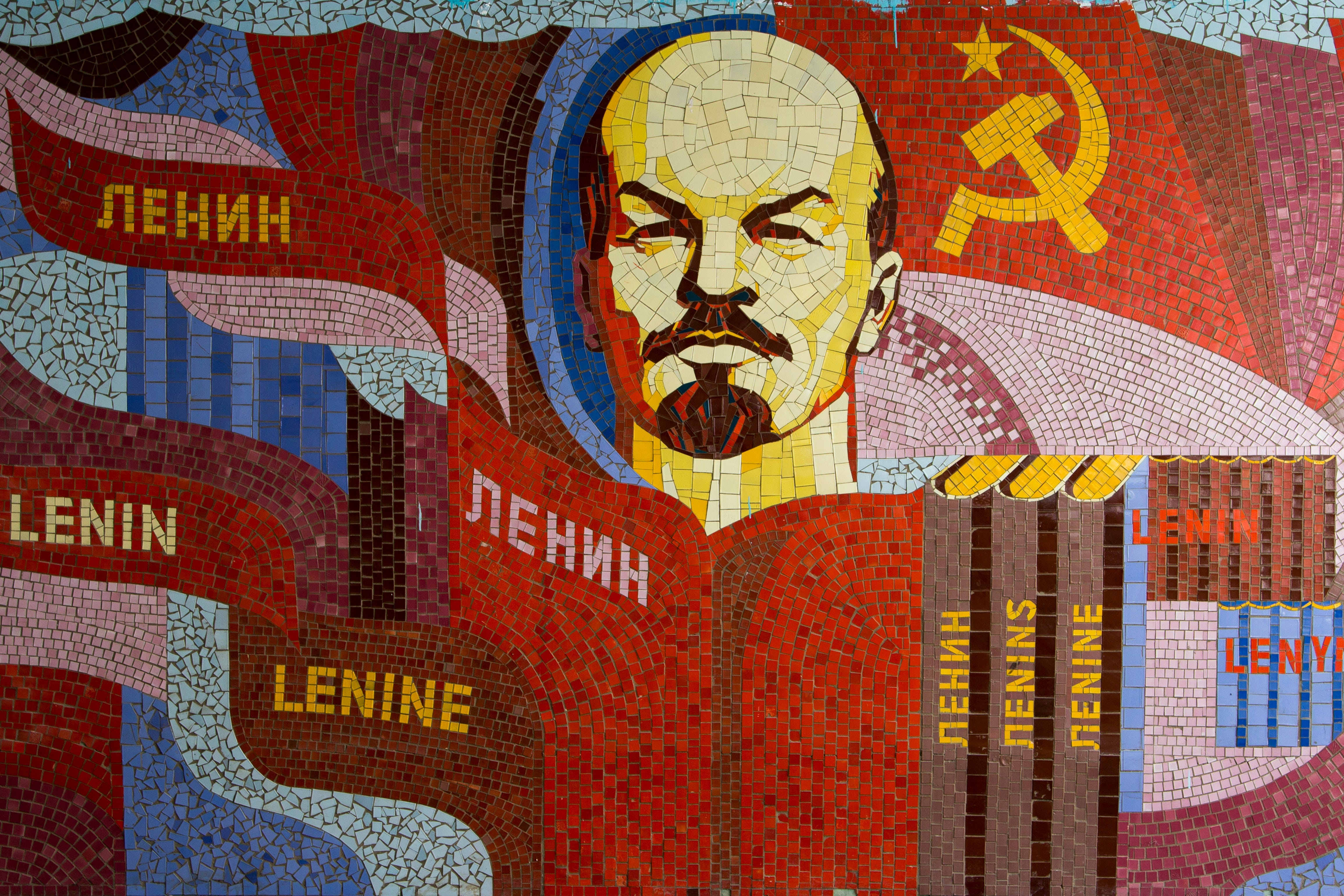
On Monday, September 21, the Revolutionary Communists of America (RCA) held a public meeting at College Library to examine the efforts of the Corey Ruiz protests and the subsequent encampment. Analyzing past attempts to organize and challenge the capitalist system, members pointed to a Marxist revolution as the country’s only option.
Committed to spreading revolutionary communism, the comrades focused on their disdain for the present. Led by comrade Mary Deck, a 2023 graduate of the UW-Madison Mead Witter School of Music, the meeting touched on various topics, namely the ills of capitalism. “The years of the U.S. being the world’s sole superpower are over. Capitalism, which once was the most revolutionary force on the planet, has produced its own gravediggers. And for nearly a century, the world has been ripe for socialist revolution.” Members expressed frustration. “Over time, conditions have become so untenable. People try so many methods, anger builds up, and then a straw can break the camel’s back.”
Affiliated with Revolutionary Communists International, the RCA Party’s objectives include the complete overthrow of capitalism, fighting for a world of material superabundance, rejecting a profit-based system, establishing a workers’ government (to tackle the capitalist roots of war, inequality, oppression, and climate catastrophe), and improving workers’ lives. Together, revolutionaries dedicate themselves to the implementation of such a society.
The meeting consisted of several undergraduate students, graduate students, and workers. A majority of those present identified themselves as members, which RCA calls “comrades.” Those who have agreed to sign up for the organization are expected to fulfill the role of revolutionary leadership, becoming “an apparatus, a force that revolutionaries can use to spread these ideas, to convince larger sections of the working class and to win them over to the perspectives, not just to put up a big fight against the system, but to actually overthrow it.”
The comrades discussed the aftermath of the Corey Ruiz demonstrations.
The July shooting of Ruiz by a police officer shook the City of Madison. Protests surfaced almost immediately after the incident. What began as a memorial for mourners and protesters soon turned into an encampment. An entire intersection was held hostage for two weeks, preventing traffic flow and harming local businesses, until city officials intervened.
Members mentioned the significance of the Madison “working class” holding the intersection for as long as they did. “People were able to go to this vigil…they were able to go there and feel like they were safe.”
The Corey Ruiz movement took lessons from the George Floyd protests; racism was deemed the sole proprietor. “Before the founding of the United States, the ruling classes on this continent have wielded racism as a weapon to split the exploited masses and keep them from uniting in struggle against their oppressors. The racial basis of chattel slavery was a conscious choice by the ruling class, which was frightened and threatened by uprisings from below. And the ruling classes effectively use racism to tamp down revolutionary struggles. It’s infected every facet of life in modern capitalist society.”
For the Revolutionary Communists, the Corey Ruiz movement has “represented a striving of exploited and oppressed layers uniting and struggling against the racist system of police terror. It [has shown] us a small glimpse of the revolutionary potential that lies buried beneath the surface of the working class.”
The group presented various complaints surrounding the failed encampment, blaming seemingly everyone except themselves. They claimed that the movement “demonstrated the profound weakness of leadership on the left in Madison,” including politicians’ lack of loyalty to the socialist movement.
Criticizing Francesca Hong’s past leadership, Deck paused to “imagine, for a moment, if we’d had a real socialist candidate, someone who told the truth about the fundamental ties between the unlivable crisis of capitalism and its reliance on force and repression to maintain the social order. Someone who could call on all the radicalizing youth and workers to put real pressure on their unions and organizations to prepare for a general strike. Someone connected to a larger apparatus built by the most class-conscious and militant layers of workers in youth and society, with no reliance on the enemy class.”
Though leadership stifled much of the movement, Revolutionary Communists maintained heightened levels of aggression. “Masses of working people who attended these protests chanted fuck the police, who bravely faced down tear gas, who defended each other, and looked to the example of our neighbors in Minneapolis.”
The movement’s failure was also attributed to protesters’ lack of awareness of the specific demands raised by Party leadership. Without a clear perspective, people became exhausted, mentally and physically. “Not only are we living through the worst cost of living crisis that we’ve seen in decades, but also, I mean, it’s not that long ago that everyone was out on the streets protesting against ICE.”
The Revolutionary Communists spent their time discussing the need for societal upheaval and the mobilization of the working class as a catalyst for revolution. “We have to prepare and we have to ensure the victory of these revolutions. But we also cannot get too big of heads about this. We alone cannot spark the revolution. We cannot make it happen. Our role is to make sure that it succeeds.”
For a group that feels as though the very social order threatens their way of life, remedy does not come through politicians that “move from the pole to the extent that their leash allows them to move from,” it comes from the working class. Members state that revolution will — and is coming — soon. “It’s gonna be weird to not have the opinion that we need an entirely different system at some point.”
The group points to the 1917 Russian Revolution, “one of the greatest moments in history,” as their guiding light. “There was a lot of impatience, and the Bolsheviks forged themselves out of a lot of the youth. They realized that they needed to base themselves on the working class, a force that was actually capable of transforming society. And they actually recognized the inevitability of revolution…We need to take power for ourselves. We need to understand how to actually seize power.”
Members directed fellow Revolutionary Communists to attend their Marxist schools, weekend-long seminars filled with programming for revolutionaries to dive deeply into the fundamentals of Marxist philosophy, revolutionary history, and strategy. A “training ground for Bolsheviks,” those who attend will prepare to organize the end of the capitalist system.
The presence of this group on campus may be a warning sign of the left’s fracturing coalition. Jenna Lawrence, co-president of the College Republicans of UW-Madison, shared her thoughts. “Any group is allowed to have meetings and share ideas. I don’t support their agenda, but they’re open to having meetings. I do think it’s concerning — the ideas that are spreading — but I would hope common sense thinkers will dismiss them.”
At present, the RCA’s resources are directed towards acquiring as many members as possible and ensuring that those members are as educated as possible. The group has grown its influence in Madison and plans for further growth by “winning over” the working class. “You need to be trying to coordinate strikes…learning these lessons faster than normal people and bringing them forward to the people who are already a little bit disillusioned, a little bit uncertain…that we can at least start to influence. And once we have numbers, we are going to have a much greater ability to bring these ideas forward and get people to listen to them. We are in a position of being in a country where capitalism was able to unnaturally prolong its existence and hold over society… so much of that is also on these foundations which are rapidly eroding.”
The Revolutionary Communists of America’s spread across the country demonstrates widespread ideological tumult, with Madison following closely behind. “And so I think that this is what we need to take away from, not only the recent events, but also the distant past, is that what is missing right now is a revolutionary party.”
