

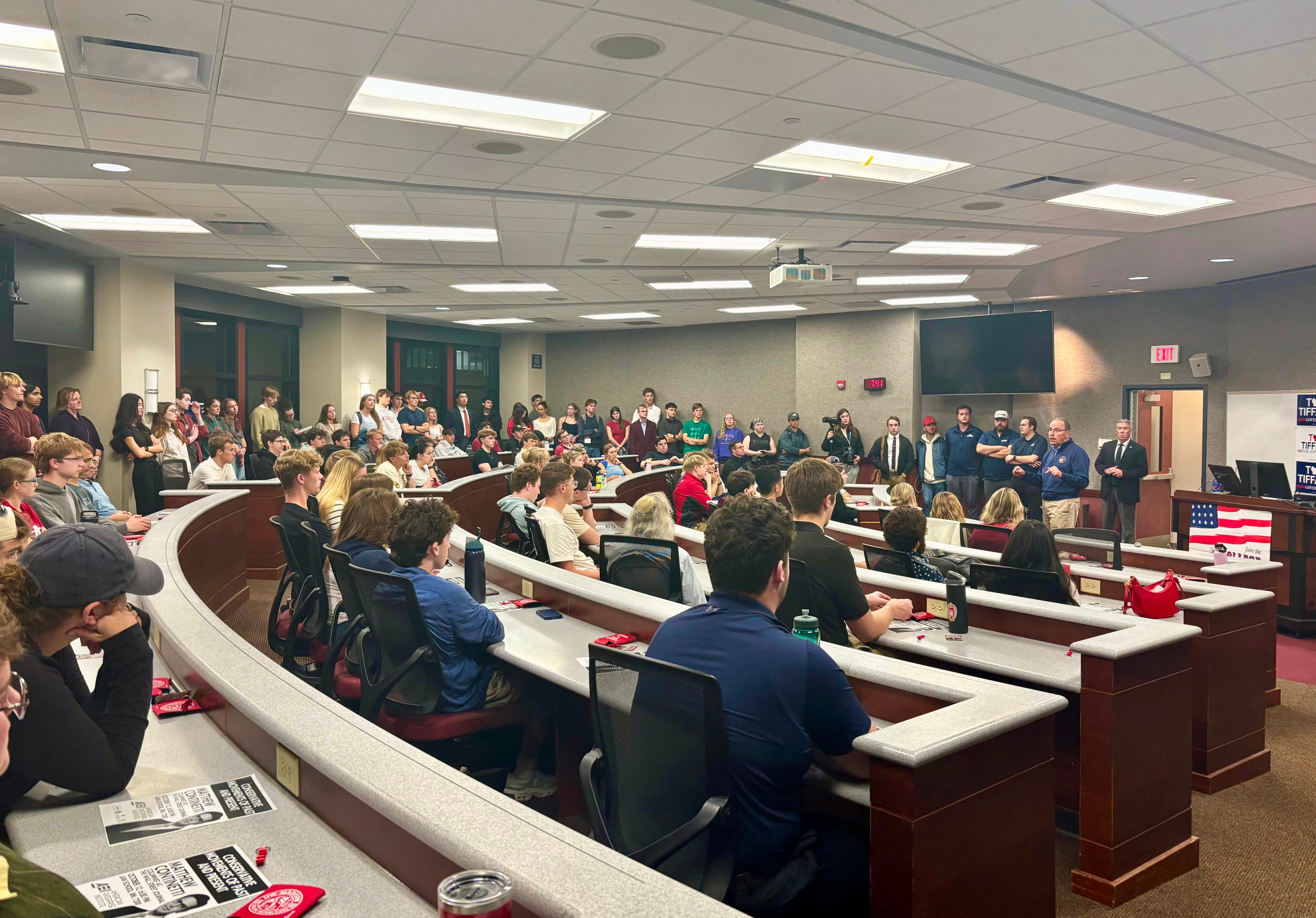
On Wednesday, October 7th, U.S. Representative and Republican gubernatorial nominee Tom Tiffany met with students at an event hosted by UW-Madison College Republicans, outlining his vision for Wisconsin ahead of the November election.
Addressing an audience of students, Tiffany emphasized economic relief, housing affordability, education reform, and government accountability, arguing that state leadership must do more to help young people build their futures in Wisconsin.
The event opened with remarks from incumbent Wisconsin State Treasurer John Leiber, who encouraged students to vote Republican all the way down the ballot.
“Vote Republican all the way down the ballot. Don’t just stop at the top.” Leiber said, emphasizing the importance of voter turnout in a competitive state like Wisconsin. He urged students to recognize their potential influence on the election, and work toward making Wisconsin “a place where young people cannot just live, but also succeed.”
Tiffany echoed that message, arguing that rising costs and state policies have made it increasingly difficult for young Wisconsinites to establish themselves. He said Democratic leadership has left the state deficient where it was once strong; property taxes, utility costs, education, and government spending were all cited as requiring significant reform.
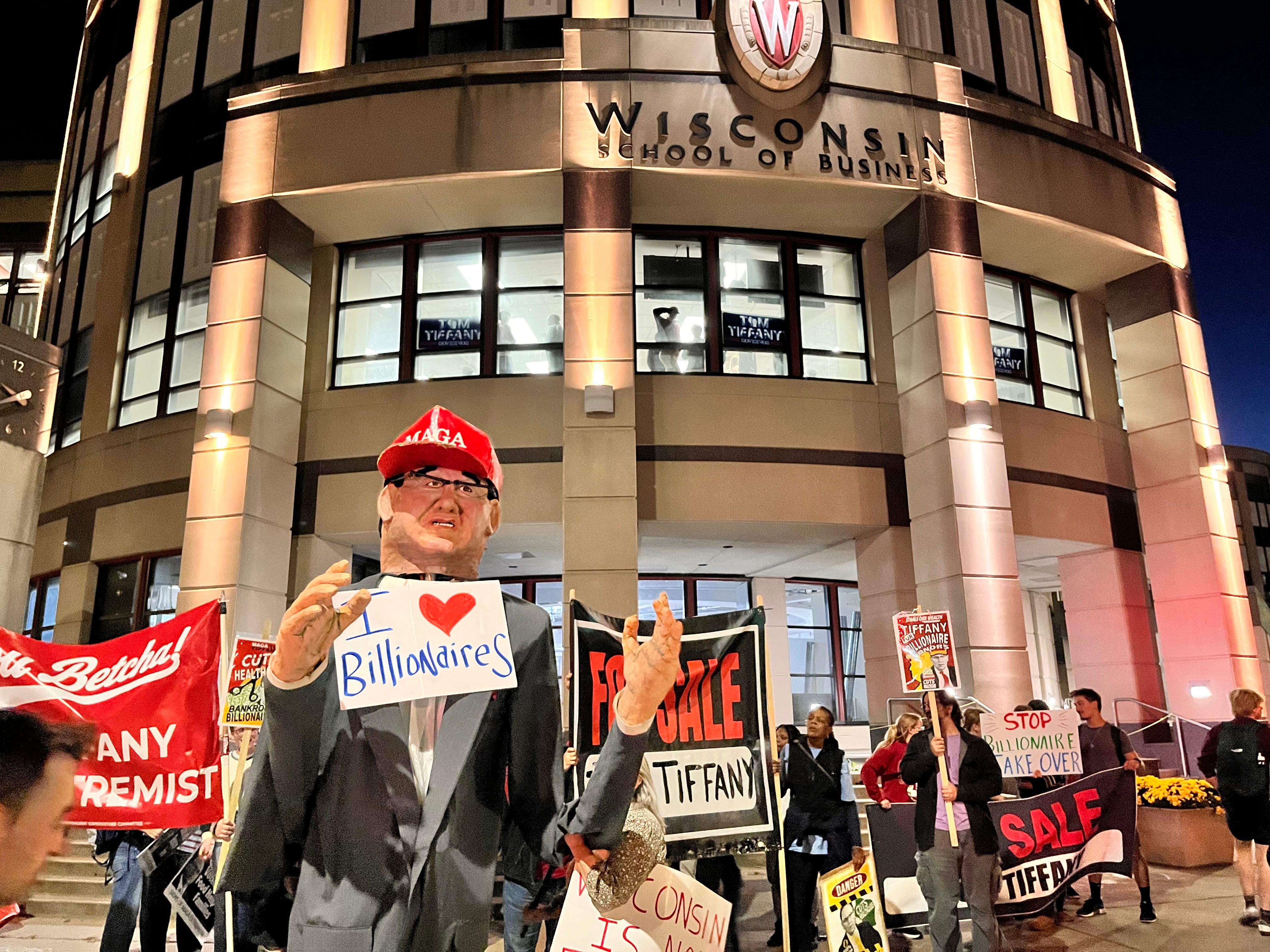
Outside, a group of protesters gathered. They held signs such as “Resist Tiffany/Billionaire Takeover” and “Wisconsin Is Not For Sale.”
Tiffany framed affordability as a central issue for Wisconsin’s future, affirming that the state must become more attractive to young professionals, families, and prospective homeowners. He identified “brain drain” — the loss of young workers and graduates to other states — as a significant concern, calling for policies that would encourage Wisconsin residents to remain in the state after graduation.
Among his proposals was returning Wisconsin’s approximately $3 billion budget surplus to taxpayers.
Tiffany argued that rising property taxes place an unfair burden on seniors who have paid off their mortgage and young people. Those who want to purchase or build homes are met with increasingly prohibitive costs, discouraging many from settling.
In response to a student’s question about prioritizing Wisconsin homes over overseas spending, Tiffany emphasized regulatory reform as a means of lowering housing costs. “The number one thing we’re going to do is reform the regulatory environment in Wisconsin,” Tiffany said. “We are a deeply overregulated state.”
As the average homeownership age has risen from 29 to 40 in the last few decades, he pledged to eliminate duplicative and unnecessary regulations, freeze property taxes, and address rising utility rates. Tiffany argued that reducing regulatory burdens would lower construction costs and make homeownership more attainable for young people.
“That’s what we wanted to see all of you have, the opportunity to, if you choose, lay down those roots,” he said.
Tiffany also proposed eliminating state taxes on tips and overtime, and criticized wind and solar energy developments on farmland. He stated that such projects threaten agricultural land, contributing to both higher electricity and food costs, and emphasized the need to protect Wisconsin’s agricultural economy.
Tiffany addressed the role of higher education in Wisconsin’s economic future, arguing that state residents should have greater access to UW-Madison. Citing the majority proportion of incoming freshmen who come from outside Wisconsin, he called to encourage more Wisconsin students to attend the state’s flagship university.
His remarks framed the issue as one of access and accountability, arguing that Wisconsin taxpayers who financially support the university should have a greater opportunity to benefit from it.
On K-12 education, Tiffany criticized what he described as declining educational standards following the COVID-19 pandemic. He called for stronger classroom accountability, while also supporting higher teacher pay and improved teacher safety.
Government spending was another major focus of his speech. Tiffany pledged to audit state agencies to identify fraud, waste, and inefficiency, referencing reports of fraud in neighboring Minnesota as a warning about the importance of oversight. “We’re going to make the state government more accountable to you,” Tiffany said. “We are going to audit all of the state government so that we root out the fraud and waste that’s going on.”
When asked about his priorities for his first 100 days as governor, Tiffany outlined several proposed actions. His plans include calling a special session, addressing the school funding provision associated with the “400-year property tax increase,” beginning to audit state agencies, and nominating two members to the Wisconsin Public Service Commission. He also pledged to produce a state budget without raising taxes.
“I can assure you of one thing about that budget: It will not raise taxes. We will not be raising taxes,” Tiffany said.
Students also raised questions about artificial intelligence, data centers, and foreign influence in Wisconsin.
Tiffany proposed that artificial intelligence should be governed by a consistent national standard, given the technology’s implications across state boundaries. However, he distinguished AI regulation from decisions about where data centers should be built, opposing federal preemption of local authority over those decisions.
He maintained the idea that state and local governments should retain a say in data center development, emphasizing the importance of local control.
Tiffany also addressed concerns about the Chinese Communist Party’s influence in the United States. He argued that Chinese interests should not own Wisconsin farmland, and emphasized the importance of protecting American intellectual property. “Communist Chinese interests should not own any farmland here in Wisconsin,” Tiffany said. “We need to be very aware. And make sure that our intellectual property is not being stolen.”
His remarks reflected broader concerns about foreign ownership of agricultural land and the potential security implications of Chinese economic and political influence.
On social issues, Tiffany advocated for determining sports eligibility by biological sex, preserving traditional terminology for mothers (not inseminated people), and displaying only the Wisconsin state flag and the American flag over the state capitol.
Tiffany closed his message with an optimistic vision for the state’s future. “We are going to turn Wisconsin around, and we’re gonna make it one of the shining stars in America.”
