

This article first appeared in the Winter 2026 print edition of The Madison Federalist.
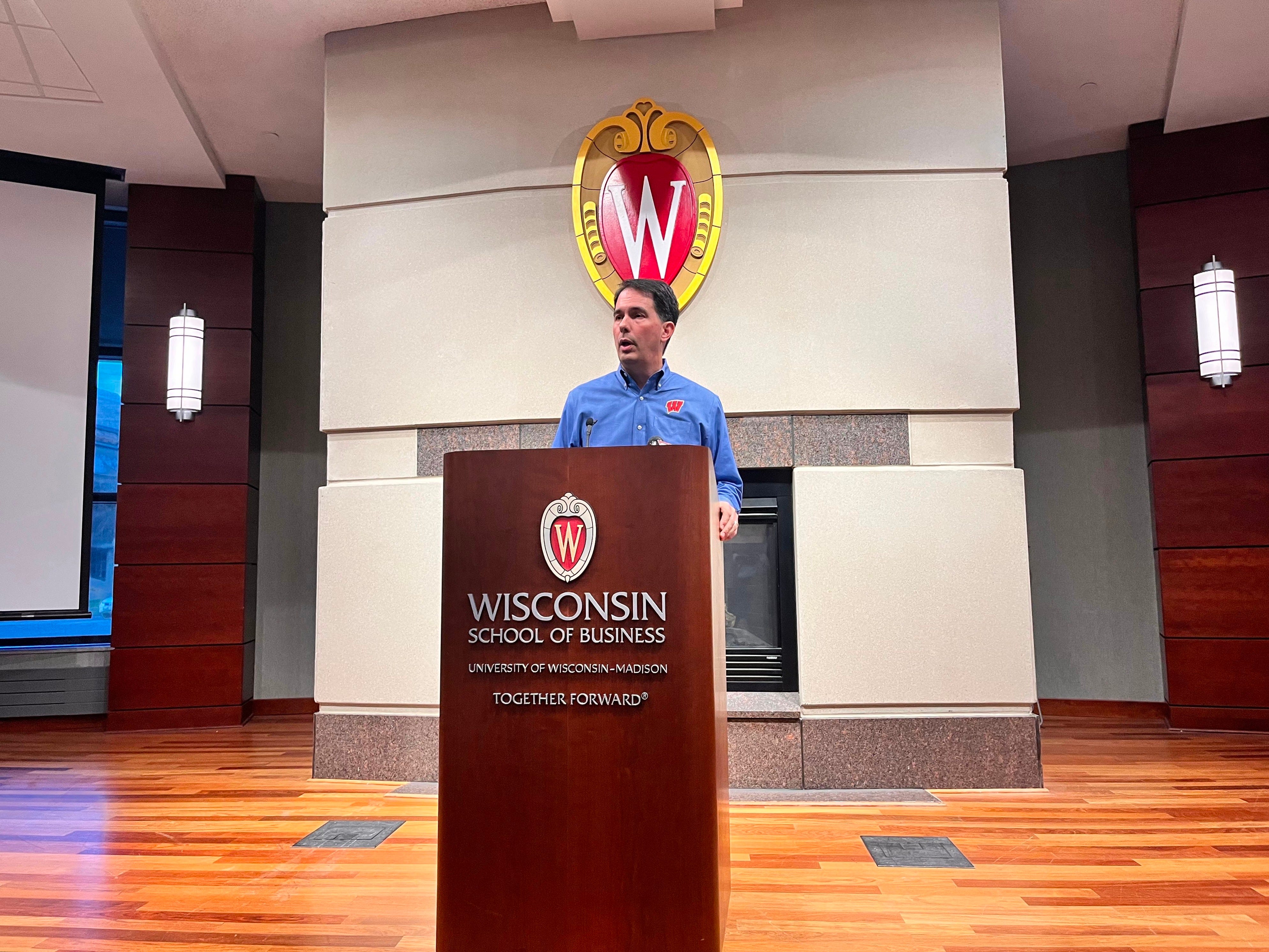
Former Governor Scott Walker joined The Madison Federalist for an interview via Zoom on Thursday, Jan. 29, to discuss topics including the upcoming gubernatorial election, campus issues, and immigration.
Gubernatorial Election
Republicans have a chance to take back the governor’s seat in the upcoming gubernatorial election. Walker believes the top priority for this election is to reduce the cost of living. “There’s still many voters, particularly young voters, who are still very concerned about cost of living and about wages keeping up with things like housing,” Walker said. “Interest rates, for example, are so much higher than they were, four or five years ago.”
“We saw what happened under Joe Biden. That had an impact on Wisconsin, so the next governor really needs to not only talk about costs of living but reduce the size of government to help drive down costs,” he said. “High taxes take away from the ability of voters and hardworking people in Wisconsin to cover the bills that they have.”
Currently, Congressman Tom Tiffany is the presumptive nominee for governor in the Republican primary. Walker noted that Tiffany is a strong candidate as “he was in the state legislature, he went through the battles, and he’s been tested in that regard.”
Walker reiterated the importance of reducing the cost of living, including taxes, fees, and student loan debt. He believes it’s important to “get the cost down in the first place so students aren’t taking on an even greater burden.”
Public safety is another key component, such as border security, in “keeping us safe from people who’ve come into this country illegally, particularly those who’ve committed additional crimes.”
Walker believes that Tiffany was in a good place to win this election. He said, “Tiffany showed a more than $2 million raise which is really good” and said “the fact that Evers is not running again” bodes well for Republicans. This leaves the Democrats with a wide open primary. Walker told The Federalist, “I think it is hopeful for us, but there’s still the swing voters in Wisconsin– kind of like undecided students on campus– who aren’t necessarily conservative or liberal.”
He continued, “It’s a difficult task to win as a Republican overall, but particularly when Republicans are in the White House. Every election– but one for governor– has gone the opposite of who was in the White House. For example, I won three elections for governor, all three were when Barack Obama was president of the United States. Typically, it goes back and forth.”
For “Tiffany to win, he’s going to have to break through that and stay focused on cost of living issues,” Walker added.
Walker recalled campaigning in Wisconsin on behalf of President Trump. “I talked about going to the grocery store and how the cost of filling up one grocery cart was about the same as what I could get four years earlier for two carts,” he said. “People can relate to that. Those are the things they want people to talk about.”
Walker was elected governor of the state twice– 2010 and 2014– and he survived a recall election in 2012. With his election experience, Walker’s “advice to whomever the nominee is, as well as people running for state senate, state assembly, Congress, on the conservative side, is don’t take the bait” and “focus on the things that really matter to everyday voters.”
In the Democratic primary, candidates such as Sarah Rodriguez, Mandela Barnes, David Crowley, Francesca Hong, and others are hoping to become the nominee for governor. Walker believes the nominee will be Barnes, but he “is the most radical.”
He added that “as we saw in New York City, it can be appealing if people don’t know anything about history” or if they don’t know what “happens when those policies fail elsewhere in the world.”
UW-Madison Campus issues
According to the 2026 FIRE Free Speech Ranking, UW-Madison placed 101st out of 267 colleges and universities nationwide, receiving a free speech grade of “F” overall. Additionally, FIRE conducted a free speech survey, which found that 35 percent of students at UW-Madison believe that violence is acceptable to stop someone from speaking on campus, at least in rare cases.
Walker said free speech “is a constitutionally protected right” and “our founders felt so passionately about it that they put it right at the beginning of the Constitution.” College campuses are “the very place that it should be revered” but “the place it’s most at risk.”
Walker believes there should not only be “a consistent free speech policy at all of the University of Wisconsin System schools, but it should be enforceable.”
“That’s the whole Socratic principle of gathering together for higher education,” Walker said. “Expanded learning should be the free debate and discussion of big ideas” and “to be exposed to things that you may fundamentally disagree with but to expand horizons. That has not happened at the University of Wisconsin. That is not happening in schools across the country.”
Walker discussed the heckler’s veto, and he believes students who try to shut down speakers should be issued “a warning, but subsequent to that, things like expelling students who violate free speech standards” repeatedly.
“That’s not saying that someone can’t protest,” Walker continued. “I can’t violate the constitutional rights of other students to be able to hear a speaker, regardless of whether I agree with him or her.”
“The students deserve the right to hear from a wide variety of different ideological, political, and other beliefs.”
Walker hopes UW-Madison “embraces and promotes” the constitutional right of freedom of speech because “one diversity most lacking on most college campuses is diversity of thought.”
He also hopes that intellectual diversity will be applied when hiring for jobs. “It’s tragic to me, particularly in the arts and sciences, the social sciences, how many campuses are almost devoid of any conservative or even slightly right-of-center faculty members.”
Chancellor Jennifer Mnookin was recently named the next president of Columbia University, and Walker said he was surprised by the announcement. For the next chancellor, Walker emphasized that “it’s going to be incredibly important to find someone who’s committed to having a safe place for all voices.” He reiterated “that conservatives overwhelmingly are concerned about speaking out about their views.”
“College should be a place where you’re free to talk about your ideas,” Walker said. That “doesn’t mean you’re protected from any challenges, but you shouldn’t feel that just because of your point of view, your grade is going to be damaged or that other students are going to take action against you.”
He believes there are many models of leadership in higher education, pointing to former president of the University of Florida and U.S. Senator Ben Sasse. Walker said that Sasse “really transformed that school and was adamant about free speech.” He also “very strongly encouraged the kind of intellectual diversity we talked about.”
“There are a handful of folks that do a really nice job, even at public institutions across the country, and we should expect that at UW-Madison.”
Walker also discussed the tragic assassination of Charlie Kirk. Walker said, “I’d known Charlie for years. He actually came up from Illinois to help our recall election.”
“I was with him and his parents a month before the assassination, so personally, I was very troubled by it,” he said. “I know just how devastating it was.”
Charlie Kirk “was such a bigger than life personality” and he “was not only talking on a college campus, he was actually listening to people.”
“One of the key things that I think is lost, particularly in the world of social media, is listening to people, not just waiting until they’re done so that we can own them with whatever their counter attack is, but actually listening to what they say.” Walker stated this is important because “most students are not ideologically tied to the left or the right. They’re just trying to figure it out.”
Immigration
Walker has experience in dealing with civil unrest from his time as governor of Wisconsin, and he gave his opinion on how he would deal with the immigration situation in Minneapolis. He said, “Governor Tim Walz has totally screwed that up.”
“He [Walz] has every right, just like any citizen does to speak out, if he disagrees with the policies” but it is another thing “to encourage people to get in the middle of federal law enforcement agents carrying out the law.”
Walker points out that it was the same laws that ICE agents were enforcing “when Barack Obama was president and when Bill Clinton was president.”
In response to the fatal shooting of ICE protesters, Renee Good and Alex Pretti, Walker said, “What happened with the two individuals whose lives were lost is tragic.” He believes Minnesota’s leadership “should be telling people to go find a place to peacefully protest.”
Walker told The Federalist the best thing a leader can do is to advise people to “not engage in creating any more chaos, and unfortunately, they’re doing the opposite.”