

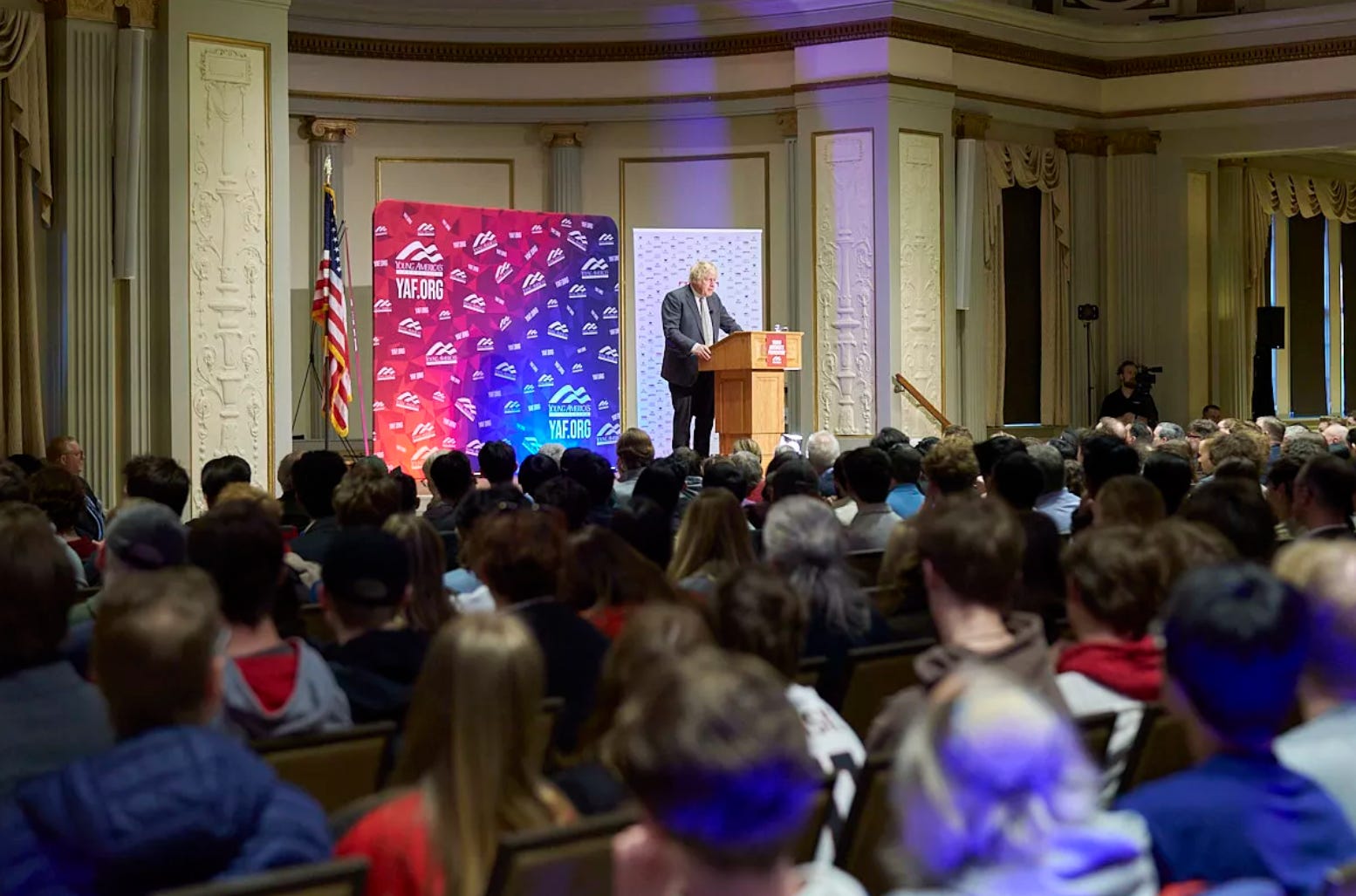
The Right Honourable Boris Johnson, who served as Prime Minister of the United Kingdom from 2019 to 2022, spoke to The Madison Federalist in an exclusive interview before his March 23 speech at the University of Wisconsin-Madison.
Johnson said he viewed “division” as the greatest threat the West faces. “I think it’s obvious to me that there’s a group of countries that include Russia, Iran, China, North Korea, that are hungry to displace the United States as the hegemonic power in the world,” he said. “Everybody in the West needs to understand that and prevent it from happening.”
He was skeptical of the United States and Israel’s recent military actions in Iran but said “it’s too early to say” how the situation will resolve.
He said they are “not necessarily what I would have advocated from what I see at the moment, but it doesn’t necessarily mean that good can’t come out of it.”
“Clearly, there’s a lot of people who are very worried about the effect it’s having on the world economy, and they include me,” he said. “Inflation is up, interest rates are up, millions of ordinary people face being impoverished because of a war whose objectives are unclear and whose exit strategy is unknown. That’s the problem.”
“I think that it was always predictable and indeed predicted that Iran would respond to being bombed by closing the Strait of Hormuz. So I didn’t quite understand why President Trump said that nobody talked about what was going to happen.”
However, he emphasized that the Iranian regime is run by “very bad guys” who “do terrible things.”
“If this leads to change in Iran, which it might well do, then that would be a good thing,” Johnson said.
He is concerned about the students and young people who “get out and demonstrate in favor of Hamas” or “the Ayatollahs.” Johnson said Western nations cannot survive “if we don’t know ourselves.”
“I think young people should look at how young people behave in the autocracies. What do they want? They want to come here. They want to come to the University of Wisconsin, Madison. They’re looking at us on the internet with real envy.”
Johnson also discussed artificial intelligence, which is one of his favorite topics. “I love it. I think it’s great. It’s a great tool. I think it’s a brilliant adventure,” Johnson said. “There are lots of functions where we just don’t have enough pairs of hands,” so AI can be used to solve many problems.
Johnson was surprised, and disappointed, to learn that students often use AI to cheat on assignments. “Do they? The rotters!,” he said. “Academics will have to find alternative means of discriminating between candidates and other ways of assessing intellectual progress, because, clearly, you can just produce a computerized essay that’s indistinguishable from what was previously thought to be a standard essay.” He believes professors will “have to find a new way of determining the originality of thought and memory and learning.”
Johnson viewed concerns about workers being replaced by AI as overstated. He said Europe and the United States have an “aging population” so artificial intelligence could help boost a shrinking workforce.
Johnson was hosted at UW-Madison by Young Americans for Freedom and the Tommy G. Thompson Center on Public Leadership.