

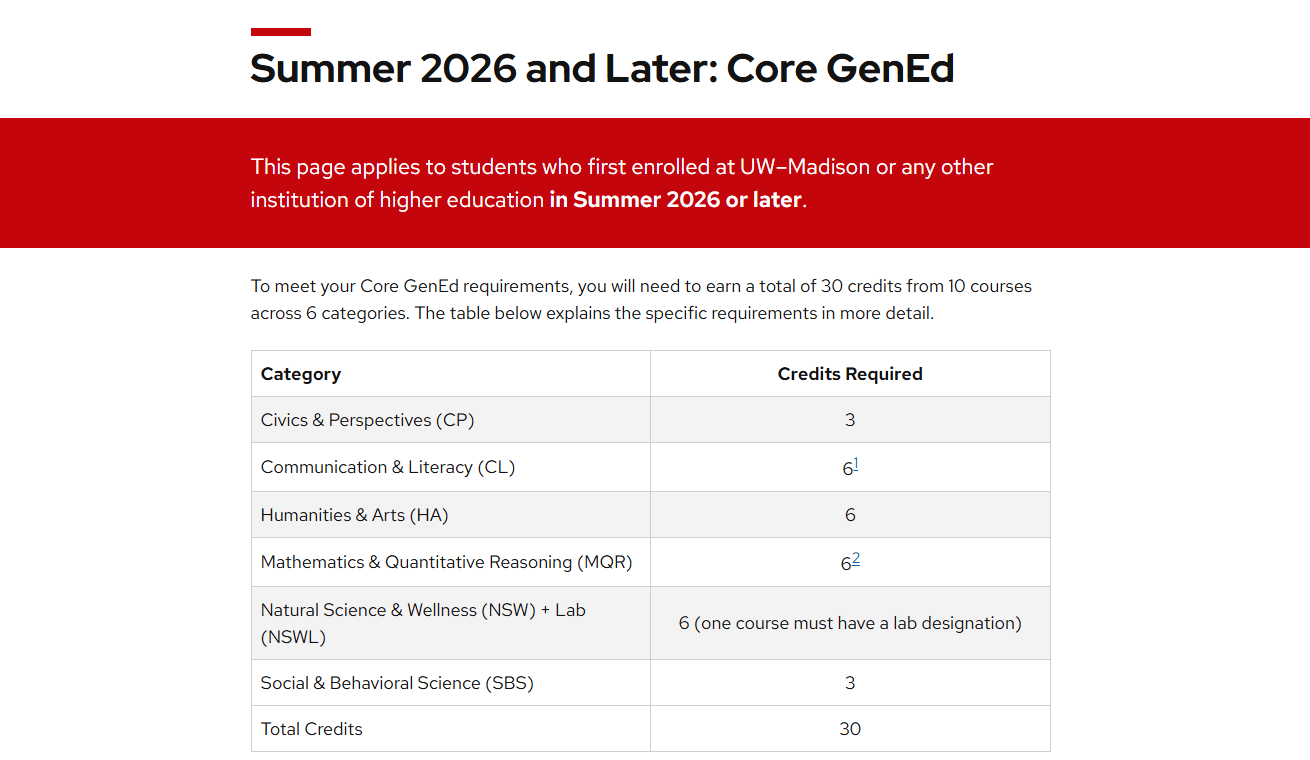
Undergraduates at the University of Wisconsin-Madison have been required to take a course in “Ethnic Studies” to graduate for decades. While the university has updated its general education requirements to reflect a new system-wide policy, “Ethnic Studies” has been retained under a new name: “Civics and Perspectives.”
This fall, Civics and Perspectives course offerings include “Intersectionalities, Self Awareness, and Social Actions for Social Change,” “Mental Health, Self-Awareness, and Social Justice: Working in Diverse Communities,” “The Politics of Education Injustice in the US,” “Race, Intersectionality, and Equity in Education,” “Diversity, Oppression, and Social Justice in Social Work,” and “Buddhism and Anti-Racism.”
In July 2025, the Wisconsin State Legislature approved Act 15, which required the UW System to ensure that general education credits can transfer between UW institutions. The system established six Core General Education categories in response, but let individual universities decide what counts toward them.
While every University of Wisconsin institution had some form of an ethnic studies requirement, it was not formally included as one of the six categories. However, UW-Madison, UW-Milwaukee, UW-Parkside, and others opted to map them into the Civics and Perspectives category.
“UW-Madison mapped its prior general education categories to the Core General Education categories defined by the Universities of Wisconsin and designated courses based on those criteria,” director of public affairs Gillian Drummond told The Madison Federalist via email. The university did not change its graduation requirements, it only shifted its existing requirements to fit under the new categories. Students who enrolled prior to summer 2026 are not subject to the changes, and they will continue to follow their individual institutions’ older general education requirements.
“Courses that meet the Civics and Perspectives definition may be given that designation,” Drummond said. UW-Madison’s Core General Education Requirements policy, which has been approved by the Faculty Senate, defines Civics and Perspectives as:
Instruction designed to increase understanding of the circumstances, conditions, experiences, cultures, literatures, arts and contributions of persistently marginalized racial or ethnic groups in the United States that equip students to respond constructively to issues connected with our pluralistic society. Students in these courses learn to draw connections between historical and present-day circumstances and consider perceptions and cultural assumptions when examining questions and making decisions.
The determination of which courses count toward Civics and Perspectives “will follow existing governance processes and are currently being reviewed by the ad hoc committee that was formed to address Act 15 core general education requirements,” according to Drummond.
While this is separate from the Ethnic Studies Subcommittee, it has reached many of the same designation conclusions. In Summer 2026, there are 54 Ethnic Studies courses and 54 Civics and Perspectives courses – 52 of them overlap. In Fall 2026, there are 159 Ethnic Studies courses and 147 Civics and Perspectives – 144 of them overlap. This count is based on the Course Search and Enroll application, which double-counts cross-listed courses.
The Civics and Perspectives description contains nearly identical language to the university’s description of Ethnic Studies. However, Ethnic Studies courses have more extensive goals. These include ensuring “that students can identify and question the racial power dynamics that undergird social and political institutions” and challenging “students to think about their own racial and ethnic identities in relation to others.”
Courses do not need to be entirely focused on race or ethnicity to satisfy the requirement. Classes such as “Women and Gender in the U.S. Since 1870” and “Introduction to Lesbian, Gay, Bisexual, Transgender and Queer+ Studies” also count toward it.
“Civics and Perspectives courses explore different perspectives and experiences to help develop critical thinking, writing, ethical reasoning, cultural literacy, and communication skills that employers have consistently told us they value,” Drummond said.
WHAT DO STUDENTS LEARN IN ETHNIC STUDIES/CIVICS AND PERSPECTIVES COURSES?
The Madison Federalist obtained the syllabi for the courses that satisfied the Ethnic Studies requirement in 2025 or spring 2026 via an open records request. The content of the syllabi revealed ideologically lopsided readings, controversial assignments and language that suggests some instructors view the classroom as a platform for their political views.
Even courses with innocuous names are filled with progressive ideology. In the nursing course “Culturally Congruent Practice,” students must complete an “action-oriented” essay that “is an opportunity for you to practice STARTING THE CONVERSATION about a social justice issue in real life.” They also must write about a “self-defining experience” associated with their race. Students can also earn three extra credit points for completing a “social justice event reflection.”
In “Culture, Language, and Communication,” students had to complete a “cultural self-assessment” and “consider how others view the different aspects of your identity, as well as how your cultural and social identities influence your view of others, especially others with different levels of ability.”
Students are asked to write about their own identities in many of the courses. In “Black Research Approaches: Qualitative Methods and Collaborative Praxis,” students must write a “positionality statement” that “illustrates both your multiple identities and how those identities intersect with the research you want to do/are already doing with Black communities.” In “Race and the Developing Child,” students “will reflect and write up their own racial, ethnic, and cultural story.”
In “Multiculturalism and Social Justice”, students completed an “Intersectionality and Your Identity Project” worth 20 percent of their grade. In it, they gave a class presentation where they “reflect on how power shapes the various aspects of your identity, including gender, class, sexual orientation, race, age, and ability.” In another assignment, students must identify how they “will continue to engage with issues of social justice after this class.”
In “Dimensions of Latin@ Mental Health,” students complete a #MySocialIdentity project where students give a presentation to discuss “your racial and/or ethnic identity, what factors contribute to your worldview, who you feel most comfortable around, suspected blind spots about how you think about race or ethnicity, and experiences that have influenced your identity within your own racial or ethnic group.”
While it is difficult to precisely determine the degree of ideological lopsidedness, prominent conservatives are rarely included in course materials. For example, one work by Thomas Sowell is used in “Race, Ethnicity and Black Population Health in the United States,” but he is otherwise missing from the reviewed courses. Other notable scholars such as Glenn Loury and Heather Mac Donald are entirely absent.
Meanwhile, Nikole Hannah-Jones of The 1619 Project is cited in “Dimensions of Latin@ Mental Health,” “African American History since 1900,” “Black Education Studies: Blackness in U.S. Public Schools,” “Introduction to the City,” and “Inequality, Race, and Public Policy.”
Feminist writer bell hooks is cited in “Introduction to Theatre for Social and Cultural Awareness,” “Asian American Feminisms,” “Theorizing Intersectionality,” “Women in Ethnic American Literature,” “Introduction to African American Studies,” “Artistic/Cultural Images of Black Women,” “Multiculturalism and Social Justice,” “Art and Visual Culture: Women of the African Diaspora and Africa,” “Black Women’s Political Behavior,” “Race, Sex, and Texts,” and “History of Race and Inequality in Urban America.”
“Anti-racist” scholar Ibram X. Kendi is also cited in “History of Race and Inequality in Urban America,” as well as “Youth, Education, and Society” and “Black Campus Fictions.”
In many of the syllabi, instructors use language that suggests they view the classroom as a place for activism. “Introduction to Theatre for Social and Cultural Awareness” refers to students as a “community of scholar-artist-activists” who “will develop tools to apply to the practice of theatre in a variety of fields (acting, directing, design, scholarship) as well as tools for community engagement and advancing awareness and equity in everyday life.” The land acknowledgment in “Immigration, Education, and Equity” says “we will regularly engage with decolonial theories” and help “grow social action.”
The syllabus for “American Indian Women” vows to “promote decolonial practices in our classroom” and says decolonization is a “guiding principle in American Indian and Indigenous Studies.” “Race, Ethnicity, and Inequality in American Education” permits the use of generative artificial intelligence in a limited capacity, but warns that AI “replicates the prejudices and violences that shape our societies, particularly the white supremacy and colonialism that this course seeks to disrupt.”
In “Social Work in American Indian Communities – The Indian Child Welfare Act,” students are told in the syllabus that making certain arguments will result in a failing grade. It says, “Zero points will be given for responses that do not demonstrate understanding of ESR Learning Outcomes. For example, responses that clearly indicate ‘the past has not affected present day circumstances regarding race and racial inequities in the U.S.’” The syllabus for “Introduction to Language and Ideology” says, “We will approach these questions in an anti-racist framework, showing that perceptions towards certain English varieties are grounded in bias against certain demographic groups and not in linguistic facts.”
In “Latina/Latino/Latinx History,” students answer questions such as “How have queer people, sex workers, and men that have sex with men been excluded by immigration law and their communities on both sides of US-Mexico border?” One of that course’s learning outcomes is to “build an intersectional critical lens of race, ethnicity, gender, sexuality, and class as it relates to Latinx/e communities.”
While Ethnic Studies/Civics and Perspectives is impossible to evade, students can easily receive a passing grade if they choose the right class, as many instructors gave the overwhelming majority of students full marks in their courses.
In Fall 2025, 85 percent of students received As in “Youth, Education, and Society” and “Jazz in 20th Century America,” according to Madgrades. Nine out of 10 students in “Race, Ethnicity, and Inequality in American Education,” “Inequality, Race, and Public Policy,” or “Race, Intersectionality, and Equity in Education” received an A. In “Anthropology and Education,” every single student received an A.