

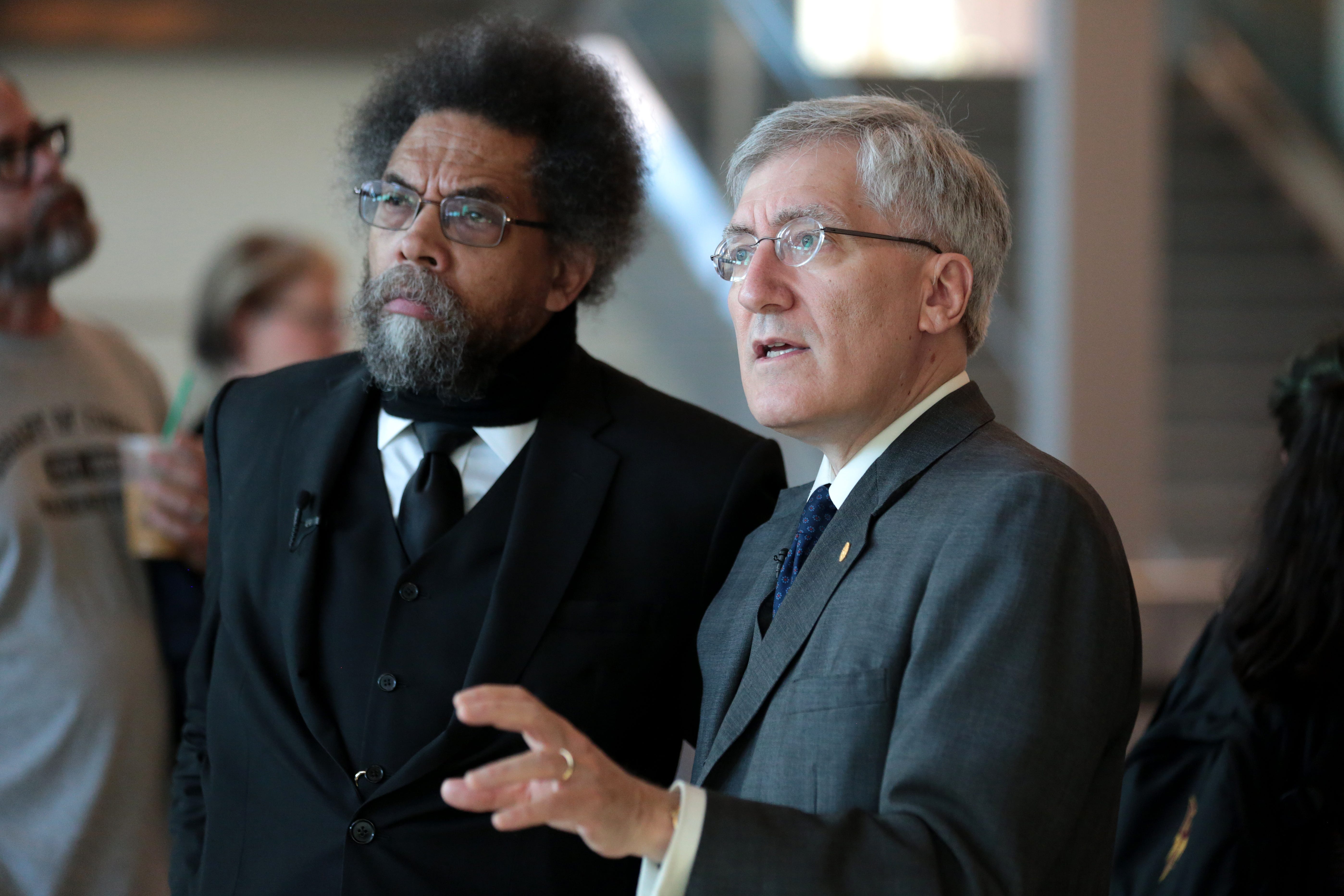
The Wisconsin Exchange recently hosted professors Robert P. George and Cornel West in a conversation called “Constructive Dialogue in a Divided Age: What Universities Can Teach About Listening, Learning, and Truth.”
The October 28 event was moderated by interim Chancellor Eric Wilcots and focused on the importance of civil dialogue, constructive disagreement and pluralism — the idea that diverse ideologies can peacefully coexist. George and West were colleagues at Princeton, where they co-taught classes and seminars. They recently wrote a book together titled Truth Matters: A Dialogue on Fruitful Disagreement in an Age of Division.
George began teaching at Princeton University in 1985 and was named McCormick Professor of Jurisprudence in 1999. West served as Professor of Religion at Princeton from 1988 to 1994 before leaving for Harvard, then returned in 2002, established the Center for African American Studies in 2006, and eventually departed again in 2012. The two met when West was tasked with interviewing George in 2005. What started as a short interview turned into a debate where they discussed “every issue imaginable.”
While the conservative George and progressive West are on opposite sides of the ideological spectrum, their friendship is defined by the idea that constructive disagreement can bring people together past the limits of ideology.
“We have something deeper than just civility and friendship,” West said. “We are brothers.”
West said that what he loved most about George was his integrity. West explained that George “says what is in his heart, mind and soul.” This integrity, he said, cuts across politics, ideology, region, and nationality. That it is “the best of what us humans have.”
George praised West for being a “determined truth seeker,” and defined him as “the example of intellectual and moral integrity.”
After developing a friendship, George and West were offered the opportunity to co-teach freshman seminars, offering the students two professors with two different political perspectives. George said that they would select six books each and require students to read one a week for twelve weeks and engage in discussions.
West said a goal of their class was to engage students by exposing them to “indisputable exemplars of intellectual excellence, that they can not but acknowledge their own deference or infallibilities.” A different way that West often stated this was “learning how to die.”
West elaborated on what learning how to die meant by saying that their classroom was not a safe space for political neutrality, and that students would be respected, but politically unnerving conversations would happen. He emphasized that their worldview would be questioned. “To die is to let certain assumptions and presuppositions go,” he said. “It’s a form of death in order to be reborn, to grow and develop, dying and emerging.”
George believes in the importance of understanding fallibility as a way to grow in intellectual integrity. He said that people often admit that some of their superficial world views are subject to fallibility, but often never admit to the potential flaws in the ones they hold in the highest regard. “It is hard to acknowledge we can be wrong on some issues that are so deep and important to us,” he said.
Both George and West emphasized how it is through being “willing to die” and open to fallibilities in our own arguments that allows for pluralism to exist and for people like them to have civil disagreements yet still remain such good friends. After saying this, they highlighted the importance of the liberal arts and family structure in developing this pluralist intellectual discourse.
George explained that liberal arts is about encouraging and empowering students to live and examine life, and challenging fundamental ideas. He said that it’s about wrestling with ideas of the living and the dead, often restating the Greek concept paideia, which emphasizes education that includes the shaping of a moral and spiritual worldview with the overall focus of creating the model citizen.
George said that what society lacks today is people willing to get out and preach what he and West do. He said that with growing polarization, parents are failing to model an attitude of truth-seeking and intellectual humility for their kids. He stated that democracy requires people to be able to reason with the other side and hold civil dialogues. “If you demonize people because they disagree with you politically,” he asked, “What kind of example are you setting for your children?”
The two closed by saying that universities should introduce more team-teaching. Although they acknowledged the cost may be a barrier, they emphasized how valuable it can be to have two professors who “radically disagree with each other” to teach at the same time to challenge perspectives. “We want [students] to challenge our beliefs as well,” George said.

