

The Institute for Reforming Government is calling for an audit of the University of Wisconsin-Madison’s BadgersVote Coalition after a report raised constitutional questions about the program.
IRG is a conservative think tank based in Wisconsin. The report “Liberal Arts: How BadgersVote Coalition Uses Donor Cash to Import Democratic Votes,” authored by IRG general counsel Jake Curtis and associate counsel Kevin Zielinski, was published earlier this month.
It detailed how BadgersVote functions as a “partisan turnout machine” for progressives and questioned how the program gets its funding.
The report makes clear that the BadgersVote Coalition is officially non-partisan. However, non-partisan voter turnout groups can have a big effect in a swing state election when they are located in a heavily partisan area such as UW-Madison.
“The Coalition operates at a scale of thousands of Wisconsin ballots per cycle, on a campus where fewer than one student in twenty-five identifies as very conservative, in the county that produces the Left’s decisive margins. A program with those characteristics does not need to be partisan in design to be partisan in effect,” the report stated.
Last week, the Coalition promoted a “Drag Yourself To The Polls” event on its Instagram story. That event featured a drag king and was co-hosted by Sex Out Loud.
The Coalition has been successful in getting UW-Madison students registering and voting. “Between the 2014 and 2022 midterms, the number of UW-Madison undergraduates who voted rose from 10,666 to roughly 17,600. In 2022, 80.2 percent of eligible UW-Madison students were registered, and 55.8 percent voted — far above the 30.6 percent national rate for college students.”
In a state where the last three presidential elections have been decided by less than 1 percent, those votes are important to the outcome of the election.
A considerable number of the students who are non-residents for tuition purposes vote in Wisconsin elections because the residency requirement for voting is lighter. Half of UW-Madison undergraduates were tuition non-residents, and less than one-quarter of tuition non-residents stayed in Wisconsin one year out from graduation.
The voter turnout process includes BadgersVote educating “students about the need to vote in countless ways, such as via ‘an electronic newsletter distributed to all students,’ a newsletter sent to all parents, slides shared with instructors, materials given to all incoming students when they pick up their campus IDs, again when they attend the Chancellor’s Convocation, and through numerous videos, social media posts, and other websites.”
It is unclear how BadgersVote pays for the voter outreach efforts. “The Coalition has relied on third-party advocacy groups including the Campus Vote Project, the League of Women Voters, and the Andrew Goodman Foundation to sponsor and fund dedicated interns; the terms of those sponsorships have never been disclosed.”
The potential problem lies within the legality of the funding. In 2024, Wisconsin voters approved a constitutional amendment that effectively banned state agencies and their employees from using privately donated money in connection with the conduct of an election.
Article 3, Section 7 of the Wisconsin Constitution states, “No state agency or officer or employee in state government and no political subdivision of the state or officer or employee of a political subdivision may apply for, accept, expend, or use any moneys or equipment in connection with the conduct of any primary, election, or referendum if the moneys or equipment are donated or granted by an individual or nongovernmental entity.”
That provision could make donations made to the BadgersVote Coalition unconstitutional. “Recall that the Coalition partners with the Madison clerk’s office; that the Coalition itself includes many state employees; that voting is conducted on campus; and that substantial private money appears to subsidize voting activities from start to finish.”
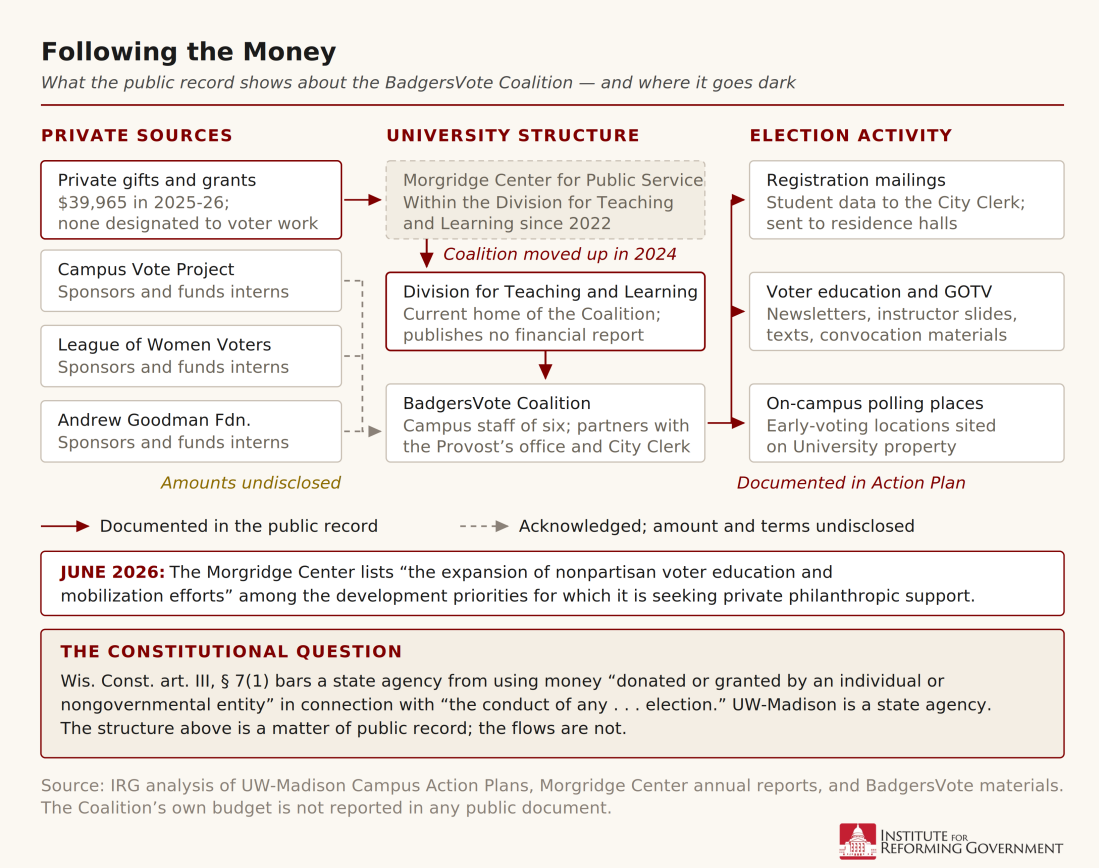
Information about the Coalition’s funding has been sparse. According to IRG, the Morgridge Center’s annual report that contains a budget summary and an itemized donor list never listed the BadgersVote Coalition as a line item.
After the passage of the constitutional amendment, the Coalition’s management moved from the Morgridge Center to the Division for Teaching and Learning. “The Coalition left the one campus unit that publishes its finances for one that publishes none, and no public accounting of the Coalition has appeared since.”
IRG makes clear that it cannot be determined at this time whether the Coalition’s efforts are illegal because of this lack of transparency.
The university argues that the work of the coalition falls outside the definition of conduct of any election. “BadgersVote is a non-partisan, educational initiative whose mission is to equip students with the knowledge and resources necessary to be active participants in democracy,” university spokesman John Lucas told The Madison Federalist. “BadgersVote has no role in elections administration.”
The report states that UW-Madison has not disclosed “the terms of its partnership with the Madison City Clerk, the arrangement under which student information is supplied so that registration materials reach residence-hall students, and who pays for the polling places sited on University property and the staff who support them. Until the Coalition’s books are open, no one outside the University can say on which side it falls—and that, rather than any confident conclusion, is the point.”
IRG says the state legislature should request a financial audit of the program and that UW-Madison should publish the BadgersVote budget and programming materials.
