

This article first appeared in the Winter 2026 print edition of The Madison Federalist.
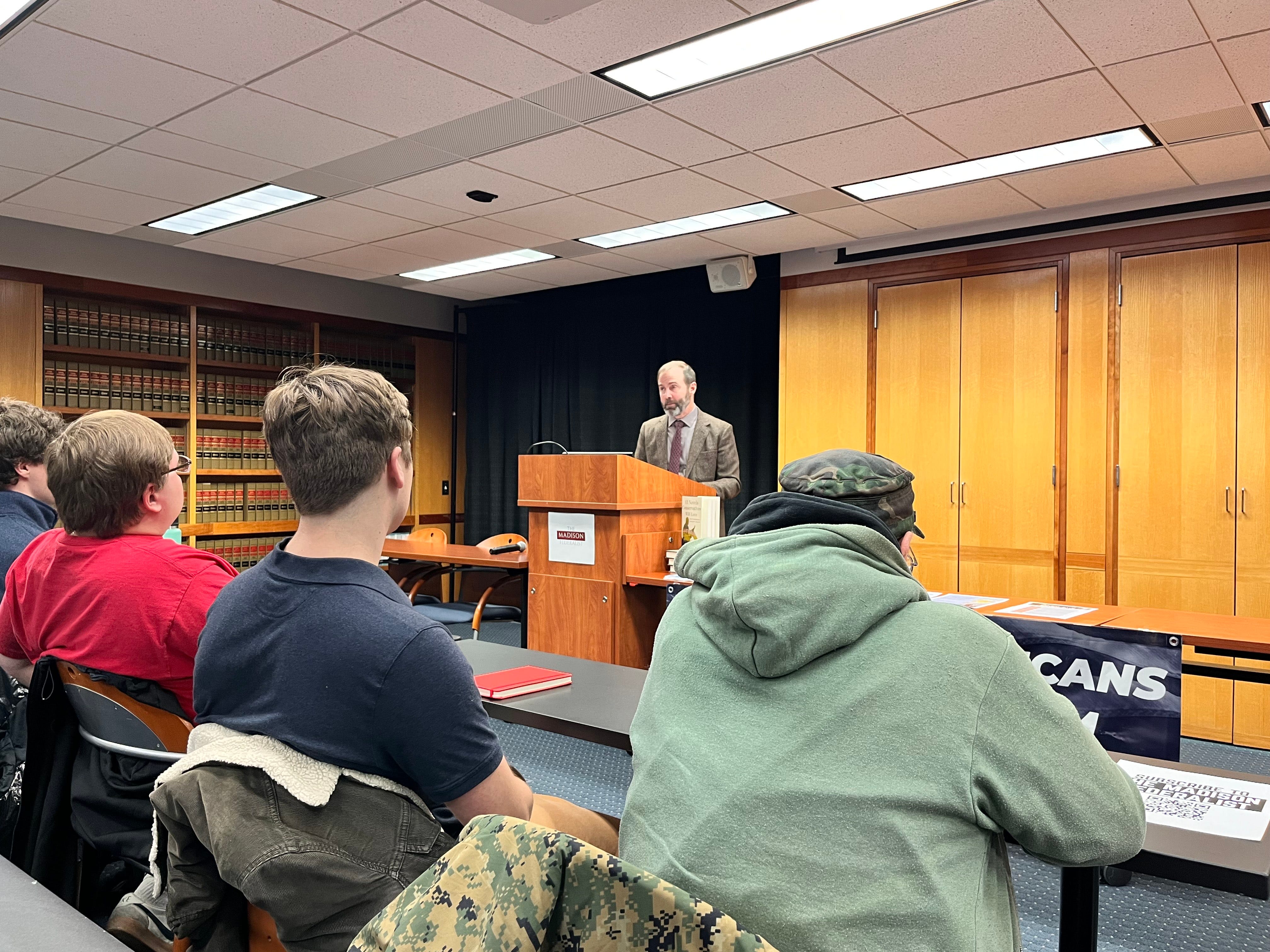
On February 4th, American Enterprise Institute Senior Fellow Christopher Scalia spoke to students and faculty about the intersection between faith, culture, and politics. Hosted by The Madison Federalist, the Center for the Study of Liberal Democracy, and Young Americans for Freedom (YAF), the talk centered on Scalia’s belief that in order to meaningfully engage with contemporary culture, conservatives must embrace the beauty of the present.
Scalia, who earned a Ph.D. in English from UW-Madison before spending time in academia and joining the American Enterprise Institute, was recently named Poetry Editor for the New Criterion and is author of 13 Novels Conservatives Will Love (but Probably Haven’t Read). He regularly writes about literature, culture, and higher education. As this issue has become increasingly pressing, Scalia emphasized that although it may feel unorthodox for conservatives to reside in the fluid and ever-changing aspects of modern culture, doing so may be far more beneficial than commonly assumed.
Scalia opened by first addressing culture itself, noting that it can refer to both intellectual and artistic activity. Conservatism, he argued, doesn’t always value both equally; instead, it tends to prioritize the intellectual activity over the artistic, a tendency he described as a serious flaw. Scalia warned of culture “drowning out conservative and political advances.” He portrayed culture and politics as two streams running alongside and interacting with one another — streams conservatives must learn to navigate in order to gain political ground in an ever-changing environment.
Using the Trump Administration as the primary example, Scalia credited President Donald Trump with understanding the importance of cultural engagement. Though describing Trump as a “right-wing populist with conservative inclinations,” Scalia remarked that “more than any Republican I’ve seen […] Trump understands how important the arts and entertainment are.” While acknowledging that Trump often leans into political stereotypes, Scalia described his attention to the arts, such as the planned Kennedy Center renovation, as a “commendable and positive impulse.” He added, however, that Trump could have demonstrated more consistent cultural support through greater investment in the National Endowments for the Arts and Humanities.
Continuing on the importance of cultural engagement, Scalia cautioned against relying on celebrity endorsements as a substitute for meaningful participation in modern culture. “There’s no doubt that having cultural voices on your team can give you a kind of sugar high and excite the base,” he said. “But rarely are they going to bring people over to your side.” Instead, Scalia emphasized appearances at popular cultural events as a more effective way to establish genuine connections with contemporary interests.
Shifting away from electoral politics, Scalia addressed “what conservatives who aren’t in the political arena can do about culture.” While acknowledging the natural conservative instinct to prefer the past — and, in extreme cases, to withdraw entirely from contemporary culture — he argued that such an attitude must change in order to achieve long-term political success. “If you don’t know anything about culture, if you close it off from yourself, you will not be able to shape it,” he said. “You can’t shape a society you’re entirely ignorant of.”
For conservatives to meaningfully institute change, Scalia believes they must first understand why people engage with modern culture in the first place. From there, appreciation may follow. “It’s a conservative instinct to think what is new is necessarily inferior, and sometimes, maybe even often it is,” he noted. “But that doesn’t mean it’s without value.” If conservatives wish to become more attuned to the country they seek to influence, they must first understand its culture by engaging with it.
Scalia also emphasized the importance of storytelling in shaping culture. Many of the most enduring ideas of the past, he argued, came from great works of literature that helped shape habits, manners, and beliefs. The moral imagination, he said, is essential. “It’s how we learn right from wrong, the proper ordering of our souls, and what it means to be human. We understand America in part by the stories we tell about America.”
Turning to the arts more broadly, Scalia stressed that the most important thing a conservative can do is learn his craft. In order to influence culture, he argued, it is better to be a better artist than a stronger ideologue. “Practice it, refine it, become excellent,” he said. “The art you create must be stronger than the messenger conveying it.”
Those who seek to shape culture, Scalia explained, should not be primarily concerned with how instructive their work is, but instead with creating work rooted in what they genuinely care about. “There is something unthreatening about the beautiful,” he said. “It works a sort of alchemy in the soul, and beautiful things awaken a desire to participate, to imitate, and finally to share.” Scalia maintained that humans are naturally drawn to beauty, and that conservatives, in particular, should pursue it because beauty has the power to persuade in ways arguments cannot.
Scalia concluded by encouraging conservatives to engage deeply with literature. Through interaction with the written word, individuals gain a stronger understanding of culture, and, in turn, a deeper understanding of themselves. To understand the culture of which we are a product of, Scalia suggested, is ultimately to better understand humanity itself.
