

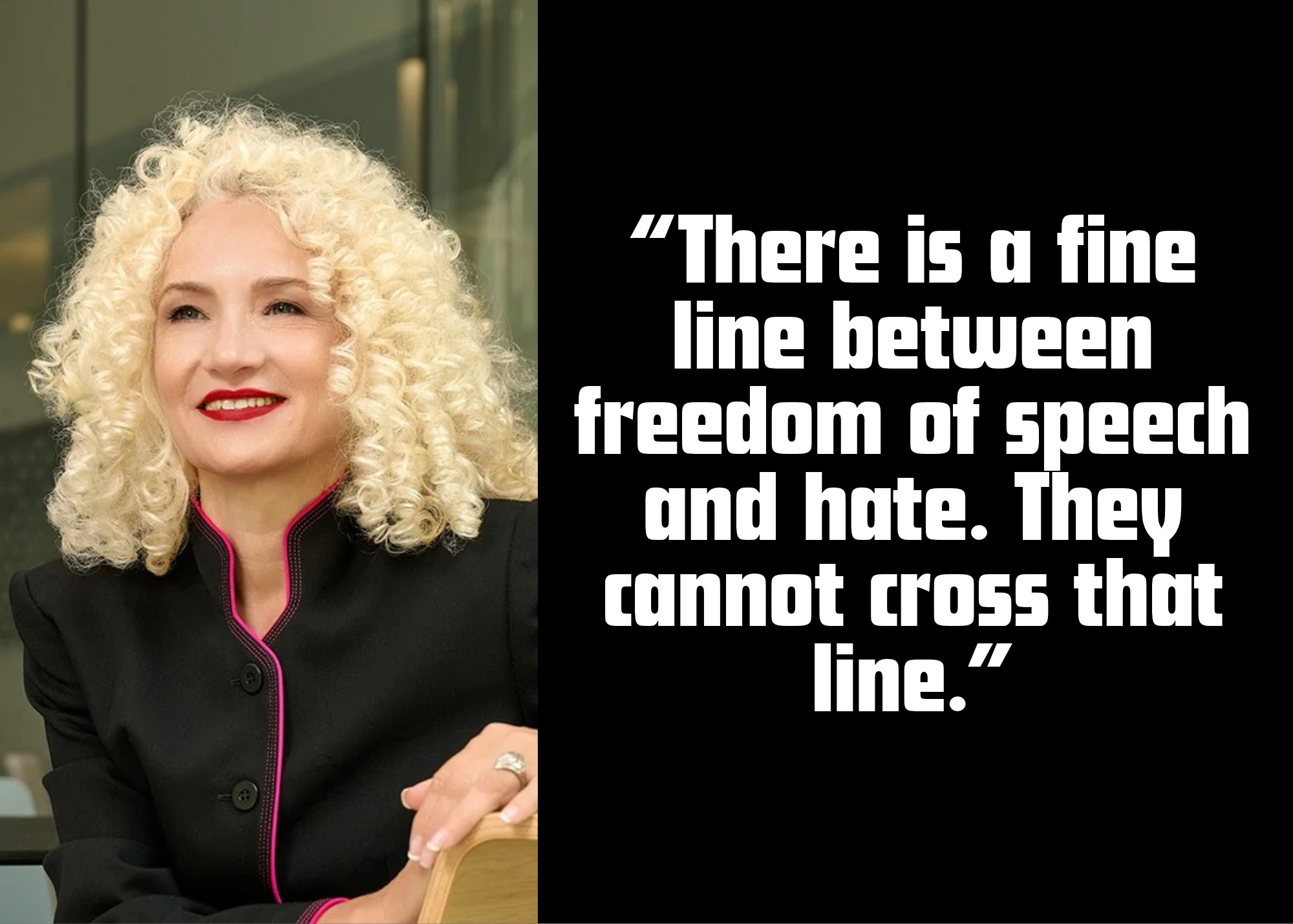
On November 5, the University of Wisconsin–Madison chancellor special regent committee announced three finalists in its search. One of the finalists, however, has a particularly concerning track record when it comes to free speech.
Radenka Maric has served as the president of the University of Connecticut since 2022. She has an academic background in engineering, and studied at the University of Belgrade in Serbia and Kyoto University in Japan.
In April 2025, UConn’s student newspaper, The Daily Campus, published 670 pages of correspondence between top university officials after the October 7th terrorist attacks and subsequent campus protests. Many of the emails sent by Maric reveal an alarming resistance to students exercising their First Amendment rights.
On November 4, 2023, in an email to other UConn administrators, Maric ordered the taking down of Pro-Palestinian posters that appeared to depict Hamas fighters. Maric raised concerns based on their content: “There is a fine line between freedom of speech and hate. They cannot cross that line.”
On November 19, 2023, Maric received an email linking to a Times of Israel article discussing antisemitism on the UConn campus. The article included, among other things, an image of posters depicting Hamas fighters, accompanied by the captions “Liberation by any means necessary” and “Resistance isn’t terrorism. Victory to Palestine.”
Although Maric may believe that hateful speech is not protected by the First Amendment, the Supreme Court has repeatedly recognized that even deeply offensive expression can receive constitutional protection.
Although the depiction of Hamas fighters may be reasonably offensive to many and viewed as antisemitic, displaying such imagery is nonetheless protected by the First Amendment. The Supreme Court has upheld the right to display offensive images in public in a variety of contexts, including on college campuses.
At the core of this doctrine is the principle that the government generally cannot prohibit speech based on its content. Most notably, in Papish v. Board of Curators of the University of Missouri, the Supreme Court ruled that “The mere dissemination of ideas—no matter how offensive to good taste—on a state university campus may not be shut off in the name alone of ‘conventions of decency.’”
Nonetheless, in an email to top UConn officials on December 12, 2023, Maric wrote, “I have to disagree…that the flyers with Hamas soldiers with automatic weapons on our campus are freedom of speech and with the message ‘By all means and resistance isn’t Terrorism.’” In the following sentence, she implies that students should be arrested for this constitutionally protected speech based on its content: “We arrest students for yelling N [word], and when students tell us how these posters affect and disturb them, we cannot say that is OK.”
What is also concerning is her apparent belief that yelling the N-word is an arrestable offense. Despite being reprehensible and racist, the use of a racial slur can also receive constitutional protection, as illustrated by cases such as R.A.V. v. City of St. Paul.
On November 21st, 2023, Maric sought the opinion of Anti-Defamation League Lawyers because, as she wrote, “I need constitutional [lawyers] to tell me when the freedom of speech crosses to hate and invites violence.” This followed her disagreement with her legal department over the constitutionality of a “swastika painting.” She asked the representatives whether “the terrorist posters on state universities [are] protected under freedom of speech?”
It was later confirmed in a December 1st, 2023 email from a student that Maric was referring to posters with the same text as those pictured in the Times of Israel article: “We were promised the Hamas posters put up around campus saying ‘By any means necessary’ would be promptly taken down.”
In the December 1st email, the student also noted that “in actuality, they were only taken down because I brought it upon myself to do so.” Presumably, Maric’s order wasn’t carried out because others in the university recognized its unconstitutionality.
This is not to suggest that these views expressed by students were in any way good, moral, or constructive. But they were constitutionally-protected.
Ultimately, although Maric’s efforts to create a comfortable campus environment for Jewish and Israeli students were well-intentioned, her heavy-handed approach revealed a disregard for students’ constitutional rights, even in the face of established law.
Her attempts to suppress freedom of expression didn’t stop there, though.
In that same December 12, 2023 email, she requested that university officials “handle the Daily Campus,” an independent student-funded newspaper, for its alleged “position to deny the publication of any Op-Eds that do not align with the Palestinian (Hamas) narrative.”
This was after she was already told by her vice president of communications, Michael Kirk, that “the Daily Campus is student-funded and student-led and has historically operated as an independent journalistic publication that the university does not attempt to exercise control over, much in the same way we do not (or cannot) when it comes to any media organization.”
Regardless of whether that was actually the editorial policy of the Daily Campus, student-run newspapers on college campuses generally have broad First Amendment protections surrounding the content they publish and their editorial policies.
In Hazelwood v. Kuhlmeier, the Supreme Court ruled that K-12 schools could censor their school-sponsored student publications when that censorship is “reasonably related to legitimate pedagogical concerns.” However, the court also wrote in a footnote that, “We need not now decide whether the same degree of deference is appropriate with respect to school-sponsored expressive activities at the college and university level.”
Although the Supreme Court has not ruled as to whether this standard applies to student-run newspapers at public universities, the Second Circuit Court of Appeals, which has jurisdiction over UConn, held in the 2022 case of Radwan v. Manuel that “Public universities have significantly less leeway in regulating student speech than public elementary or high schools…At a minimum…Hazelwood…cannot be taken as gospel in cases involving public universities.”
Even if a court would have upheld a decision to force the Daily Campus to publish articles that did not align with their editorial policies—which would be very unlikely considering what the Second Circuit has already determined—it still would be out of tune with the principles of the First Amendment and our already enshrined guarantees against government interference in the press, whether it be private or student-run.
Maric also acknowledged that her associate vice president of public safety and police chief, Hans Rhynhart, was working with the FBI. The Daily Campus characterized this collaboration as an effort to surveil student protesters. In her December 12th email, Maric wrote, “We are making a lot of effort at the University to address both Islamophobia and antisemitism on campus, and I am aware that Hans and his team are working with the FBI.”
Altogether, based on her own words, Maric is a troubling finalist for the chancellor’s office. Her apparent indifference to students’ constitutional rights should deeply worry the search committee, which must take a cautious approach in its selection process.
Antisemitism should have no place on this campus, but the response to it must come through constructive dialogue, not heavy-handed intrusions by the university administration. If Maric is ultimately selected as chancellor, she must clearly state her support for free speech and take action to protect students’ First Amendment rights.
